
- Health Conditions A-Z
- Health & Wellness
- Nutrition
- Fitness
- Health News
- Ayurveda
- Videos
- Medicine A-Z
- Parenting
How Endurance Exercise Reduces Body Fat Without Weight Loss? Here's A 4-Week Workout Plan

4-Week Workout Plan for Endurance Exercise (Credit: Canva)
A study highlighting how heavy-duty endurance exercise can significantly reduce body fat levels without causing noticeable weight loss. Published in the American Journal of Physiology-Endocrinology and Metabolism, the research involved a small group of middle-aged male cyclists who cycled 710 miles over seven consecutive days. The study focused on body fat reduction, cholesterol levels, and overall body composition changes, emphasizing the importance of physical activity over caloric restriction in obesity prevention.
Led by co-senior author Jean-Pierre Despres, a professor of kinesiology at University Laval, the research analyzed the impact of extreme endurance exercise on body fat and metabolic health. Eleven men, aged between 50 and 66, participated in the study. Over seven days, they cycled a total of 710 miles, maintaining an average speed of 19 miles per hour.
They were given unrestricted access to food, including buffet-style breakfasts, lunches, and snacks, to maintain body weight during the intense physical activity.
Despite the high-calorie intake, the cyclists experienced minimal weight loss, shedding only about 1% of their total body weight. However, the results showed a significant reduction in body fat. The cyclists lost over 9% of their overall body fat, with a 15% reduction in visceral fat, the type that surrounds vital organs and poses serious health risks. Additionally, the participants showed a 20% reduction in total cholesterol and a 40% decrease in triglyceride levels.
The study provided crucial evidence that endurance exercise can dramatically alter body composition even without noticeable weight loss. This challenges the traditional belief that caloric restriction is essential for reducing body fat. Instead, the findings support the idea that the human body is designed for physical activity rather than limiting food intake.
Visceral fat, in particular, is dangerous as it crowds vital organs and contributes to various metabolic issues. The study found that even when body weight remained stable, participants could reduce this harmful fat significantly through endurance exercise.
The findings suggest that promoting regular physical activity could be a more sustainable and effective method for managing body fat and improving overall health compared to restrictive diets. This approach can benefit individuals, especially in environments where highly processed, calorie-dense foods are prevalent.
How Exercise Affects Metabolic Health
The study also demonstrated positive effects on metabolic health. The cyclists experienced significant improvements in blood pressure, cholesterol, and triglyceride levels. These changes were observed even with minimal weight loss, underscoring the importance of exercise in improving cardiovascular and metabolic health.
The researchers noted that the combination of increased lean muscle mass and reduced body fat contributed to better health outcomes. While weight is often seen as the main marker of health, this study shows that focusing on body composition — increasing muscle mass and reducing fat — can be a more effective measure of fitness.
4-Week Workout Plan for Endurance Exercise and Body Fat Reduction
For those looking to replicate these benefits, a structured workout plan focusing on endurance exercise can be highly effective. Below is a 4-week endurance workout plan aimed at reducing body fat while building lean muscle:
Week 1
- Day 1: 45 minutes of cycling at a moderate pace.
- Day 2: Strength training (focus on lower body: squats, lunges).
- Day 3: Rest or light activity (yoga or stretching).
- Day 4: 60 minutes of cycling at a moderate pace.
- Day 5: Strength training (upper body: push-ups, pull-ups).
- Day 6: 30 minutes of cycling at a fast pace.
- Day 7: Rest or light activity.
Week 2
- Day 1: 60 minutes of cycling with varied intensity.
- Day 2: Strength training (lower body).
- Day 3: Rest or light activity.
- Day 4: 75 minutes of cycling at a moderate pace.
- Day 5: Strength training (upper body).
- Day 6: 45 minutes of cycling with sprints.
- Day 7: Rest or light activity.
Week 3
- Day 1: 75 minutes of cycling at a moderate pace.
- Day 2: Strength training (lower body).
- Day 3: Rest or light activity.
- Day 4: 90 minutes of cycling with varied intensity.
- Day 5: Strength training (upper body).
- Day 6: 60 minutes of cycling at a fast pace.
- Day 7: Rest.
Week 4
- Day 1: 90 minutes of cycling with varied intensity.
- Day 2: Strength training (lower body).
- Day 3: Rest.
- Day 4: 105 minutes of cycling at a moderate pace.
- Day 5: Strength training (upper body).
- Day 6: 75 minutes of cycling with sprints.
- Day 7: Rest or light activity.
This study emphasizes the need to focus on physical activity and endurance exercises to improve health, particularly in terms of body composition and metabolic well-being. Engaging in regular, high-volume exercise, individuals can reduce dangerous visceral fat, improve cholesterol levels, and enhance overall fitness.
Disclaimer: The information in this article should not be substituted for expert advice. Consult a healthcare professional or fitness expert before starting any exercise program to ensure it’s appropriate for your individual health conditions and fitness level.
Lindsey Vonn Airlifted With Broken Leg After ACL Injury Mid-Winter Olympics 2026

Credit: Handout
American Skier Lindsey Vonn was in pursuit of becoming the oldest Alpine skier, man or woman, to win an Olympic medal at the Winter Olympics 2026 in Milan, Italy, However, her dream came to an end after she crashed only 13.4 seconds into the downhill final and ended up with a broken leg.
The 2010 Winter Olympic gold medalist wanted to create a new record despite skiing in a brace merely nine days after rupturing the ACL in her left knee.
The 41-year-old American lost control over the opening traverse after cutting the line too tight and was spun around in the air, according to AP.
Vonn was heard screaming on camera after the crash while being surrounded by medical personnel. After being examined on site, she was strapped to a gurney and flown away by a helicopter, possibly ending the skier’s championship-packed career.
Vonn’s sister Karin Kildow said Vonn “put her whole heart” into making the Olympics. “That’s definitely the last thing we wanted to see,” Kildow told NBC. “When that happens, you’re just immediately hoping she’s OK, and it was scary. When you start to see the stretchers being put out, it’s not a good sign. She dared greatly, and she put it all out there.”
According to supplier Dainese, a mandatory safety air bag had inflated under Vonn’s racing suit during the crash. The air bag, which is triggered by a complicated algorithm when racers lose control, is expected to have softened her fall.
The US Ski Team later assured that Vonn is in stable condition and the Ca' Foncello hospital confirmed she is undergoing surgery to stabilize a fracture in her left leg.
Vonn's teammate and this year's gold medalist, Breezy Johnson later said of the crash: "To have this course burn you and to watch those dreams die, it was one of the most heartbreaking moments of my life.
"It’s not the physical pain, we can deal with physical pain, but the emotional pain is something else. I wish her the best and I hope that this isn’t the end."
Anouk Patty, chief of sport for US Ski and Snowboard also added: "She'll be OK, but it's going to be a bit of a process. This sport's brutal and people need to remember when they're watching (that) these athletes are throwing themselves down a mountain and going really, really fast."
What Is An ACL Injury?
The Anterior Cruciate Ligament (ACL), a vital ligament in your knee that connects the femur, or thighbone, to the tibia, or shinbone, is crucial for maintaining your stability and agility when playing sports. However, it is also among the most susceptible to harm.
An ACL rupture is basically described as a tear in the ligament that typically occurs in sports that involve quick changes in direction, such as basketball, soccer and skiing. Athletes typically hear a loud “pop” in the knee, which immediately gives out, followed by significant swelling.
An ACL tear may be a game-changer for players, keeping them out of the game for months and interfering with their training.
How To Prevent An ACL Injury?
1. Strengthening
Consider your body as a well-tuned device. One has to have a solid foundation in order to prevent ACL damage. This entails concentrating on building the quadriceps, hamstrings, and calf muscles—the muscles that surround your knee. Leg presses, lunges, and squats are excellent exercises for this. However, before that, it is essential to strengthen the gluteus maximus and medius muscles, minimizing rotational force and avoiding knee injuries. Including stability and balance training can help increase the durability of your proximal joints. Recall that a stronger body makes a greater barrier against possible harm.
2. Develop Your Method
In athletics, it's just as important how you move as how much you move. The significance of using correct technique, particularly when jumping and landing. With your knees slightly bent and your weight evenly distributed, practice a smooth landing. Refrain from landing with your knees bending inward as this may cause excessive strain on your ACL. You can improve your overall performance and lower your chance of injury by perfecting your movement patterns.
3. Use Caution When Warming Up
Make sure you're adequately warmed up before engaging in strenuous activity. A thorough warm-up helps your body get ready for the physical demands of your sport by boosting blood flow to your muscles. Include stretches and workouts that are energetic and imitate the actions you will be doing. This lessens the possibility of strain-related ailments and aids in your body's adaptation to the strain.
4. Include Training in Flexibility
An important factor in preventing injuries is flexibility. Stretching on a regular basis can help your muscles absorb shock more efficiently and increase your range of motion. Paying special attention to hamstring, quad, and calves stretches. Flexibility training of hamstrings and power training of all three quads, mainly rectus femoris helps a great deal. Pilates and yoga can also be helpful since they strengthen the core and increase overall flexibility, both of which assist knee stability.
5. Pay Attention to Your Body
Listening to your body is perhaps the most important piece of advice. Do not force yourself to continue if you are experiencing discomfort or exhaustion. Weariness and overuse can affect your form and raise your chance of injury. Get enough rest and recuperation, and if you're unsure about any pain or discomfort, consult your physiotherapist as soon as possible.
Ultra Marathoner Sufiya Sufi: The Rajasthani Woman Who Set 5 Guinness World Records
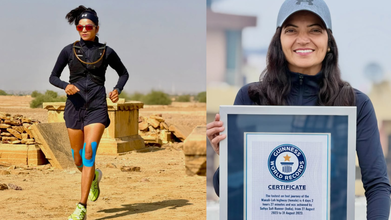
Credit: Instagram/Sufiya Sufi Runner
Sufiya Sufi grew up in Ajmer, Rajasthan and dreamed of becoming a part of the aviation industry. After spending years studying and training, she began working at the Indira Gandhi International Airport, Delhi in 2008.
However, life had different plans for her and after spending a decade working long nights at her dream job, Sufiya began to feel like her life had turned robotic and started looking for outlets for her frustration.
Soon after, the now 40-year-old who lives in Manali, discovered running and starting attempted 3km runs in her local park to channel her energy and gain fresh perspective.
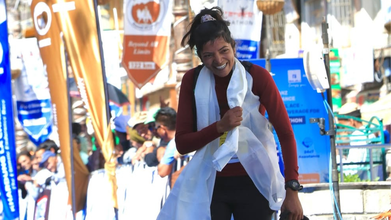
Talking about how she found motivation to begin, she exclusively told Healthandme: "I believe that sometimes, frustration pushes people more than motivation to do something in life. That’s exactly what happened to me. After working night shifts for nearly a decade, I felt that my life had become robotic. I wasn’t able to take time out for myself, and my health was declining.
"I felt the need to break out of that daily routine, both for my fitness and to divert my mind. So I decided to start running a little in a nearby park. I chose running because it’s a sport that doesn’t require much equipment or preparation. I began by running three kilometers in the park, and slowly, it turned into my passion. I started enjoying it more and more."
As she continued to gain pace, Sufiya, who now goes by Sufiya Sufi Runner, began participating in marathons across Delhi and soon moved on to participating in ultra-marathons. While marathons have a limit on the distance to be covered, ultra-marathons can stretch for endless kilometers.
"I wanted to experiment with many things. I wanted to explore different places and understand whether the so-called human limits, of our body and mind, actually exist or not. To test this, I kept taking on new challenges," she told the publication.
The first ever ultra marathon Sufiya wanted to attempt was the Golden Triangle Run, covering 700 kilometres across Delhi, Agra, and Jaipur which she managed to cover in 18 days.
She said: "It was a test run for me. I wanted to see what impact running 40–50 kilometres daily would have on my body, and how running across different terrains would affect me. It was all an experiment for me."
Fueled by success, Sufiya decided to attempt running from Kashmir to Kanyakumari (K2K) in 2019 - a feat that forced her to quit her aviation job and commit to her passion full-time.
But without thinking twice, the ultra-marathoner gave up on her lifelong dream and began training for one of the longest runs in her career which she completed in 87 days, including a five day stay at a local hospital after her lung collapsed due to an infection.
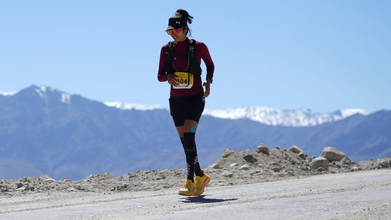
However, despite successfully running the length of the country, her crowning achievement is the latest Guinness World Record she set for the Fastest Run from Manali to Leh in 98 hours and 27 minutes, breaking her own previous record by more than 15 hours and setting a new record.
Sufiya said: "The Manali–Leh route is among the toughest routes in the world, with high altitude passes and extremely tough terrain.
"My first attempt was in 2021 and it took me 156 hours. I was new to mountain running. Training on plains doesn’t prepare you for mountains unless you acclimatize properly. Although I set the record, I wasn’t satisfied, I felt I could do better.
"In 2023, I attempted it again. My first attempt that year took 113 hours, but I had a stomach infection. Even though the record was broken, I wasn’t satisfied. So the very next week, I started again and completed the distance in 98 hours and 27 minutes.
What makes this feat even more remarkable was her choice to take not just the main roads but also extreme mountain trails, pushing her limits and making the
run significantly more demanding.
What Does Her Training Look Like?
When asked what a typical day of training look like for her, Sufiya noted that she usually alters her exercises and diets depending on her next project and the kind of terrain she'll be running on.
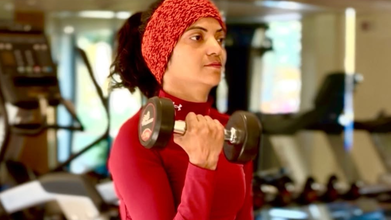
What remains consistent are her yoga sessions and breathing workouts . Breathing workouts, or breathing exercises, improve lung function, reduce stress and promote relaxation.
Techniques like diaphragmatic (belly) breathing, box breathing (4-4-4-4), and 4-7-8 breathing focus on slow, deep inhalation and controlled, prolonged exhalation. Practicing these for 5-10 minutes daily can also lower blood pressure and anxiety.
Apart from this, she also maintains a healthy balance between running drills and training runs as well as strength and core training. Additionally, Sufiya also undergoes a long run every week.
However, for her Manali to Leh ultra-marathon, training alone wasn't enough and she had to adapt herself to the cold and rough terrain. "For my final attempt, I moved to Manali six months in advance, trained there, then spent 40 days in Ladakh training at high-altitude passes," she said.
Along with this, she strictly focuses on her daily protein intake and hydration, noting that coconut water is her favorite drink. For an adult with a healthy weight, the recommended daily amount of protein is 0.75g per kg of body weight per day. That's about: 45g a day for a 60kg woman.
The Five Time Guinness World Record Holder's Advice For Beginner Runners
Talking about the rise in running culture in young Indians, she told the publication: "It actually makes me very happy to see people getting into running, because I think after COVID people have understood how important fitness really is. Things can stay the same in life, but if you are not healthy, you will have to face many challenges ahead. If you can’t work with a healthy body and a healthy mind, I don’t think you can give your hundred percent to anything. I feel people have realized this now.However, she also noted that it is important for runners to not be engrossed in buying multiple new gadgets and merely stick to the classics to maintain mental focus.
"I don’t rely too much on gadgets, because I feel that when you run, too many gadgets disturb your peace. For example, if you’re running with a watch on your hand, a running watch, you keep looking at it again and again, your heart rate, your pace, and somewhere it distracts your mind and creates stress. I do use a watch too.
"There comes a point where you feel that you really don’t need so many gadgets. Sometimes it feels like it’s perfectly fine even without a watch on your wrist. There’s a moment when all these things start to disturb you—too much," she said.
For beginners, Sufiya recommends to always start small and not rush into big distances out of excitement. She also advises practicing meditation, yoga, and staying positive to build a strong mindset.
"For beginners, this is what I would like to say, always start small. I want to say that I started my running journey very small too. It wasn’t like one day I suddenly decided to run and tied my shoelaces and stepped out.
"Any sport, like a form of tapasya (discipline), takes a lot of time, to build your body, strengthen your muscles, and develop the right mindset. So always increase your running gradually. What happens otherwise is that when you suddenly try to cover long distances just out of excitement, there’s passion but no preparation—injuries become inevitable. You push yourself too hard, get injured, and then end up sitting out for three or four months.
"So I think you should start gradually, and patience is extremely important in this journey. These days there is so much competition that people change their game by looking at others and lose focus. I think that’s something you really need to avoid. Stay positive, practice meditation, do yoga, because these things help you immensely in your sport.
"This is my message to everyone.”
How to Build a Marathon-Ready Body Like a Pro Athlete, Runners Reveal

As marathon season commences across India, many runners have begun to warm up to set and beat their personal records. However, many also wonder: What does it take to get ready for a marathon?
According to Sanjana Rao, a Mumbai-based nutritionist who recently participated in the Tata Mumbai Marathon 2026, the first step to training well is to focus on efficiency.
Rao exclusively told Healthandme: "Running a marathon is not just about clocking miles, it’s about teaching the body to sustain effort efficiently. Having run the Tata Mumbai Marathon twice and worked with distance runners as a nutritionist, I have observed that endurance improves when training focuses on efficiency rather than exhaustion.
"Running volume should increase gradually, with one long run each week to build aerobic capacity. Easy runs form the foundation, while tempo runs and controlled speed sessions help runners sustain faster paces without early fatigue. Consistency matters more than intensity, especially for new runners."
"Endurance is not built by doing more, but by doing the right things consistently. When training and fueling align, runners feel lighter, stronger and better prepared for race day."
Which Exercises Can Help You Build A Marathon-Ready Body?
Cherry Aggarwal, a clinical nutritionist at Sir Ganga Ram Hospital tells Healthandme: "Runners should include structured and compound lower-body strength training exercises such as squats, lunges, step-ups, hip thrusts, and calf raises to improve muscular endurance, joint stability, and running efficiency.
"Single-leg exercises are particularly important as they help correct imbalances and reduce the risk of overuse injuries common in long-distance running. Building strong marathon legs goes beyond just clocking mileage, requiring a combination of smart strength training, progressive running, and targeted nutrition."
And Rao agrees, citing that strength training that focuses on improving full-body movement and power, rather than increasing muscle size should be prioritized while getting ready for a marathon.
She told the publication: "Strength training is often misunderstood in endurance preparation. Many runners rely heavily on heavy back squats and leg presses. While effective for general strength, these lifts can promote quad and adductor hypertrophy, making the legs feel bulky and reducing running economy.
"For marathon runners, strength work should support movement quality and power transfer, not muscle size."
Talking about how long runners should be working out, Rao revealed: "Most runners benefit from at least one complete rest day each week, with 24–48 hours between hard or long runs. In the final week before race day, reducing training volume allows muscles to repair, glycogen stores to replenish and the nervous system to reset."
What Should You Eat To Build Running Stamina?
Both Rao and Aggarwal note that eating well is as important as building strength in the gym. Without proper fuel and hydration, the body as well as the mind begin to experience fatigue and disarray which paves the way for serious injuries mid-run.Rao explained: "A less known yet crucial factor for new runners is gut training. Many runners experience fatigue or discomfort during long runs not because their legs fail, but because the digestive system struggles to absorb fuel while in motion. Like muscles, the gut adapts with repeated exposure.
"Practicing carbohydrate intake during long training runs through sports drinks, bananas or gels helps the intestine improve glucose absorption under stress, which improves sustained energy output. Hydration and electrolytes are critical in India’s hot and humid conditions to prevent cramps and premature fatigue.
Talking about the exact foods you should be eating, Aggarwal said: "From a nutrition standpoint, adequate carbohydrate intake is essential to maintain glycogen stores for long runs as it is the primary fuel, while sufficient protein supports muscle repair and recovery. Iron-rich foods play a crucial role in oxygen transport and endurance capacity, especially for regular runners.
"Foods like whole grains, bananas, potatoes, lentils, lean meats or paneer, nuts, seeds, and leafy greens play a key role. Including healthy fats like omega-3s can help manage inflammation from repetitive impact, while calcium and vitamin D support bone health.
"Hydration and electrolytes are often overlooked but are critical for muscle contraction and preventing cramps. Consistent training, nutritional recovery and sleep together determines how well the marathon legs perform on race day.”
- Follow Us :


© 2024 Bennett, Coleman & Company Limited