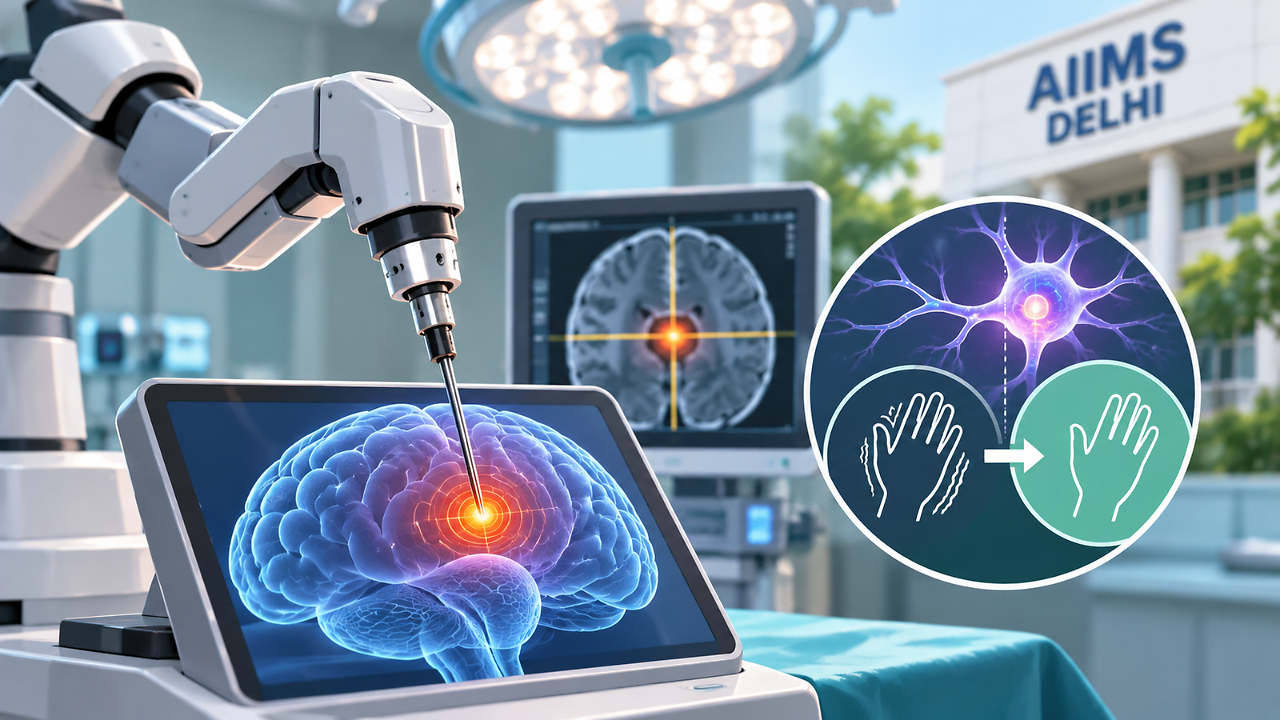
The All India Institute of Medical Sciences (AIIMS), New Delhi has performed India’s first robotic-guided deep brain stimulation (DBS) surgery for a patient with Parkinson’s disease. This has marked a major development in precision-based surgical treatment for movement disorders. Carried out in collaboration with experts from Tel Aviv University, the surgery was led by Prof. P. Sarat Chandra of AIIMS and Prof. Ido Straus of Tel Aviv University, along with Prof. Ela Varsi, Prof. Manjari Tripathi and teams from the institute’s Departments of Neurosurgery and Neurology. The procedure was demonstrated live on November 25 during an international workshop on deep brain stimulation held at AIIMS.Robotic guidance was used to help surgeons accurately position stimulation electrodes at specific targets deep inside the brain, where even small deviations can impact the precision-based procedure.What Is Deep Brain Stimulation And How Does It Help Parkinson’s?Also read: Changes In Speech, Pauses & Word Choice May Help Detect Alzheimer's Early; Bill Gates Calls Research 'Fascinating'Deep brain stimulation is a surgical treatment for selected people with Parkinson’s disease whose symptoms are not controlled with medication. It does not cure Parkinson’s or stop its progression, but it can help manage certain symptoms and improve quality of life.The procedure involves implanting thin electrodes into specific brain regions involved in controlling movement. These electrodes deliver electrical impulses that help modulate abnormal brain activity associated with Parkinson’s symptoms.The electrodes are connected through wires beneath the skin to a neurostimulator, which is implanted in the chest. The device functions like a pacemaker, but instead of regulating the heart’s rhythm, it delivers stimulation to targeted brain circuits.DBS can help improve symptoms such as:TremorsMuscle stiffness or rigiditySlowness of movement (bradykinesia)Motor fluctuations in some patientsBut not every patient with Parkinson’s is eligible for this procedure. Candidates are carefully examined by a multidisciplinary team, considering their symptoms, response to levodopa, overall health and other factors.How Does Robotic Guidance Improve DBS Surgery?Also read: Changes In The Way You Walk May Reveal Early Signs Of Parkinson’s Up To 7 Years Before DiagnosisIn traditional DBS surgery, precise electrode placement is critical because surgeons must reach specific brain structures that are responsible for movement regulation. Robotic guidance can help plan the trajectory and navigate electrode placement accurately.During the AIIMS procedure, doctors also used intraoperative microelectrode recording (MER), which records electrical activity from neurons in deep brain structures during surgery. These signals help surgeons confirm that they have reached the target.An artificial intelligence-based method to analysing neuronal signals was also demonstrated during the workshop.But AI-assisted signal analysis and robotic electrode guidance are different technologies that can complement one another. They do not replace the surgeon’s clinical judgement. Can Robotic DBS Deliver Better Outcomes For Patients With Parkinson's? Robotic guidance may help improve the accuracy and consistency of electrode placement, which is an important factor in DBS surgery. But greater technical precision does not automatically translate into better long-term symptom control.Comparative evidence is still needed to establish whether robotic-guided DBS produces superior clinical outcomes compared with conventional DBS, including sustained symptom improvement, fewer complications or better quality of life.