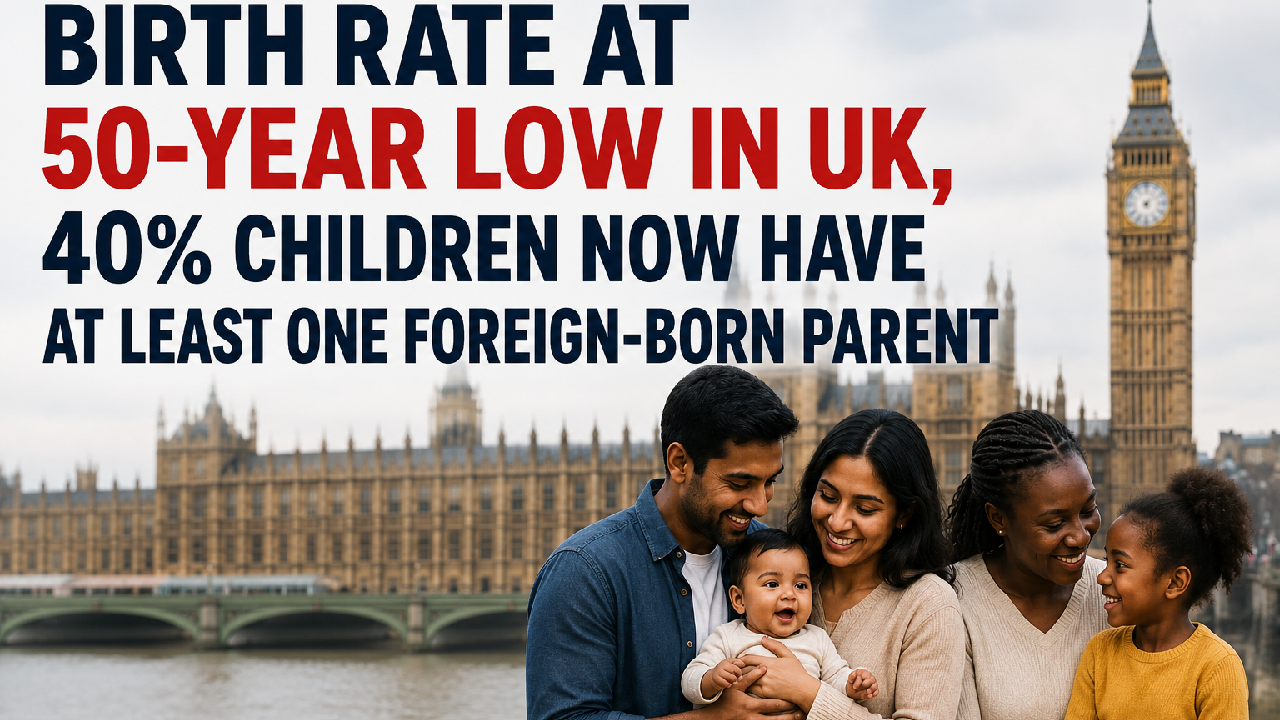
The birth rate in England and Wales has been plummeting continuously over the past few years. In 2025, the same trend continued for the fourth year in a row as the birth rate in the island nation had dropped. The Office for National Statistics (ONS) has reported that the birth rate is at its lowest in the last 50 years.Though this downward birth rate trend is not a recent occurrence, as it was in 2010 when it started to steadily decline. In 2025, the United Kingdom had 585,000 live births, which was 10,000 fewer than the year before and the lowest overall figure since 1977. The estimated number of children born per woman also fell under 1.4 for England and Wales in 2025, down from 1.9 in 2010. Along with this decline, women are also marrying later at 29.6 years of age. This is about two years older than it was in 2010, when the fall birth rate began.Other than this huge dip in birth rate, most notably, 4 in 10 children born since 2010 have at least one foreign-born parent, while in 2010 it was 30 percent. Is the United States In The Same Downward Spiral?The US is facing a long-term decline in birth rates. The US Centers for Disease Control and Prevention (CDC) reported that more than 3.6 million babies were born in 2024. This is just a 1% increase from the previous year, which had been the lowest record in births. While this uptick may seem encouraging, it is not enough to reverse the troubling trend.The US fertility rate remains around 1.6 births per woman. This is significantly below the 2.1 births required to sustain the population growth without immigration.As per the demographers, this continuous drop began during the Great Recession in 2007. It has continued steadily since.One of the biggest shifts is the steep decline in teen births. In 1991, about 62 of every 1,000 teenage girls had a child. This number has now fallen to just under 13 by 2024. This is a historic low that reflects a positive shift, better education, access to contraception, and changing attitudes about early parenthood.A similar trend is seen among women in their 20s, as the rates there, too, have dropped. In 2007, about 106 of every 1,000 women aged 20 to 24 gave birth. By 2024, the number has dropped to around 57. For women aged 25 to 29, the rate fell from 118 in every 1,000 women in 2007 to 91 in 2024.