
- Health Conditions A-Z
- Health & Wellness
- Nutrition
- Fitness
- Health News
- Ayurveda
- Videos
- Medicine A-Z
- Parenting
Brain-Eating Amoeba That Thrives In High Heat Is Spreading Fast: What You Need To Know
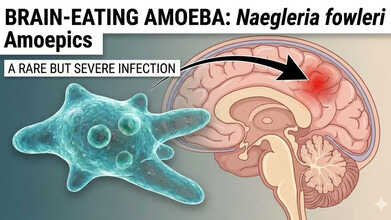
Credits: AI Generated
A collective of environmental and public health researchers has raised serious concerns over free-living amoebas, warning that these organisms could become an increasing global health risk. Their concern stems from the amoebas’ ability to survive in harsh conditions and bypass routine water treatment processes.
These tiny protozoa occur naturally in soil and freshwater and are usually harmless. However, certain species, particularly Naegleria fowleri, widely referred to as the “brain-eating amoeba,” can trigger rare but deadly infections when contaminated water enters the nose during activities such as swimming or diving.
This issue is especially significant for India, as Naegleria fowleri causes primary amoebic meningoencephalitis (PAM), a fatal condition that has seen repeated outbreaks in states such as Kerala.
What Is Naegleria Fowleri?
Naegleria fowleri is a free-living ameba, meaning it is a single-celled organism that survives independently in the environment. It flourishes in warm freshwater sources such as lakes, rivers, ponds, and hot springs. Commonly labelled the “brain-eating ameba,” it earns this name because of its ability to infect the brain and damage brain tissue. The organism is found worldwide in soil and warm freshwater bodies.
On rare occasions, it has also been detected in inadequately maintained swimming pools, splash pads, and other recreational water facilities. In some instances, the ameba has even been identified in tap water.
According to the US Centers for Disease Control and Prevention (CDC), when water containing the ameba enters the nose and reaches the brain, it can lead to an infection known as primary amebic meningoencephalitis (PAM). In the United States, PAM affects fewer than 10 people each year. Almost everyone diagnosed with PAM does not survive. From 1962 to 2024, 167 cases were reported in the US, with only four known survivors.
What Is Primary Amebic Meningoencephalitis?
Primary Amebic Meningoencephalitis (PAM) is a rare but almost always fatal brain infection caused by the Naegleria fowleri amoeba, often called the “brain-eating amoeba.” The organism enters the body through the nose from warm freshwater or soil, travels to the brain, and destroys brain tissue. This leads to intense inflammation, confusion, seizures, and, in most cases, death within days of the onset of severe symptoms.
Primary Amebic Meningoencephalitis Signs And Symptoms
Early signs of PAM may include headache, fever, nausea, and vomiting. The disease progresses very quickly. Most patients die within one to 18 days after symptoms appear, with coma and death often occurring within five days. As the infection advances, symptoms can worsen to include a stiff neck, confusion, reduced awareness of people and surroundings, loss of balance, and hallucinations.
Brain Eating Amoeba Can Thrive In Heat
In a recent perspective published in the journal Biocontaminant, scientists led by Longfei Shu from Sun Yat-sen University explain how climate change, ageing infrastructure, and poor monitoring systems are creating conditions that allow these microbes to spread into areas where they were previously uncommon. Some species are capable of surviving high temperatures and can withstand disinfectants such as chlorine, making them particularly difficult to remove from drinking water supplies and distribution systems.
Adding to the concern, free-living amoebas can serve as protective carriers for harmful bacteria and viruses, housing them inside their cells and helping them spread. This so-called “Trojan horse” effect has raised fresh questions about water safety and how pathogens move through the environment, highlighting the need for coordinated, One Health-based approaches.
Experts warn that without strong intervention and improved water management policies, free-living amoebas could emerge as a major and largely overlooked threat to global public health in the coming years.
US CDC Warns Of New Immune-Evasive COVID Variant In 23 Countries

Credit: iStock
The US Centers for Disease Control and Prevention (CDC) has raised concerns about a highly mutated variant of COVID-19 -- BA.3.2 -- which has been reported in at least 23 countries, including 25 states in America.
The BA.3.2 variant was first identified in a respiratory sample in South Africa in November 2024.
The World Health Organization (WHO) has designated BA.3.2 as a Variant Under Monitoring (VUM). It does not boost immunity from previous infection or vaccination.
What makes the BA.3.2 variant special is the “70 to 75 substitutions and deletions in the gene sequence of its spike protein”, according to the CDC’s latest Morbidity and Mortality Weekly Report.
“BA.3.2 represents a new lineage of SARS-CoV-2, genetically distinct from the JN.1 lineages (including LP.8.1 and XFG) that have circulated in the US since January 2024,” said the CDC researchers.
“BA.3.2 mutations in the spike protein have the potential to reduce protection from a previous infection or vaccination,” they added.
What Is The BA.3.2 Variant?
BA.3.2 is a descendant of the Omicron BA.3 lineage. It is genetically distinct from the previously circulating JN.1 lineages (including LP.8.1 and XFG).
BA.3.2 comprises two major branches, BA.3.2.1 and BA.3.2.2. BA.3.2.2 also has substitutions like: K356T, A575S, R681H, and R1162P, the CDC report said.
The first BA.3.2 lineage sequence was detected in a respiratory sample collected on November 22, 2024, in South Africa from a boy aged 5 years.
It was then identified in 2025, in Mozambique (March), the Netherlands (April), and Germany (April). It began to increase in September 2025, with the highest number of detections reported during the week beginning December 7, 2025.
As of February 11, 2026, BA.3.2 had been detected in at least 23 countries.
Between November 2025 and January 2026, the weekly BA.3.2 detections increased and reached approximately 30 percent of sequences reported in three European countries (Denmark, Germany, and the Netherlands).
BA.3.2 In The US
The strain was detected in the US on June 27, 2025, through the CDC’s Traveler-Based Genomic Surveillance program in a participant traveling to the US from the Netherlands.
The first US detection of BA.3.2 in a clinical specimen collected from a patient was reported on January 5, 2026. Since then, the CDC has detected the BA.3.2 variant from
- nasal swabs collected from 4 US travelers,
- clinical samples from 5 patients,
- 3 airplane wastewater samples,
- 132 wastewater surveillance samples from 25 states in the US.
- Till February 11, the strain has been prevalent among 2,579 total genetic sequences.
The CDC stressed the need for “continued genomic surveillance to track SARS-CoV-2 evolution and determine its potential effect on public health”.
BA.3.2 A Variant Under Monitoring
According to the WHO, BA.3.2 demonstrates antigenic drift and reduced neutralization in vitro from previously infected or vaccinated individuals.
However, the global health body noted that currently approved COVID-19 vaccines are expected to continue providing protection against severe disease.
Despite immune evasion, phenotypic data suggest BA.3.2 has reduced infectivity.
It shows resistance to some monoclonal antibodies (cilgavimab, bebtelovimab, sotrovimab) but increased sensitivity to tixagevimab-be, the WHO said.
India Launches Second Intensified 100-day TB Mukt Bharat Campaign
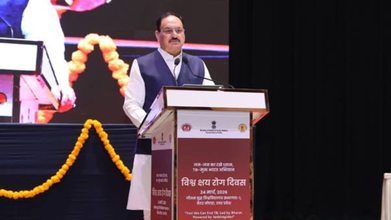
Credit: PIB
After the huge success of the first phase of its 100-day TB Mukt Bharat campaign in 2025, India has launched the next phase of a focused and intensified campaign to end tuberculosis — the most infectious disease in the world — in the country.
The campaign was launched by Union Minister for Health and Family Welfare Jagat Prakash Nadda at a national-level event held in Greater Noida to commemorate World TB Day 2026.
He reaffirmed India’s unwavering commitment to eliminating tuberculosis, ahead of the global Sustainable Development Goals target of 2030.
The second phase marks “a decisive, mission-mode push to accelerate progress towards TB elimination”, the Ministry of Health said.
The campaign is expected to “cover 1.58 lakh villages and urban wards, each guided by granular, locally tailored micro-plans, ensuring precision in implementation and measurable outcomes,” it added. The villages and wards were identified using AI-based assessment of 30+ indicators.
“World TB Day 2026 as both a moment of reflection and a renewed call to action in India’s journey towards a TB-Mukt Bharat,” said Nadda, while delivering the keynote address.
The 100-day campaign
The 100-day campaign was first launched on December 7, 2024, and it continued till March 24. It aims to accelerate TB detection, rapid decline in TB incidence, finding of missing cases, reducing mortality, and following a Jan Bhagidari or community approach.
In 2025, the campaign targeted a selected 347 high-priority districts across 33 States/UTs. It was later scaled nationwide and deployed advanced tools such as portable X-rays, AI-enabled diagnostics, and molecular testing.
Nadda noted that the 100-day campaign led to the detection of “nearly 10.9 lakh asymptomatic patients who exhibited no classical symptoms at the time of testing”.
The campaign led to the identification of the “invisible” pool of infection that would otherwise have remained undetected and contributed to continued transmission in the community, the Minister said.
Other key milestones achieved in the fight against TB since December 2024 include:
- screening of vulnerable population – more than 20 Crores
- new TB patients diagnosed - 32,65,215
- asymptomatic patients diagnosed - 10,90,742
- TB preventive treatment initiated - 16,45,493
- Ni-kshay Poshan Yojana paid - 8,36,754
- New Ni-kshay mitras registered - 5,40, 028
- Food Basket distributed - 31, 91, 091.
India Acing Forward In Fight Against TB
In 2024, India notified 26.18 lakh TB cases — the highest so far. TB notification has remained a key area of concern. A total of 67, 933 gram panchayats have achieved the TB-free status, the Ministry
“Over the past decade, India’s TB response has evolved into a transformational, people-centric movement, driven by innovation, equity, and strong political commitment,” Nadda said.
Also read: Tuberculosis in 2026: Why It Still Remains India’s Silent Epidemic
The Minister highlighted key achievements from 2015 to 2024. This includes:
- a 21 percent reduction in TB incidence — from 237 to 187 per lakh population
- a 25 percent decline in TB mortality — from 28 to 21 per lakh population
- treatment coverage increased — 92 percent from 53 percent in 2015
- sharp decline in undetected cases — from >10 lakhs annually to <1 lakh
- treatment success rate increased — 90 percent — higher than the global rate of 88 percent.
- Over 3,000 handheld AI-enabled X-ray units deployed
- NAAT laboratories scaled up to over 9,800
- TB services integrated across 1.8 lakh Ayushman Arogya Mandirs
- Nikshay Poshan Yojana transferred over Rs 4,590 crore to 1.39 crore TB patients since 2018
- Ni-kshay Mitra initiative participation increased to over 7.16 lakh citizen.
Sonia Gandhi Admitted To Hospital, Doctors Say 'Nothing Serious'

Wikimedia Commons
Sonia Gandhi, Congress Parliamentary Party chairperson was admitted to the Sir Ganga Ram Hospital on March 24, 2026 in late evening. As per reports, she was feeling unwell due to the change in weather and has been put under observation.
Team of doctors who is attending her said that there is nothing serious. According to Dr. Ajay Swaroop, Chairman, Sir Ganga Ram Hospital, she is stable. Doctors are conducting further investigations to check for possible infection in the stomach and urinary tract. A team of doctors is closely monitoring her condition, and antibiotics have been administered.
Earlier this year in January, Sonia Gandhi was admitted to Sir Ganga Ram Hospital after she suffered respiratory discomfort.
What Happened To Sonia Gandhi Early This Year?
While reports mentioned that her condition was "absolutely stable", she had a problem of chronic cough. This was due to capital city's pollution. Due to increase in population during the peak winter season in Delhi, she had been regular with hospital visits and check-ups. Hospital source, while speaking to the news agency PTI said that "it is a routine admission".
Read: Sonia Gandhi Admitted to Hospital After Delhi Pollution Aggravates Bronchial Asthma
Did Delhi Pollution Make Sonia Gandhi Sick?
According to reports, she had complained of some respiratory discomfort. Once her medical examination was done, it was found that "her bronchial asthma had been mildly exacerbated", confirmed Dr Ajay Swaroop, Chairman of the hospital. A hospital source told PTI that this is due to the combined effects of cold weather and pollution.
As a precautionary measure, she was admitted in hospital for further observation and treatment. The physicians who were treating her took a decision on her discharge based on her clinical progress.
Sonia Gandhi's Health History
On June 7, 2025, she was admitted to the Indira Gandhi Medical College and Hospital (IGMC) in Shimla for a routine medical-check up. She was also later discharged after her medical examination. As per Naresh Chauhan, Principal Advisor (Media) to the Himachal Pradesh Chief Minister, she was brought in due to minor health concerns. However, he said that after being put in observation by doctors to assess her condition, she was stable.
Dr Aman Chauhan, Deputy Medical Superintendent at IGMC said, "Her blood pressure was slightly on the higher side, but there is nothing serious. No additional tests were conducted; only routine investigations were carried out. She was not given any special medical advice because everything was perfectly fine."
In the same month on June 15, she was admitted to Sir Ganga Ram Hospital again under the Department of Surgical Gastroenterology for a stomach-related issue. Before that she was again in the Delhi hospital on June 9, for a medical check up.
Earlier in September 2022, she travelled to the United States for a deferred medical check-up which was postponed due to the COVID-19. Due to this she missed a significant portion of the Monsoon Session of Parliament in 2022. Her son and Congress leader Rahul Gandhi accompanied her during the trip.
- Follow Us :


© 2024 Bennett, Coleman & Company Limited