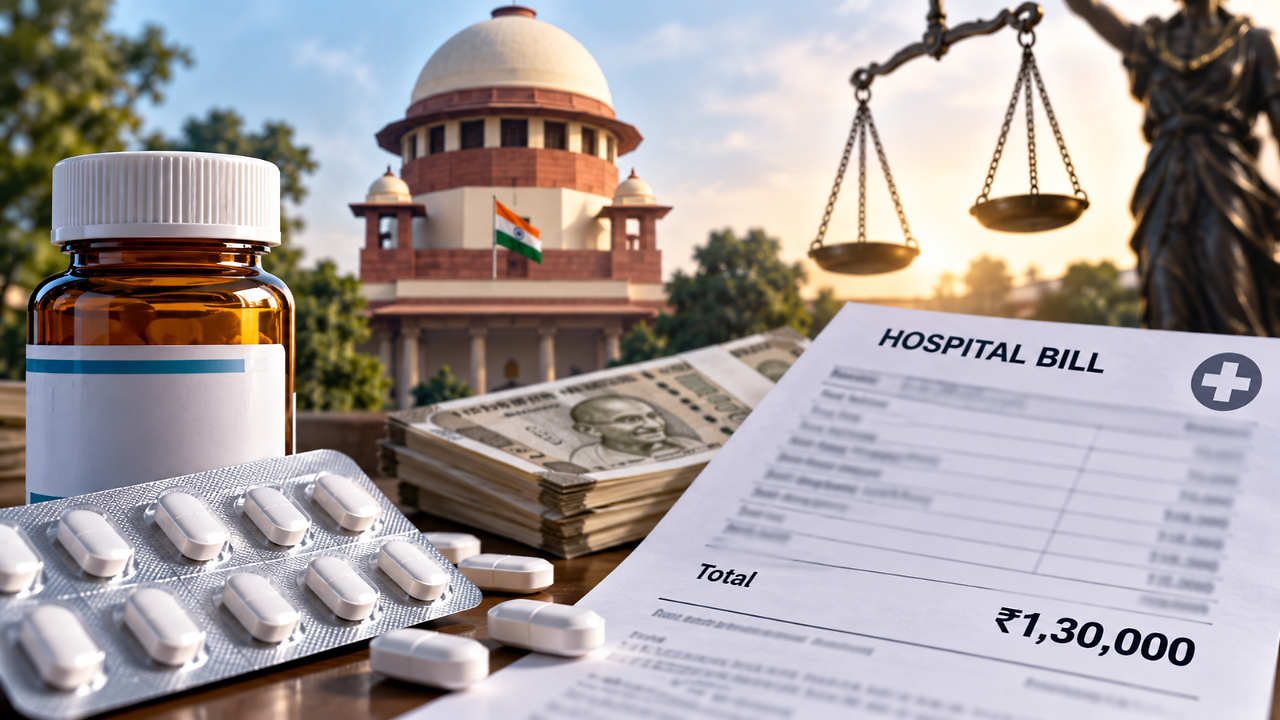
The Supreme Court of India has slammed the steep mark-ups private hospitals charge for cancer medicines, describing excessive pricing as “loot” and “dacoity” as it considers whether tighter regulations are needed to protect patients.During a hearing on October 27, a bench of Justices Vikram Nath and Sandeep Mehta reserved its verdict on petitions seeking stronger controls on the prices of medicines. The court highlighted the financial burden faced by people who need life-saving treatment, especially those battling cancer, and questioned whether the government’s current pricing framework protects patients from excessive healthcare costs.Cancer Injection Costs ₹11,000 But Billed At ₹1.3 lakhAlso read: India Caps Cancer Drug Trade Margins At 30%; Patients May Save Rs 2,500 Crore AnnuallyThe Court was hearing a public interest litigation (PIL) filed by advocate Kishan Chand Jain who sought seeking mandatory generic drug prescriptions, stricter initial price controls on non-scheduled medicines, and statutory margin caps on medical devices under the Drug Price Control Order (DPCO).One example cited by the court is of a medicine distributor whose wife was undergoing cancer treatment at a prominent private hospital. According to the account presented during the hearing, the distributor offered to procure a chemotherapy injection at his dealer price of ₹11,000, but the hospital charged ₹1.3 lakh for the same medicine.“Can you show any justification for this loot, please? Why this difference? Where does the money go?” the bench asked.The judges also questioned the pricing of routine hospital supplies. A saline drip line with a cost ₹15 was reportedly being billed to patients at ₹250.These examples raised questions about how medicine procurement costs, manufacturer discounts, hospital operating expenses and final patient bills are accounted for.The Court also addressed Centre's recent decision to cap trade margins for anti-cancer drugs at 30 percent but how nearly 90 percent of medicines available in the market remain outside the purview of the Drug Price Control Order (DPCO)."Why is the DPCO in place at all? The government is allowing this to happen. There have been three parliamentary committees on this. And their outcome is not very convenient to people who pull the strings, let us tell you," the Bench remarked.Medicine Price Caps Under ScrutinyAlso read: 137 Cancer Drugs To Cost Up To 70% Less From November 9: NPPA Caps Trade MarginsIndia regulates prices of scheduled medicines under the Drugs (Prices Control) Order, 2013. The government has also introduced trade margin limits for a few anti-cancer medicines.During the hearing, the Centre said trade margins on 137 anti-cancer medicines had been capped at 30% of the maximum retail price (MRP), a measure it estimated could save patients around ₹2,500 crore annually.The court questioned why such interventions were limited to only a few medicines and whether a bigger and more comprehensive drug regulation was needed.The petitions seek measures including mandatory generic prescriptions, controls on the initial prices of non-scheduled medicines and limits on trade margins for medical devices.Hospitals And Government Raise Concerns Representing private hospitals, senior advocate Mukul Rohatgi argued that healthcare institutions must maintain round-the-clock infrastructure and cover substantial operating costs. He also raised concerns about patients bringing medicines from outside, including the risk of counterfeit products.The Centre maintained that medicine pricing policy must balance affordability with investment, competition and the sustainability of the pharmaceutical sector. Additional Solicitor General Aishwarya Bhati told the court that the government continued to review its rules. The bench questioned whether these considerations addressed patients’ limited bargaining power when they need life-saving treatment."Your calibration is too wayward. ₹11,000 to ₹1,30,000 is no calibration. When you talk of patients and life, should we have such capitalistic thinking. Hospitals can survive through other means. Not through this dacoity,” the bench remarked, according to reports of the proceedings.The Supreme Court has reserved its verdict. Until the order is delivered, no new price cap should be assumed. The court’s decision could influence future regulation of medicine prices and hospital mark-ups.