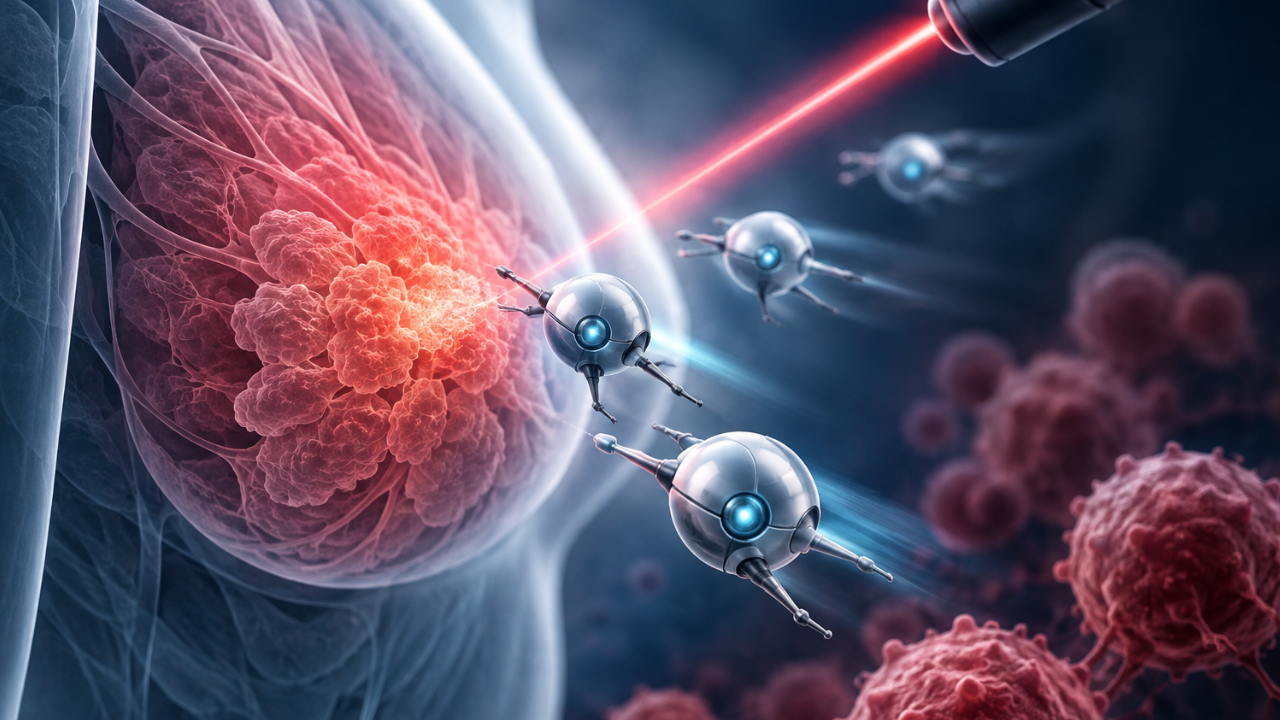
Indian scientists have developed tiny, light-responsive nanobots that could pave the way for more precise breast cancer treatment. The findings indicate that this approach could potentially reduce damage to healthy tissues during therapy. Researchers from the Institute of Nano Science and Technology (INST), Mohali, in collaboration with scientists from the Bhabha Atomic Research Centre (BARC), Mumbai, have developed multifunctional nanobots that can move towards a light source and destroy cancer cells using a combination of heat and reactive oxygen species. The findings were published in ACS Applied Materials & Interfaces. How Do The Nanobots Work? The experimental nanobots are made of upconversion nanoparticles, which can respond to near-infrared (NIR) light. Unlike conventional light-driven systems that may require ultraviolet, NIR light has greater potential to penetrate tissue. When exposed to a 980-nanometre NIR laser, the nanobots generate heat and show directional movements towards the light source. This is called phototaxis. The researchers reported that the nanobots reached speeds of around 27 ± 7 micrometres per second under the tested conditions. The team also coated the nanobots with folic acid. This helps them recognise breast cancer cells that have higher levels of folate receptors, improving their ability to target tumour cells. At the tumour site, the nanobots use two mechanisms to attack cancer cells. Photothermal therapy generates localised heat, while photodynamic therapy produces reactive oxygen species that can damage and kill cancer cells. “The field of fuel-free light-powered nanobots and microbots with stimulus-responsive behaviour can have crucial implications for biomedical research,” the researchers said in the study. Also read: The Office Actress Lucy Davis Reveals Incurable Stage 4 Breast Cancer: 'It’s Too Late For Chemo'Why Is This Important For Breast Cancer? Chemotherapy remains an important part of breast cancer treatment, but its effects go beyond targeting tumour cells. Drugs circulating through the body can also affect healthy tissues, leading to side effects. Tumours may also develop resistance to the treatment. The researchers say conventional nanomedicines often depend on passive accumulation inside tumours, which can limit penetration and control over exactly where treatment acts. The new method attempts to work with a navigation system managed externally by light. Also read: Breastfeeding Can Help Reduce Mothers' Risk of Type 2 Diabetes, Breast Cancer and MoreWhat Did The Study Find? The technology has so far been tested in laboratory cancer-cell models and in mice carrying breast tumours. The researchers reported significant inhibition of tumour-growth when the nanobots with folic acid function were combined with 980 nm laser irradiation. Researchers say that this is still preclinical research and may need further examination and clinical trials. The nanobots have not been established as a treatment for breast cancer patients, and a lot more research will be needed to gauge their safety, effectiveness, dosing and ability to successfully work in humans.Also read: Don't Fear The Biopsy, Fear The DelayGlobal Breast Cancer Burden Breast cancer is the most common cancer worldwide, with steady increases in incidence over the last few decades. It accounts for around one in four cases of cancer and 15 per cent of cancer deaths in women, and is one of the leading causes of death in women under 50.Breast cancer is the most common cancer in the UK, with around 59,400 new cases diagnosed annually and roughly 11,200 deaths each year. About one in seven women in the UK develops the disease in their lifetime, though survival rates are high, with nearly 90% surviving for five years or more.