
- Health Conditions A-Z
- Health & Wellness
- Nutrition
- Fitness
- Health News
- Ayurveda
- Videos
- Medicine A-Z
- Parenting
Delhi Air Quality Hits ‘Severe,’ GRAP-3 Curbs Kick In: Full List Of Restrictions Explained
Credits: Canva
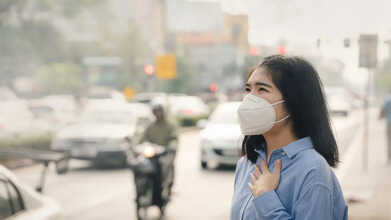
Anti-pollution measures under GRAP-3 came into force in Delhi on Saturday as air quality slipped into the “severe” bracket. By noon, the national capital reported an Air Quality Index of 405, according to figures released by the Central Pollution Control Board (CPCB). Earlier in the day, Delhi’s AQI hovered close to 390 during the morning hours.
Delhi Air Quality Hits ‘Severe'
Each winter, Delhi and the surrounding NCR (National Capital Region) bring in curbs under the Graded Response Action Plan, which divides air quality into four levels: Stage 1 (Poor, AQI 201–300), Stage 2 (Very Poor, AQI 301–400), Stage 3 (Severe, AQI 401–450) and Stage 4 (Severe Plus, AQI above 450).
Under GRAP-3, non-essential construction and demolition activities have been halted, along with stone crushing and mining operations. The measures also include restrictions on older diesel goods vehicles within Delhi. Schools up to Class 5 are required to move to a hybrid learning model, while offices across Delhi-NCR may function with only 50 per cent staff strength, as per Press Information Bureau.
Hazardous AQI levels have become a recurring feature across several parts of Delhi during the winter months. Quoting environmental experts, an IANS report linked the sharp decline in air quality to a mix of stagnant wind conditions, vehicle emissions, industrial pollution and seasonal factors such as crop residue burning in neighbouring states.
What Changed in GRAP?
The biggest shift under the updated GRAP framework is that stricter steps will now come into force earlier, instead of waiting for air quality to deteriorate further.
As per Press Information Bureau, under the revised system, measures that were earlier reserved for Stage 4 will now apply at Stage 3 itself. This means that once the AQI reaches the 301–400 range, public, municipal and private offices will function with only 50 percent staff. Central government offices will also move to work-from-home at this stage, rather than waiting for the AQI to cross 450.
In the same way, actions that earlier fell under Stage 3 have now been pushed to Stage 2. As a result, staggered timings for government offices will begin as soon as the AQI enters the 201–300 category.
Stage 2 measures have also been advanced to Stage 1. This brings uninterrupted power supply arrangements into effect earlier, at an AQI level of 101–200, to reduce the need for diesel generator use and limit additional emissions.
Delhi AQI: GRAP Stage 3 Restrictions Announced
In response to the worsening situation, the Delhi government confirmed that the Commission for Air Quality Management (CAQM) has activated all measures under Stage III of GRAP, which falls under the “Severe” air quality category with AQI levels between 401 and 450, across the entire NCR.
These Stage 3 curbs will apply in addition to the existing Stage I and Stage II measures. Authorities, including NCR Pollution Control Boards, have been instructed to step up enforcement to prevent further deterioration of air quality across the region.
- Ban on the transportation of construction materials such as sand and cement, particularly on non-paved roads
- Complete suspension of demolition and construction work unless unavoidable, including earthwork, piling and trenching
- Advisory for private firms to permit work-from-home or hybrid arrangements to reduce traffic-related pollution
- Restrictions on inter-state diesel buses entering or operating within Delhi
- Prohibition on BS-3 petrol and BS-4 diesel four-wheelers in Delhi and nearby NCR districts
- Shutdown of stone crushers, mining operations and hot-mix plants that do not run on clean fuel
- Ban on the use of diesel generator sets, except for emergency and essential services
GRAP III Imposed in Delhi-NCR: What’s Allowed
Even as Stage III of the Graded Response Action Plan comes into force, certain essential activities and services will continue to operate to minimise disruption to daily life.
- Essential infrastructure and public service projects permitted include:
- Metro, railway, airport, highway, defence, healthcare and sanitation-related projects
- Construction work linked to critical infrastructure, provided strict dust control and proper waste management norms are followed
- Vehicles used by persons with disabilities
- Recommended measures under GRAP III include:
- Greater use of public transport to reduce private vehicle emissions
- Hybrid or online classes for students up to Grade 5 to limit outdoor exposure and traffic movement
Influenza A: After Three Child Deaths, Health Officials Urge Flu Vaccination in Canada

Credits: Canva
Three children from Ottawa and Eastern Ontario have died due to flu-related complications over the past two weeks, as an unusually early and aggressive flu season grips the region. Health officials have confirmed that the cases are linked to Influenza A, a strain currently circulating widely and affecting children more severely than usual, as per CTV news.
The children were between five and nine years old. Authorities have not released further personal details about the two Ottawa cases and one case from Eastern Ontario.
What Is Influenza A?
Influenza A is a fast-spreading respiratory virus responsible for seasonal flu outbreaks and, at times, global pandemics. It changes quickly through genetic shifts, which makes new strains harder to predict and control. The virus is grouped based on surface proteins called hemagglutinin and neuraminidase, with H1N1 and H3N2 among the most common strains in circulation. It spreads mainly through coughs, sneezes, or close contact and often comes on suddenly, causing fever, cough, body pain, and extreme tiredness. In some cases, it can lead to serious complications, especially in vulnerable groups.
Influenza A: Health Officials Call Deaths a Serious Warning
Public health leaders from Ottawa and Eastern Ontario described the deaths as a troubling reminder of how dangerous the flu can be, especially for children.
“This highlights that influenza is not always a mild illness. It can lead to serious complications that require hospitalization,” medical officers of health from both regions said in a joint statement issued on Monday, as per CTV News.
Influenza A: Child Flu Deaths Rare but Not Unprecedented in Canada
While flu-related deaths among children are uncommon in Canada, they are not unheard of. During the last severe flu season in 2022, two children in Ottawa died due to influenza.
Most flu-related deaths in Canada occur among older adults. Of the estimated 3,500 flu deaths reported nationwide each year, roughly 90 percent involve people over the age of 65. However, experts say the current Influenza A strain is behaving differently.
Influenza A Hitting Children Hard This Season
The strain of Influenza A currently circulating has been linked to a sharp rise in severe pediatric flu cases globally. Health officials say the cluster of three child deaths within such a short period, and within a relatively small geographic area, is highly unusual.
This unusual pattern prompted the regional coroner to alert public health authorities after three sudden, unexpected child deaths tested positive for Influenza A.
“It’s rare for the coroner to reach out like this,” said Dr. Trevor Arnason, Ottawa’s medical officer of health. “But this season has been particularly severe.”
Influenza A: Hospitals Strained as Pediatric Cases Rise
CHEO, Ottawa’s children’s hospital, has reported high numbers of children falling seriously ill with the flu since November. Hospitalizations have continued to rise through early December.
Last week, CHEO issued an urgent request asking family doctors to extend clinic hours and assist at the hospital’s Kids Come First clinic to help manage patient volumes.
Hospital officials have also noted that many children arriving at the emergency department with severe flu symptoms had not been vaccinated.
Influenza A: Strong Push for Flu Vaccination as Cases Surge
Public health officials, including Ontario’s Chief Medical Officer of Health Dr. Kieran Moore, are urging everyone aged six months and older to get vaccinated as soon as possible.
Dr. Arnason and Dr. Paul Roumeliotis, medical officer of health and CEO of the Eastern Ontario Health Unit, stressed that vaccination is especially important for children this season.
Influenza A: Vaccine Still Effective Despite Strain Mutation
Some people have expressed concern after reports suggested this year’s flu vaccine is not a perfect match for the circulating Influenza A strain. Health officials clarified that while the virus has mutated slightly since circulating in the southern hemisphere, the vaccine still offers meaningful protection.
“The flu vaccine may not always prevent infection, but it significantly reduces the risk of severe illness, hospitalization, and complications,” officials said. They added that the vaccine takes about two weeks to become fully effective, making early vaccination crucial ahead of the holiday season, when virus spread typically increases.
You're Breathing Your Way Into Diabetes

AIIMS Study Finds No Evidence Linking COVID-19 Vaccination To Sudden Deaths In Young Adults

Credits: Canva
There has been a long-running belief that COVID-19 vaccines are behind sudden deaths in young adults. Posts circulating on social media and unverified online claims have repeatedly linked vaccination to sudden collapses, heart attacks, or unexpected deaths, particularly among people aged 18 to 45 who seemed otherwise healthy.
These claims have caused anxiety among families, despite the absence of solid scientific backing. A new study published by AIIMS now brings much-needed clarity on whether COVID vaccines have any connection to sudden deaths in young adults.
Also Read: Can Overusing Air Purifiers Harm Your Lungs? Expert Explains
AIIMS Study Finds No Link Between Covid Vaccination And Sudden Deaths In Adults
Worries around sudden deaths in young adults have increased in recent years, especially in the period following the COVID-19 pandemic. Speculation blaming COVID vaccines gained traction across platforms, adding to public concern. However, fresh findings from a study carried out by the All India Institute of Medical Sciences (AIIMS), New Delhi, offer a clear answer. After examining detailed autopsy reports, researchers concluded that underlying heart disease, and not COVID-19 vaccination, is the leading cause of sudden deaths in younger individuals.
Heart Problems Leading Cause Among Deaths In Young People
The AIIMS study found that heart-related conditions were responsible for 42.6 per cent of sudden deaths among people aged 18 to 45 years. Within this group, heart attacks accounted for nearly 85 per cent of cardiac-related deaths. Other contributing factors included structural abnormalities of the heart, congenital defects, and inflammation of the heart muscle. Respiratory illnesses made up around 21.3 per cent of sudden deaths, with choking, pneumonia, and tuberculosis emerging as the main causes. In close to one-fifth of the cases, doctors were unable to determine the exact cause of death.
No Evidence Linking Deaths To Covid Or Vaccines
Crucially, the researchers observed no meaningful rise in sudden deaths among individuals who had previously contracted COVID-19 or received the vaccine. Of the cases analysed, only 4.3 per cent had a history of COVID infection, while 82.8 per cent had been vaccinated. Dr Sudheer Arava, Professor of Pathology at AIIMS, explained that the year-long study reviewed nearly 100 cases and found no signs of vaccine-related complications, with just one instance of myocarditis reported. The findings also pointed to differences across age groups.
Among those aged 46 to 65, nearly three-quarters of sudden deaths were linked to heart disease, while unexplained deaths were far fewer. Notably, the proportion of women among sudden deaths was higher in the younger age group than among older adults. The study carries weight as it directly challenges claims blaming COVID-19 vaccines for sudden deaths.
Doctors emphasise that lifestyle-related issues such as unhealthy eating habits, lack of physical activity, and chronic stress continue to play a major role in heart disease among younger people. This, they say, highlights the importance of early prevention and regular health screenings. Dr Arava also urged the public to rely on credible scientific information and steer clear of misinformation that could erode trust in proven public health measures, including vaccination.
- Follow Us :


© 2024 Bennett, Coleman & Company Limited