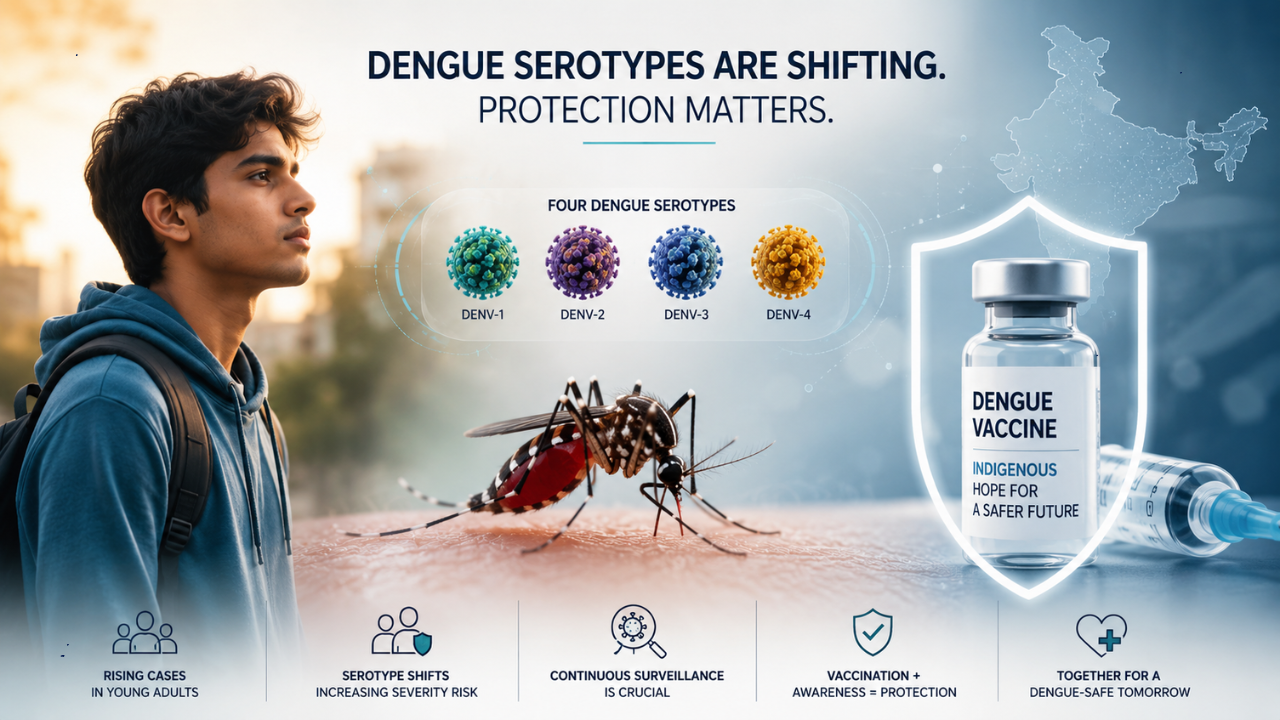
The dengue virus is rapidly shifting serotypes, especially in young adults. The phenomenon is not unique to India and has been observed in several dengue-endemic countries across Asia, Latin America, and parts of the Pacific.Dengue is caused by four closely related virus serotypes: DENV-1, DENV-2, DENV-3, and DENV-4. The dominant serotype in circulation can change over time, leading to new outbreaks when population immunity is low against the emerging strain.A 2026 genomic study, published in the international journal Acta Tropica, found that DENV-2 and DENV-3 were the most common serotypes between 2019 and 2024 in South India, with dominance shifting every 2–3 years. The authors, including those from the Indian Institute of Science, Bengaluru, highlighted the importance of monitoring these shifts because they can alter outbreak severity and vaccine effectiveness.A 2025 study led by researchers from AIIMS Bhopal reported the emergence of a new DENV-2 lineage that displaced the previously dominant DENV-1 strain between 2019 and 2023. The findings, published in the journal Viruses, demonstrated how one serotype can replace another in a population.“India is witnessing active serotype shifts, and they directly explain rising severity, especially in young adults. Initial infection with one of the four dengue serotypes results in lifelong immunity to that specific serotype. Whereas, a secondary infection with a different serotype can trigger Antibody-Dependent Enhancement (ADE),” Dr. Shikha Taneja Malik, Senior Scientific Affairs Manager, Drugs for Neglected Diseases initiative (DNDi), South Asia, told HealthandMe.“Young adults who were exposed to one serotype in childhood are now encountering a new dominant serotype, making them especially vulnerable to severe secondary infections,” she added.The four serotypes of dengue virus makes it a difficult virus; and protection against one does not always mean balanced protection against all."In young adults, this becomes even more important because many may have already been exposed to one dengue serotype earlier in life, while later infections may involve a different or shifting virus serotype. This can make the immune response more complex and, in some cases, may increase the risk of severe disease through antibody-dependent enhancement," Dr. Rohit Sharma, Consultant, Apollo Spectra Hospital, Jaipur, told HealthandMe.Shifting Serotypes: A Global Trend Beyond IndiaCountries including Brazil, Thailand, Vietnam, the Philippines, Indonesia, and Sri Lanka have also reported periodic serotype shifts that altered outbreak patterns and sometimes increased severe dengue cases.Researchers have also documented a gradual shift in disease burden from children toward adolescents and young adults in some regions. This occurs because:Previous exposure patterns change over time.Urbanization increases transmission among older age groups.Childhood immunity profiles evolve as dominant serotypes change.Secondary infections with a different serotype can increase the risk of severe disease.India's Indigenous Dengue Vaccine: DengiAllDengiAll is India's first indigenous tetravalent dengue vaccine. Developed by the Indian pharmaceutical company Panacea Biotec, it is designed to protect against all four serotypes of the dengue virus and requires only a single dose.The indigenously developed dengue vaccine is expected to play a crucial role in protecting the 10–20 age group, who are most susceptible to severe dengue cases, Dr. N. K. Arora, Member of the National Technical Advisory Group on Immunisation in India (NTAGI), told HealthandMe."Most dengue infections are mild, and treatment protocols have improved significantly over the years. However, the disease can become severe, particularly among adolescents and young adults aged 10–20 years. This is why the indigenous dengue vaccine is being eagerly awaited, as it has the potential to provide an important layer of protection for this vulnerable age group," he said.The vaccine expert noted that the indigenous dengue vaccine is currently undergoing trials.“The trials will take at least two and a half years, which means by the end of 2028, we will have the results,” Dr. Arora said. Brazil's Vaccine Setback Raises Questions for IndiaAlso read: Dengue Is Spreading Beyond Monsoons And Into New Regions Across India, Says ExpertMeanwhile, Brazil has suspended its Butantan-DV dengue vaccine after the death of two people who received the shot, which was proven to be over 80 percent effective in preventing the risk of severe disease for up to five yearsThis suspension, announced on June 8, is a crucial wake-up call for India, said experts, as the Butantan-DV is pretty similar, if not identical, to DengiAll. Both are also based on the same core viral strains developed by the US National Institutes of Health (NIH),"Brazil’s recent experience with its dengue vaccination campaign should be viewed as an important safety signal for India, especially as India prepares for the possible rollout of DengiAll," Dr. Rohit said."Before any large-scale rollout, India must carefully study whether the vaccine produces strong type-specific protection against all four serotypes and whether there is any risk of imbalance in immunity," he added.A dengue vaccine can be a major public health tool, but it must be supported by transparent data, long-term safety monitoring, and region-wise surveillance of circulating dengue serotypes, the experts said.