
- Health Conditions A-Z
- Health & Wellness
- Nutrition
- Fitness
- Health News
- Ayurveda
- Videos
- Medicine A-Z
- Parenting
DNA Test On World’s Oldest Woman Reveals Clues To Living Past 100
Credits: Wikimedia Commons and Cell Reports Medicine
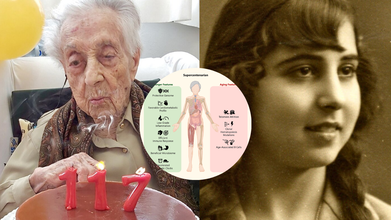
Who can live past 100 years? Well, to everyone's surprise, Maria Branyas Morea lived to the age of 117, with a bit of luck and a healthy diet. A study published in Cell Reports Medicine noted that her diet that included daily yogurts ensured that she could live this long. During her final year, in 2024, she was verified as the oldest living person, and drew a lot of attention of researchers from all over the world who wanted to explore the biology of aging.
The researchers also ran a DNA-test on her, and here's what they found.
Also Read: Candida Auris - The Deadly Superbug Spreads Across 27 States: Here’s Why the Fungus Is Surging
What A DNA Test On 117-year-old Revealed
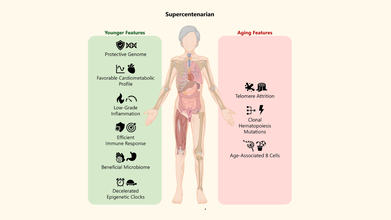
Health evaluation of Maria Branyas suggest that she may have an exceptionally young genome. The rare genetic variant was what linked to longevity, immune function, and a healthy heart and brain. The researchers based in Spain said that they are now using these findings to "provide a fresh look at human aging biology, suggesting biomarkers for healthy aging, and potential strategies to increase life expectancy".
The tests scientists ran were based on blood, saliva, urine, and stool samples. Branyas volunteered to have these tests run on her before she passed in August 2024. The researchers reveal that her cells "felt" or "behaved" as though they were much younger than her chronological age. She is known to have exceeded the average life expectancy of women in her home of Catalonia by more than 30 years.
While she was 117, her cardiovascular health was marked excellent, with very low levels of inflammation. Her immune system and gut microbiome both had markers that matched much younger samples. The levels of 'bad' cholesterol and triglycerides were very low, while 'good' cholesterol was very high.
"Extreme human lifespan, exemplified by supercentenarians, presents a paradox in understanding aging: despite advanced age, they maintain relatively good health," write the researchers, led by epigeneticists Eloy Santos-Pujol and Aleix Noguera-Castells.
Maria Branyas didn’t just live long, she lived fully. Mentally sharp, socially engaged, and physically active well into old age, her lifestyle clearly mattered. Genetics helped too. While her Mediterranean diet, rich in yogurt and fermented foods, may have supported her health, scientists say extreme longevity is rarely about one habit alone. It is usually a mix of biology, environment, and chance.
Also Read: Australian Cricketer Damien Martyn in Hospital With Meningitis
A Surprising Finding
One of the most surprising findings from studying Branyas was what researchers saw at the ends of her chromosomes. Her telomeres, the protective caps on DNA that typically shorten with age, showed what scientists described as “huge erosion.” Usually, shorter telomeres are associated with higher mortality risk. But in people who reach extraordinary ages, telomeres may not tell the full story.
In fact, the researchers suggest Branyas’ very short telomeres might have worked in her favour. Short-lived cells may have reduced the risk of uncontrolled cell growth, potentially protecting her from cancer. It is a counterintuitive idea, but one that challenges how scientists think about aging markers.
Longevity Does Not Equal Poor Health
What stands out most is that Branyas’ advanced age did not automatically come with prolonged illness. Her case reinforces the idea that living longer does not have to mean living sicker. As the researchers note, extreme old age and poor health are not inherently linked.
What One Life Can and Cannot Tell Us
Of course, studying one exceptional individual has limits. Researchers in Spain stress the need for larger studies to confirm these findings. Still, broader research on centenarians has already shown that some people carry unique biological traits that help them resist disease.
With centenarians now the world’s fastest-growing age group, Branyas’ life offers a rare glimpse into what might make extreme longevity possible. Her story, scientists say, opens new doors to understanding healthy aging and extending not just lifespan, but health span.
Rising Temperatures May Lead To Fewer Male Births: Study
Credit: Canva
A warming climate may not only reshape the planet, weather patterns, and ecosystems, but may also influence who is born and cause gender imbalance, according to an alarming study.
The large study published in the journal Proceedings of the National Academy of Sciences provides new evidence that higher temperatures can influence the sex ratio at birth -- the number of boys born relative to girls.
The findings, based on an analysis of more than five million births across 33 sub-Saharan African countries and India, showed that temperatures above 20 degrees Celsius have consistently led to fewer male births in both regions.
"Extreme heat is not only a major public health threat. We show that temperature fundamentally shapes human reproduction by influencing who is born and who is not born,” said lead author Dr. Jasmin Abdel Ghany, from the University of Oxford.
“Our findings indicate that temperature has measurable consequences for fetal survival and family planning behavior, with implications for population composition and gender balance. Understanding these processes is essential for anticipating how the environment affects societies in a warming climate," Ghany added.
Climate Change May Determine Who Is Born
The study showed a decline in male births among women exposed to high temperatures during the first trimester of pregnancy in sub-Saharan Africa.
This pattern is consistent with increased prenatal mortality driven by maternal heat stress. It is particularly pronounced among women living in rural areas, those with lower levels of education, and those with higher birth orders.
On the contrary, the team found that in India, where sex ratios have historically been distorted by preference for a male heir and sex-selective abortion, the effects appear later in pregnancy.
Higher temperatures during the second trimester led to fewer male births. This was particularly seen among older mothers, high-parity births, and women without sons in northern states.
Notably, the study highlighted that the effects of heat are not evenly distributed.
Women with fewer resources and those living in more vulnerable settings are more strongly affected, raising concerns about widening health inequalities under climate change.
Warming Temperatures Can Reshape Demographics
The research demonstrates how environmental change can shape fundamental population processes.
It contributes to growing evidence that extreme heat is not only an environmental and economic challenge, but also a major public health and demographic issue.
Amid rising global temperatures, the researchers stressed the need to protect maternal health and to improve access to health care, as this will cut down the long-term impacts of heat on reproduction and population dynamics.
MAHA Moms Turn on Trump Over Cancer-Linked Pesticide Approval
Credit: Canva
During the height of President Trump's third political campaign in 2024, Robert F Kennedy Jr. shocked the world by changing his affiliation with the Democratic Party and throwing his support behind the Republican candidate.
But Kennedy Jr. was not the only one to switch sides. He also brought along a string of health conscious female followers who called themselves the MAHA Moms after his Make America Healthy Again movement, all of whom enthusiastically voted for Trump.
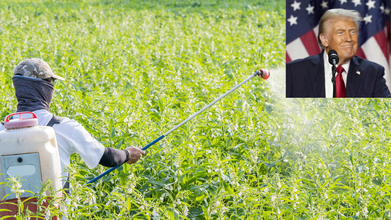
However, a new executive order by Trump to protect the production of glyphosate-based herbicides, such as Roundup, has caused unrest among the MAHA community and invited severe backlash.
In a February 18 order, the President wrote: 'Elemental phosphorus is also a critical precursor element for the production of glyphosate-based herbicides, which play a critical role in maintaining America’s agricultural advantage by enabling farmers to efficiently and cost-effectively produce food and livestock feed.
"As the most widely used crop protection tools in United States agriculture, glyphosate-based herbicides are a cornerstone of this Nation’s agricultural productivity and rural economy, allowing United States farmers and ranchers to maintain high yields and low production costs while ensuring that healthy, affordable food options remain within reach for all American families.
"There is no direct one-for-one chemical alternative to glyphosate-based herbicides. Lack of access to glyphosate-based herbicides would critically jeopardize agricultural productivity, adding pressure to the domestic food system, and may result in a transition of cropland to other uses due to low productivity.
"Given the profit margins growers currently face, any major restrictions in access to glyphosate-based herbicides would result in economic losses for growers and make it untenable for them to meet growing food and feed demands."
What Is Glyphosate?
Registered as a pesticide in the US since 1974, glyphosate is a widely used herbicide that controls the growth of broadleaf weeds and grasses. The chemical compound is considered important in the production of fruits, vegetables, nuts, and glyphosate-resistant field crops such as corn and soybean.In addition, glyphosate breaks down in the environment, can be used for no-till and low-till farming which can reduce soil erosion, and facilitates integrated pest management.
Apart from farming, the compound is also used in conservation land, pastures, rangeland, aquatic areas, forests, turf grass, residential areas, non-food tree crops (pine, poplar and Christmas trees), rights of way, commercial areas, paved areas, spot treatments, ornamentals, parks, and wildlife management areas.
Glyphosate can be applied in agricultural, residential and commercial settings using a wide range of application methods, including aerial sprays, ground broadcast sprayers of various types, shielded and hooded sprayers, wiper applicators, sponge bars, injection systems, and controlled droplet applicators.
Why Is It Dangerous?
People can be exposed to the herbicide through agricultural use, as residues are found in food, water, and sometimes, the urine of the general population.
In 2015, the World Health Organization’s International Agency for Research on Cancer (IARC) classified glyphosate as "probably" carcinogenic to humans (Group 2A). Previous studies have also shown that the herbicide can cause DNA damage in humans and rodent cells.
Acute exposure can also cause skin/eye irritation, nausea, and, in high-dose ingestion, severe toxicity or death. Chronic exposure studies have raised concerns about liver inflammation, metabolic syndrome, and endocrine disruption, especially in early life.
Talking about the President's new order, Alex Clark, a health and wellness podcaster for the conservative group Turning Point USA, which is closely allied with the president said: "Women feel like they were lied to, that MAHA movement is a sham. How am I supposed to rally these women to vote red in the midterms? How can we win their trust back? I am unsure if we can.”
Vani Hari, a food activist, author and one of the grass roots leaders of the MAHA coalition also added: "This executive order reads like it was drafted in a chemical company boardroom. Calling it ‘national defense’ while expanding protections for toxic products is a dangerous misdirection. Real national security is protecting American families, farmers and children.”
Kelly Ryerson, another key player in the MAHA movement who has been lobbying US regulators and lawmakers for restrictions on glyphosate and other pesticides, further noted that this recent move by Trump and Kennedy Jr. is an insult to those who have largely supported the administration because of promises that MAHA issues would be taken seriously.
But despite wide criticism, the US Environmental Protection Agency (EPA) classification for glyphosate is “not likely” to be carcinogenic (causing cancer) to humans, based on evidence from animals and humans.
The International Agency for Research on Cancer (IARC) has also classified glyphosate as “probably” carcinogenic to humans, which means there was sufficient evidence of cancer in animals, but limited evidence of cancer in humans.
What Does The Government Say?
Paying no heed to his followers' complaints, Kennedy Jr. is doubling down on his defense of Trump's order and claims that while pesticides can cause health problems, but said they are necessary to ensure an adequate food supply.
In a X post, he explained: "Pesticides and herbicides are toxic by design, engineered to kill living organisms. When we apply them across millions of acres and allow them into our food system, we put Americans at risk. Chemical manufacturers have paid tens of billions of dollars to settle cancer claims linked to their products, and many agricultural communities report elevated cancer rates and chronic disease.
"Unfortunately, our agricultural system depends heavily on these chemicals. The U.S. represents 4 percent of the world’s population, yet we use roughly 25 percent of its pesticides. If these inputs disappeared overnight, crop yields would fall, food prices would surge, and America would experience a massive loss of farms even beyond what we are witnessing today. The consequences would be disastrous.
"I support President Trump’s Executive Order to bring agricultural chemical production back to the United States and end our near-total reliance on adversarial nations. His EO protects two pillars of national strength: our defense readiness and our food supply. When hostile actors control critical inputs, they directly threaten the security of the American people. The Trump administration will secure these supply chains to eliminate that vulnerability."
But his allies continue to disagree.
Zen Honeycutt, founder of Moms Across America, said in a post replying to Kennedy Jr.: "It’s been a year. Not a single thing has been done by the EPA [Environmental Protection Agency] to reduce our children’s and families exposure to pesticides. In fact regulations have only gotten worse, loosened and more harmful pesticides have been approved.
"There is no excuse for this. We love you Bobby but this administration needs to keep their word. We were promised specifically clean air, clean water, and addressing of the pesticides [in] our foods. Whether glyphosate comes from China or the USA it’s still sterilizing and killing us and our soil."
Lori Ann Burd, environmental health program director at the Center for Biological Diversity, also called the executive order “a sickening love letter from Trump to the largest pesticide companies in the world.
“It’s more proof that Trump doesn’t care at all about Americans’ health,” she said. “While he’s pandering to chemical companies the rest of the country, especially those who’ve been poisoned by pesticides, is rightfully asking ‘what about us?’”
Indigenous Td Vaccine Rollout In India To Boost Immunity In Children, Adults, Say Experts
Credit: X
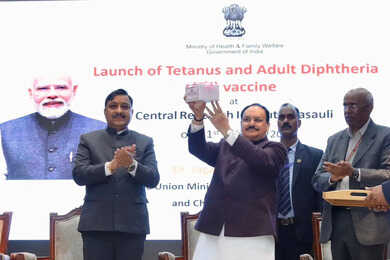
The recent launch of the indigenous Td vaccine in India by Union Health Minister JP Nadda will boost immunity and reduce the risk of tetanus and diphtheria in children and adults, said health experts.
Union Health Minister JP Nadda formally launched the indigenously manufactured Td vaccine in Himachal Pradesh last week.
With the launch, the Tetanus Toxoid (TT) vaccine has been replaced with the Tetanus and adult diphtheria (Td) vaccine in India’s immunization program for all age groups, including pregnant women.
The move comes amid increasing numbers of cases of diphtheria amongst older age groups. Tetanus and diphtheria can lead to hospitalizations or even cause death. The Td vaccine will help to decrease diphtheria outbreaks.
“In keeping with global practice, India has shifted from TT, which covers for tetanus, to Td, which covers for both tetanus and diphtheria. This vaccine is indigenously manufactured and is expected to significantly reduce the risk of both these diseases in older children as well as adults,” Dr. Rajeev Jayadevan, Ex-President of IMA Cochin and Convener of the Research Cell, Kerala, told HealthandMe.
What Is The Td Vaccine?
The Td vaccine, indigenously manufactured at the Central Research Institute (CRI), Kasauli in Himachal Pradesh, is a combination of tetanus and diphtheria with a lower concentration of diphtheria antigen (d), and is recommended for older children and adults.
The use of Td, instead of TT, is recommended during pregnancy to protect against maternal and neonatal tetanus and diphtheria during prenatal care.
Vaccination during pregnancy also serves to boost immunity and increase the duration of protection in pregnant women who have not received the full set of recommended booster doses.
The Td is a safe vaccine, and 133 countries are currently using it.
The Health Ministry, in a statement, said that the Central Research Institute will supply 55 lakh doses to the UIP by April 2026, with production expected to scale up progressively in subsequent years to further strengthen the Universal Immunization Program in India.
“India’s indigenous Td vaccine rollout marks a significant milestone in strengthening the nation’s immunization program by enhancing self-reliance, affordability, and supply stability,” Dr. Neha Rastogi, Senior Consultant - Infectious Diseases, Fortis Gurugram, told HealthandMe.
“Locally produced vaccines reduce dependency on imports, ensuring uninterrupted protection for adolescents and adults against tetanus and diphtheria. This initiative supports wider coverage, faster distribution to remote regions, and improved public health preparedness,” she added.
Tetanus And Diphtheria: Disease burden In India
As per the National Health Profile 2022, India has reported 1,586 cases and 22 deaths due to diphtheria in 2020, and 3,677 cases and 47 deaths in 2021.
Around 10 Indian states report the majority (84 per cent) of the cases.
As of 21 June 2024, Orissa has also reported six deaths and 21 suspected diphtheria cases. There has been more than 90 percent coverage of diphtheria vaccination in birth cohorts since 2014, but gaps in booster dose coverage are widely prevalent.
Plugging of gaps in the routine immunization, coupled with inclusion of booster doses in the national data on diphtheria vaccination, is the need of the hour.
“Diphtheria is one of the most dangerous infectious diseases known to man; it spreads easily through the respiratory route. It can cause death due to the bacterial toxin affecting the heart (Myocarditis). It is vaccine-preventable, but the immunity fades over time,” Dr. Jayadevan said.
Therefore, the Td booster shots at ages 10 and 16 are essential to maintain protection. Similarly, pregnant women should receive two doses to protect both mother and child.
Given the recent outbreaks of diphtheria in India and elsewhere, this transition is a public health priority, the expert said.
- Follow Us :


© 2024 Bennett, Coleman & Company Limited