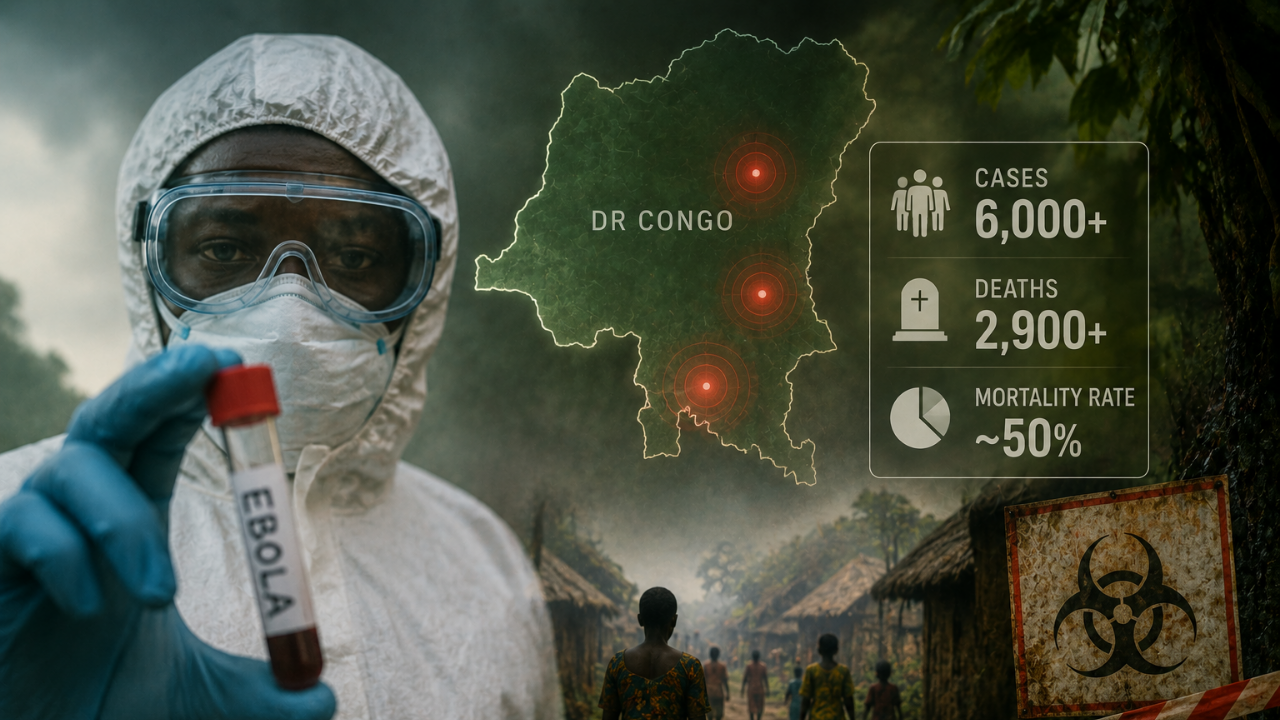
The Ebola outbreak in the Democratic Republic of Congo has crossed another grim milestone, with more than 6,000 confirmed cases and nearly 3,000 deaths. As of August 31, 2026, DRC had reported 6,041 confirmed cases and 2,911 deaths, according to government figures. That puts the outbreak's case-fatality ratio at approximately 48.2%, meaning nearly one in every two confirmed patients has died. More than 1,360 people have recovered. With Ituri remaining the epicentre, the outbreak, caused by the Bundibugyo species of Ebola virus, has spread across six provinces and nearly 60 health zones. Mortality Rate Is Close To 50%Ebola can cause severe complications as the virus can damage multiple organs and trigger profound immune and inflammatory responses. But the current mortality figure is also closely linked to how quickly patients are identified and receive appropriate care.In its latest Disease Outbreak News update, the World Health Organization (WHO) reported a 48.1% crude case-fatality ratio as of August 26 and said the figure “underscores the severity of the disease”.The number also highlights other issues like timely diagnosis, access to and quality of clinical care and containing transmission. Delayed diagnosis can be particularly dangerous as people may continue interacting with family members and healthcare workers while infectious.WHO reported that 81 new confirmed cases were recorded in a single 24-hour period as of August 26. Ituri alone had recorded 4,802 confirmed cases by that point. A nearly 50% case-fatality ratio does not mean that every person infected with Bundibugyo virus has a 50% chance of dying.It is calculated from recorded cases and deaths and that can change as patients recover, die or are newly diagnosed. It is also be affected by how early cases are detected, access to treatment and whether infections are being missed.Also read: Ebola Bundibugyo Virus: American Health Worker Had 10x Higher Viral Load In Throat Than BloodSecond-Largest Ebola Outbreak On RecordThe US Centers for Disease Control and Prevention (CDC) says, "The DRC outbreak is spreading substantially faster than previous Ebola outbreaks” and is now the second-largest Ebola outbreak on record. The outbreak surpassed 1,000 confirmed cases within about 40 days of response activation, compared with approximately 235 days during the 2018 DRC outbreak. The CDC says the response is being affected by limited healthcare infrastructure, ongoing conflict, violence against healthcare workers, shortages of protective equipment, population movement, mistrust and misinformation. WHO's Emergency Committee met again in August and concluded that the outbreak continues to meet the criteria for a Public Health Emergency of International Concern (PHEIC). The committee described the continuing rapid growth and geographic expansion of the epidemic as “of grave concern”, calling for urgent, intensified and sustained action. WHO Director-General Tedros Adhanom Ghebreyesus has repeatedly stressed that communities need to be at the heart of the response.In a joint WHO-Africa CDC commentary published on August 25, Tedros, WHO Africa Regional Director Mohamed Yakub Janabi and Africa CDC Director-General Jean Kaseya wrote, “Ebola spreads through communities, and communities hold the knowledge required to stop it.”Also read: Ebola Outbreak In DR Congo Records Its Highest Weekly Death Tolls Yet, With More Than 300 Deaths Vaccine-Related Developments Unlike Zaire strain, this outbreak is being caused by Bundibugyo virus, for which there is currently no vaccine or treatment. But researchers are in the process of testing vaccine and treatment on candidates. Health authorities have also taken the unusual step of testing Ervebo, the vaccine licensed for Zaire Ebola, against the Bundibugyo strain.WHO and Africa CDC announced in August that DRC would receive 70,000 Ervebo doses. Of these, 20,000 doses are intended for a Phase 3 clinical trial, while 50,000 are intended for frontline and healthcare workers under current recommendations. WHO said, “It is not known whether Ervebo may be protective against the Bundibugyo virus in humans.”