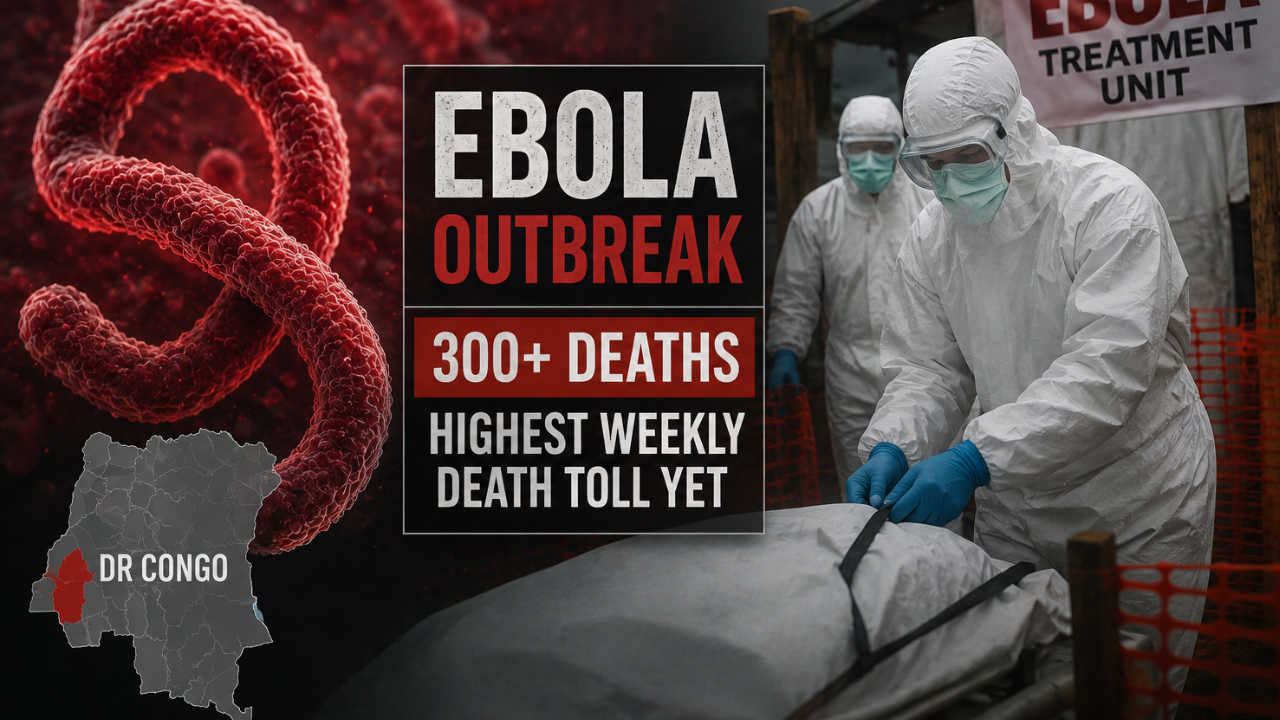
The Ebola outbreak in the Democratic Republic of Congo (DRC) has resulted in more than 300 deaths in a single week, marking one of the highest weekly death tolls since the outbreak began in mid-May. According to the latest data by the DRC's Ministry of Health, 5,514 confirmed cases and 2,642 deaths had been recorded as of August 23. The outbreak, caused by the Bundibugyo virus, has already become the largest and the deadliest Ebola outbreak in history, surpassing the 2018-2020 epidemic. Highest Weekly Death Toll In terms of the pace of the Ebola outbreak, the latest numbers follow an alarming pattern. WHO previously reported 304 deaths and 579 cases in the week of August 3-9, the highest weekly totals recorded at that point. An earlier WHO update had recorded 296 deaths in one week, showing how rapidly the outbreak has escalated over recent weeks. The increase is partly linked to expanded surveillance and testing, but WHO says most of it is due to genuine expansion of the outbreak. Rare Bundibugyo Strain Is Making Containment Challenging Also read: DR Congo Gets 70,000 Ebola Vaccine Doses For A Different Strain: Can Ervebo Protect Against Bundibugyo?Unlike the Zaire species of Ebola, for which licensed vaccines and treatments exist, this outbreak is being driven by Bundibugyo virus, a rare Ebola species that has not been studied adequately. There is currently no approved vaccine specifically for Bundibugyo virus, making the response more challenging. However, DRC recently received 70,000 doses of the Ervebo vaccine, which targets Zaire strain. It is being evaluated for potential protection against Bundibugyo virus. WHO says early laboratory and animal studies suggest that the vaccine may provide some protection against Bundibugyo. Ebola spreads through direct contact with the blood or other bodily fluids of an infected person, particularly once they become ill or after death. Hence, containing the outbreak depends heavily on finding cases quickly, isolating patients, tracing their contacts and ensuring transmission control.But in parts of eastern DRC, health workers face attacks, communities are displaced and people frequently move between areas. These factors allow transmission chains to continue undetected. WHO has warned that sustained transmission across communities that are interconnected is driving the aggressive expansion.The outbreak has also been affected by misinformation and mistrust, which can discourage people from seeking treatment or cooperating with response teams. Health Workers And Remote Communities At Major Risk Also read: Congo's Ebola Outbreak Is Spreading Fast But WHO Says It Can Still Be Contained In 3 MonthsThe outbreak has spread across dozens of health zones, with Ituri remaining the epicentre. WHO reported that cases had reached at least 54 health zones across six provinces by August 12. Health workers have also been heavily affected. At least 155 healthcare workers had contracted the virus and 45 had died as of August 9, according to WHO. Insecurity, population displacement and poor access to healthcare are making it harder to identify cases, trace contacts and get infected people into treatment quickly.WHO Says The Outbreak Can Still Be Contained Despite the alarming numbers, WHO officials have said the outbreak can still be brought under control if response efforts are scaled up as soon as possible.WHO Director-General Tedros Adhanom Ghebreyesus and Africa CDC Director-General Jean Kaseya have stressed the importance of surveillance, increasing treatment capacity and working closely with affected communities to tackle the outbreak.