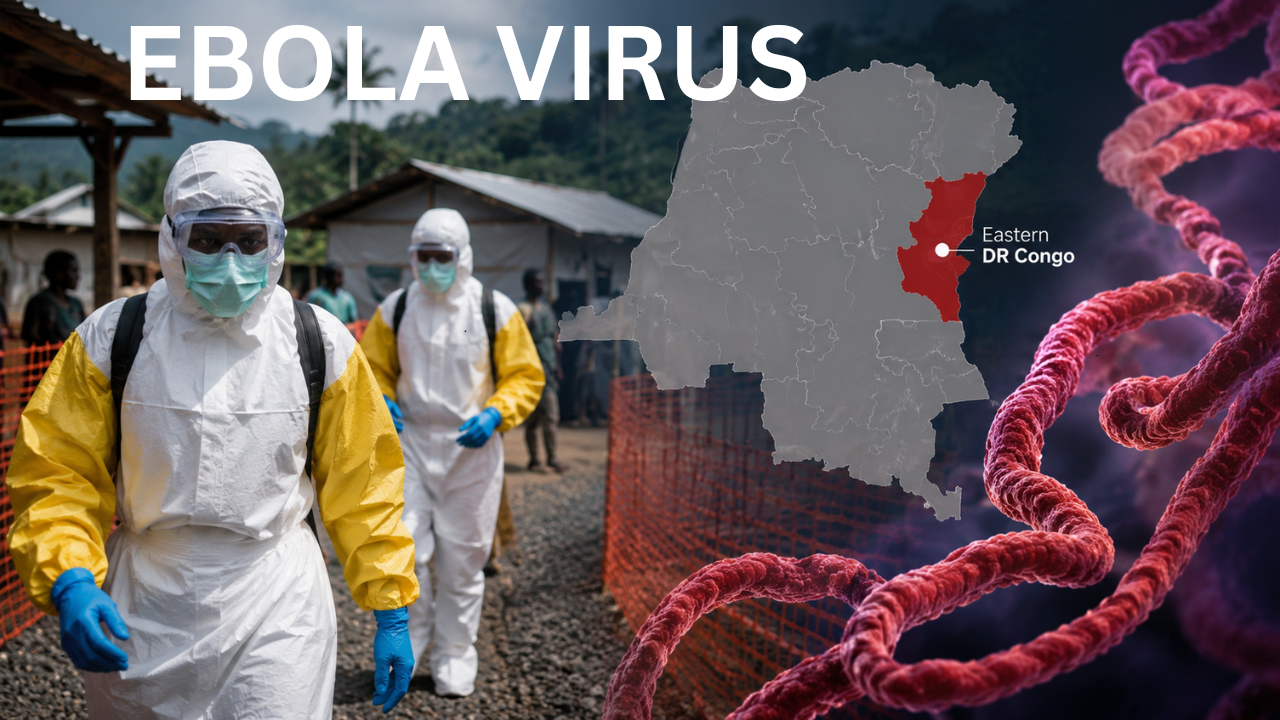
Even as the world is still grappling with the news of a hantavirus and two separate norovirus outbreaks, the Africa Centres for Disease Control and Prevention (Africa CDC) today confirmed that the Ebola virus has resurfaced in eastern Democratic Republic of the Congo for the 17th time.In a statement, the Africa CDC reported that there are 246 suspected cases and 65 deaths, mainly in the mining areas of Mongwalu and Rwampara, about 100 kilometers north of the provincial capital, Bunia.While tests are being carried out to identify the strain of the virus, early indications suggest the strain is not the Zaire variant, which has been responsible for several previous outbreaks in the country, the health officials said.The Ebola Zaire strain was prominent in Congo’s past outbreaks, including the 2018 to 2020 outbreak in the eastern region that killed more than 1,000 people.Ebola: 17th outbreak in DR CongoEbola was first discovered in 1976 in the DR Congo. This is the 17th outbreak of the deadly viral disease in the country.As per preliminary tests conducted at the Institut National de Recherche Biomédicale (INRB) in the country's capital, Kinshasa, the Ebola virus has been detected in 13 of 20 samples analysed, following consultations with DR Congo's Ministry of Health and National Public Institute.Of the 65 deaths, four were reported among lab-confirmed cases, Africa CDC said.Additional suspected cases have also been reported in Ituri's provincial capital, Bunia, a densely populated urban centre near the borders with Uganda and South Sudan, raising fears of regional transmission.All affected communities and at-risk areas have been advised to follow guidelines from the national health authorities.What Is Ebola Virus Disease?As per the WHO, Ebola virus disease (EVD) is a rare but severe illness in humans and is often fatal. People can get infected with the virus if they touch an infected animal when preparing food, or touch body fluids of an infected person, such as saliva, urine, feces, or semen, or things that have body fluids of an infected person, like clothes or sheets.How Does Transmission Work?Ebola enters the body through cuts in the skin or when one touches their eyes, nose, or mouth. Early symptoms include fever, fatigue, and headache. It is a highly infectious and transmissible disease; in fact, there have been cases of healthcare workers who have frequently been infected while treating patients with suspected or confirmed Ebola. This occurs through close contact with patients when infection control precautions are not practiced strictly.Cases of people conducting burial ceremonies, involving direct contact with the body of the deceased, can lead to the transmission of Ebola. Even after the long suffering and recovery, there is a possibility of sexual transmission. Pregnant women who get acute Ebola and recover may still carry the virus in their breastmilk or in pregnancy-related fluids and tissues. Symptoms include:feeling tiredheadachemuscle and joint paineye pain and vision problemsweight gainbelly pain and loss of appetitehair loss and skin problemstrouble sleepingmemory losshearing lossdepression and anxiety.Is There Any Vaccine for Ebola?According to the WHO, there are two vaccines against the Ebola virus. But both the Merck-developed Ervebo vaccine, administered in one dose, and Johnson & Johnson-developed Zabdeno and Mvabea vaccine, administered in a two-dose regimen, target Zaire ebolavirus.The Ervebo vaccine is recommended for use in outbreak settings and is currently the only vaccine available in the global stockpile.