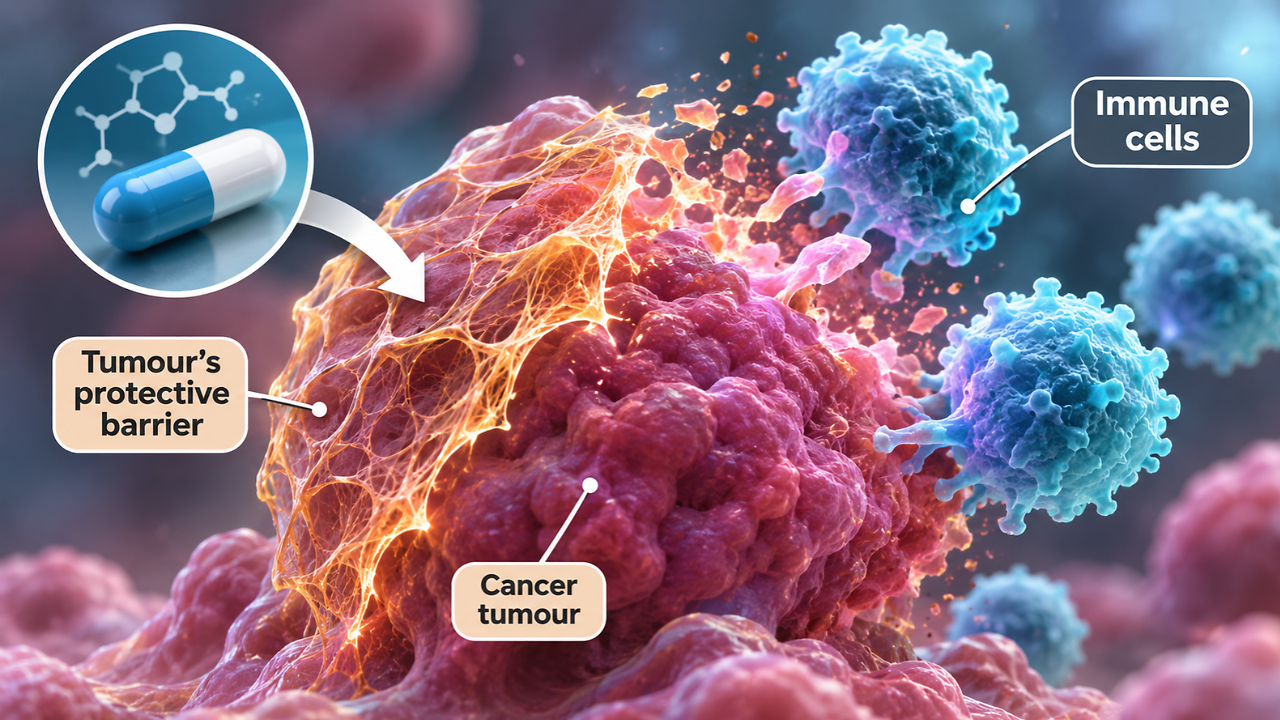
Many cancers often protect themselves by building a barrier around tumours that look like scars. It prevents immune cells by destroying cancer cells. Researchers recently developed an experimental drug that dismantles this protective shield, allowing the body’s immune cells to attack tumours effectively. In experiments involving mice, the drug eliminated aggressive pancreatic tumours, prevented breast cancer from spreading and helped tumours that were resistant to immunotherapy respond to treatment. It also created an immune memory that allowed some mice to fight off cancer again, including different types of tumours.The findings, published in Cancer Cell, could be a new way for treating solid tumours that are difficult to tackle with existing immunotherapies. More About The Experimental Cancer Drug Also read: Ozempic May Increase Breast Density, Impact Mammogram Results: Why It Matters For Breast Cancer ScreeningMany solid tumours, including pancreatic, breast, lung and colorectal cancers, create a protective environment around themselves in the form of a dense tissue. It can physically restrict the movement of immune cells, suppressing their ability to attack cancer.The researchers focused on transforming growth factor-beta (TGF-β), a molecule that tumours produce in large amounts. TGF-β helps surrounding cells build fibrous tissue around tumours to suppress immune activity, which allows cancer to evade the immune system’s attacks.The experimental drug, called FEBP-sTβRII, is designed to block TGF-β activity within tumours rather than throughout the body.It carries a component that binds to a form of fibronectin, a protein found in high levels in tumour tissue but rarely in healthy tissue. This allows the drug to accumulate within tumours, where it can disrupt the protective environment.What Did The Study Find?Also read: Wilserdly: Roche's New Breast Cancer Pill Wins FDA Approval; Giredestrant Cuts Recurrence Risk By 30%The drug generated promising results in several mouse models of cancer:Pancreatic cancer: In one aggressive model, tumours completely disappeared in 75% of the mice population. Seven out of eight animals remained alive 270 days after treatment ended.Triple-negative breast cancer: The treatment slowed tumour growth, prevented spread to the lungs and improved survival in mice.Immunotherapy-resistant tumours: Combining the experimental drug with an existing anti-PD-1 immunotherapy nearly eliminated pancreatic tumours that had resisted immunotherapy before.Long-lasting immune protection: Mice whose tumours disappeared were able to reject the same cancer when it was introduced again months later. Some also resisted different cancers, including bladder and lung tumours.Researchers also found that the targeted drug had a more limited effect on gene activity in the blood than an untargeted version of the TGF-β blocker, suggesting that directing the drug to tumour tissue could help reduce effects on healthy tissues.How Does It Help The Immune System Fight Cancer? When the drug weakened the tumour's protective barrier, T cells that fight cancer were able to enter the tumour more effectively. These T cells released interferon-gamma, a molecule that changed the behaviour of nearby support cells and immune cells. The cells began presenting cancer fragments to the immune system, allowing it to recognise the tumour more effectively and create an immune response.Researchers say that this may explain why the treatment produced immune memory in mice. Instead of just allowing T cells to enter the tumour, it helped reprogramme the surrounding environment so that it could support immune activity.The findings are promising but the drug remains under investigation. Researchers have developed a version intended for human use that has entered safety testing. Its clinical trials have been planned for 2027.