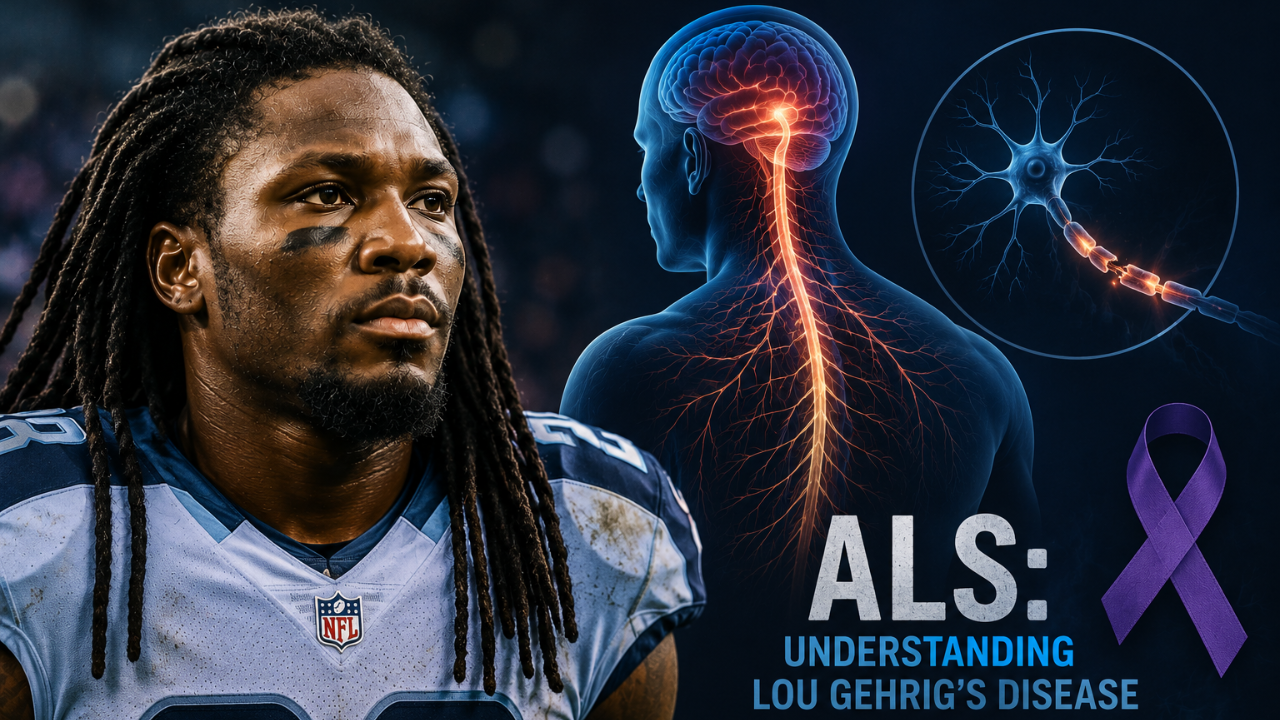
Former NFL running back Chris Johnson recently shared a heartbreaking health crisis. The ex-Tennessee Titans star revealed that he has been diagnosed with amyotrophic lateral sclerosis (ALS), the progressive neurodegenerative disorder for which there is no cure. Former NFL Player Chris Johnson Reveals ALS Diagnosis Chris Johnson revealed that he has sporadic ALS, the most common form of the disease, which occurs in patients with no family history. In a recent pre-taped interview, he spoke about finding out about the disease. He recalled, “At first it was little things like my grip didn't feel right, and I wasn't as strong as I'd always been.” He also said that he thought the initial symptoms were related to the wear and tear from his sports career. He said, “I thought because of football and his career that it must be something with that. Maybe a pinched nerve or something along those lines, but never ALS.” Dr. Merritt Cudkowicz, a neurologist at Mass General Brigham Neuroscience Institute, who also worked with actor Eric Dane before his death from ALS this year, revealed that Chris has been on a clinical trial that could help in alleviating inflammation. He further shared that even though it has helped him, the disease has progressed rapidly in the last year. The former football star revealed using a speech-generating device, which is controlled by his eyes, to communicate. Before Johnson lost his ability to speak, doctors recorded his voice, allowing the device to sound like him. What is ALS? ALS is a neurological disorder that targets motor neurons, nerve cells in the brain, and spinal cord that are responsible for voluntary muscle movement. When these neurons degenerate and die, the brain can no longer communicate with muscles, leading to muscle weakness, paralysis, and eventually respiratory failure. There are two major types of ALS: Sporadic ALS: This is the most common form, accounting for 90% of cases. Though it appears without family history, a portion of cases may involve genetic mutations. Familial ALS: Representing about 5% to 10% of cases, this inherited form results from specific genetic changes.Who Is At Risk? Certain groups are at higher risk. Military veterans and firefighters are nearly twice as likely to be diagnosed with ALS, potentially due to environmental exposures, physical trauma, or toxins encountered during service. The U.S. Department of Veterans Affairs recognizes ALS as a service-connected condition, entitling veterans to specialized care and benefits. Complications Related to ALS As ALS advances, it affects nearly every function that depends on muscle control. Some serious complications include: Respiratory Failure: Weakening of the diaphragm and chest muscles creates breathlessness. Respiratory failure is often the main cause of death in ALS. Speech and Communication Impairment: The disease will lead to slurred speech or mumbling, so that there is dependence on aid to communication.Difficulty Swallowing and Feeding: Weakening of the muscles disrupts chewing and swallowing capacity so that patients become vulnerable to aspiration pneumonia or choking. Feeding tubes are most often required. Dementia and Cognitive Impairment: A small percentage of ALS patients develop frontotemporal dementia, which is marked by changes in behavior and decision-making. Despite the complications of the disease, Chris Johnson has assured his fans that he still possesses the same spirit he had before the diagnosis. With advanced symptomatic treatment, support, and medical technology, ALS patients can maintain a decent quality of life.