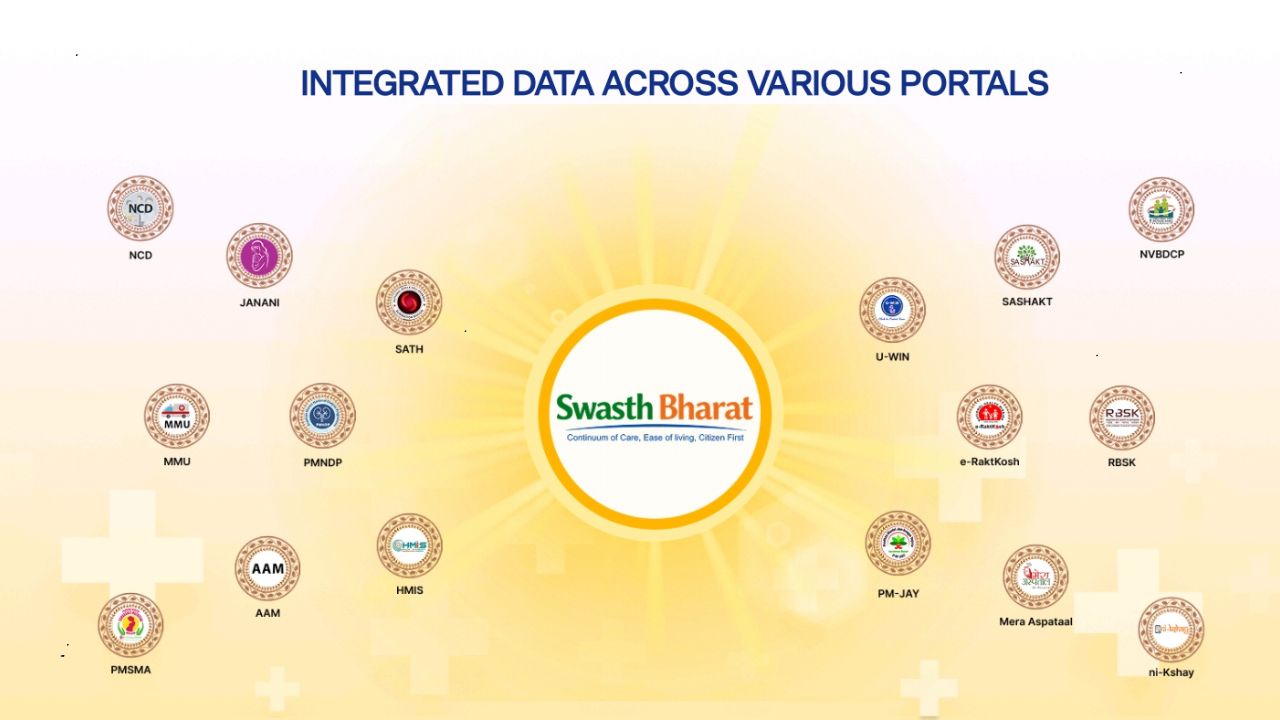
In yet another milestone in India’s digital healthcare, the government has launched the Swasth Bharat Portal, which aims to bring together the fragmented health systems in the country. The portal, unveiled during the recent 10th National Summit on Innovation and Inclusivity by Union Minister for Health and Family Welfare JP Nadda, signifies a decisive shift towards a more integrated, efficient, and scalable digital public health architecture. The portal aims to enable seamless integration with the Ayushman Bharat Digital Mission (ABDM) and support the exchange of patient records through the ABHA health account system. What Is The Swasth Bharat Portal? The Swasth Bharat Portal has been conceptualized as an aggregator platform that integrates existing program systems through an API-based federated architecture. It enables interoperability and convergence, creating a unified digital layer across programs. It is a one-stop integrated platform that brings multiple national health programs onto a single interface. It eliminates the need for multiple logins and repetitive data entry, and significantly reduces the administrative burden on healthcare providers while enhancing efficiency at all levels. The portal also provides a single platform for easy access, along with data visualisation tools and the use of data at the local level for monitoring and evidence-based planning. It is ABDM-compliant and supports integration with ABHA (Ayushman Bharat Health Account), enabling seamless and secure exchange of patient health records. It is designed to evolve into a comprehensive and interoperable digital health ecosystem, further integrating with national registries such as the Healthcare Professionals Registry (HPR) and Health Facility Registry (HFR). Also read: India AI Summit: Union Health Minister Nadda Launches SAHI And BODH Initiatives To Boost AI In HealthcareHow Swasth Bharat Portal Will Boost HealthcareThe new portal will help: Reduce infrastructure duplication by 20–30 per cent: Independent hosting, storage, and compute resources are maintained across programs, which will be reduced when they are aggregated through Swasth Bharat Reduce Repetitive Data Entry: Similar beneficiary data that was entered across multiple systems will be entered on a single platform, thus reducing repetitive tasks by ~20–40 per cent. Unify HR Deployment: Separate development and maintenance teams are required in all programs; a unified system will reduce the HR burden and reduce duplication by ~20–40 per cent. Increase Interoperability: As the system is designed on a federated architecture via APIs, the interoperability will be higher. Read More: Medical Miracle: World First Frozen Testicular Implant Gives ‘Infertile’ UK Man Hope of FatherhoodThe Swasth Bharat portal will also lead to substantial government savings both in terms of human resources, time, and IT infrastructure as compared to the current individual portals being managed by different program divisions, the Health Ministry said. Further, the portal enables a shift towards an integrated, efficient, and scalable digital public infrastructure with significant efficiency gains. The Swasth Bharat Portal thus represents a transformative step towards convergence, efficiency, and data-driven governance in India’s public health system.