
- Health Conditions A-Z
- Health & Wellness
- Nutrition
- Fitness
- Health News
- Ayurveda
- Videos
- Medicine A-Z
- Parenting
Italy Confirms First Human Case Of H9N2 Avian Flu Case In Europe

Credit: iStock
The Italian authorities this week have confirmed the first human case of H9N2 Avian Flu in the Lombardy region – also the first in the European Union.
The influenza A(H9N2) infection was identified in a traveler returning from a non-European country, where the virus has previously been identified in birds. The patient has coexisting medical conditions and is currently receiving medical treatment in a hospital.
Italy’s Ministry of Health, in a statement, said that they identified “infection with the low-pathogenicity avian influenza A (H9N2) virus of animal origin, in a frail person with concomitant illnesses, who came from a non-European country where he contracted the infection, and is currently hospitalized”.
Public health authorities in the country have performed contact tracing as a precaution to identify and control possible onward transmission and have initiated several epidemiological and microbiological investigations.
“All the required checks were promptly carried out, and the relevant contacts were identified, as part of the ordinary prevention and surveillance activities. Currently, no critical issues have been identified, and the situation is being constantly monitored,” the Ministry said.
What is H9N2?
H9N2 is a subtype of the avian influenza A virus (bird flu) that causes respiratory illness in poultry worldwide and is endemic in many parts of Asia, Africa, and the Middle East.
While low-pathogenic in birds, it sporadically infects humans—usually children—causing mild, influenza-like illness, though severe cases can occur.
According to the WHO, most human cases of infection with avian influenza A(H9N2) viruses are exposed to the virus through contact with infected poultry or contaminated environments.
Also read: Japan Confirms New Highly Pathogenic Bird Flu Outbreak: Report
Human infection tends to result in mild clinical illness. However, globally, there have been some hospitalized cases and two fatal cases reported in the past.
“Based on available information, further sporadic human cases could occur as this virus is one of the most prevalent avian influenza viruses circulating in poultry in different regions. With the currently available evidence, the WHO assesses the current public health risk to the general population posed by this virus as low,” the WHO said.
Human bird flu cases have been reported in countries like China, India, the UK, and Vietnam, often resulting in full recovery.
Also read: UK Reports Its First Human Case Of Bird Flu
Rising Global Bird Flu Cases: Are Humans At Threat
Globally, the spread of bird flu cases has been driven by migratory birds, with increasing outbreaks in poultry farms across Japan, India, South Korea, and the US, among others.
To date, most human cases have occurred in people handling infected poultry or animals.
Key Symptoms of bird flu in humans include:
Cough,
sore throat,
runny or stuffy nose,
difficulty breathing
High fever (often >38°C),
fatigue,
muscle/body aches
Conjunctivitis (red/irritated eyes),
nausea,
vomiting,
diarrhea.
In severe cases, pneumonia and Acute Respiratory Distress Syndrome (ARDS), have been reported.
Human infections remain rare, and the risk is also low, yet scientists say that the virus may someday evolve into a variant that can cause significant harm to humans. Recent infections in mammals (like cattle) increase concern.
Bird flu (H5N1) was detected in the US milk supply, particularly in raw milk from infected dairy cows, with high levels found in milk and udder tissues.
“There is a consensus among those who study how infectious diseases originate and spread that the next pandemic in humans is most likely to originate in a bird flu. Of the different types of bird flu that are especially important, H5N1 avian influenza is considered the most likely candidate for a spillover event, with a high fatality rate,” Dr. Gautam Menon, Professor of Physics & Biology, Ashoka University, told HealthandMe.
“From the small number of infections in humans that have been diagnosed, we know that about 30-40 percent of such cases can be fatal. But we don’t know the possible background of infections in which these deaths or serious cases might occur. In particular, the possibility of asymptomatic infections is open,” he added.
Measles Outbreak In Bangladesh: Death Toll Crosses 500, Suspected Cases Over 64,000

Credit: iStock
India's neighbor in the east, Bangladesh, is facing the worst of a crisis in the form of a massive measles outbreak. As per media reports, measles in Bangladesh has taken 545 lives. Facing this growing challenge, the authorities are in complete disarray.
The nation has been struggling with the disease almost from the beginning of the year, but as of now, the situation has worsened and appears as one of the worst outbreaks of measles since the inception of the country in 1971.
According to the local media, the country has a total of 458 suspected deaths and 87 confirmed deaths linked to measles since mid-March of this year. On the other hand, Bangladesh has seen 64,940 suspected measles cases and 8,719 confirmed infections in the same period.
The Directorate General of Health Services (DGHS) of Bangladesh has said that since the 15th of March, the number of admitted patients with measles was 51,585. This information was directly released by the Health Emergency Operations Center and Control Room, which is under the authority of DGHS.
Why The Measles Cases Are On The Rise In Bangladesh?
The United Nations Children’s Fund (UNICEF) said that gaps in immunization worsened during and after the 2024 student-led uprising that toppled the government, leaving large numbers of children unprotected. UNICEF emphasized the need to boost vaccination programmes and provide more funding for health facilities in the future.
Why The Situation Can Go South From Here?
Bakrid or Eid al-Adha is an occasion that is widely celebrated in Bangladesh. This Eid usually sees massive gatherings and festivities. As measles is a highly contagious disease, the chances of spreading the disease during the festivities are very likely. The public health experts and doctors are warning against attending mass gatherings. Other than that, usual long-distance travel and family visits during Eid holidays could spread the disease at an exorbitant pace.
What Is Measles?
Measles is a highly contagious virus that spreads through direct contact or through the air when an infected person coughs or sneezes. It is a vaccine-preventable disease that can cause devastating complications, including blindness, pneumonia, encephalitis, and long-term immune dysfunction.
Symptoms usually appear in 7 to 14 days after exposure and may include:
- high fever,
- cough,
- runny nose,
- red eyes,
- rashes across the body.
How To Stay Safe From Measles?
- Maintaining good hygiene, such as frequent handwashing and covering the mouth while coughing or sneezing, helps reduce transmission.
- Avoiding close contact with infected individuals and ensuring proper nutrition to boost immunity are also important.
- Public awareness and community health programs play a crucial role in prevention.
‘Heat Dome’ Triggering Record-Breaking May Temperatures In France, UK, Spain

Credit: AI generated image
European countries like France, the United Kingdom, Spain, and Germany are experiencing early heatwaves and record-breaking conditions.
The sweltering heat conditions have affected scores of people, reportedly resulting in the deaths of about seven people in France. The unusually high temperatures early in May are being triggered by a phenomenon called a “heat dome”.
“A classic, highly anomalous and powerful Heat Dome has parked over Western and Central Europe,” said Severe Weather Europe in a statement.
The forecaster also warned that temperatures are soaring by 12-16°C above “long-term climatological norms” with an extraordinary thermodynamic plume sending “a massive core of extreme warmth over Spain, Portugal, Ireland, the UK, France, and Germany”.
As a result, southern and southwestern regions, including Portugal, Spain, and France, will experience daytime temperature highs of 38°C. The majority of France is under a moderate to high temperature warning, while Germany and the UK are witnessing maximum temperatures exceeding 30°C, the Euronews reported.
“Air mass will be even hotter in the coming days for many countries, as the Heat Dome aloft intensifies further,” the weather forecaster said.
“Because this pattern restricts vertical mixing and cloud cover, maximum and minimum temperatures alike will challenge historical monthly records across hundreds of stations in Western Europe,” it added.
What Is A Heat Dome?
Also read: Heatwaves And Toxic Air Create A Growing Health Crisis In Delhi
Also known as a ‘heat bubble’, the term heat dome is a weather phenomenon in which a strong high-pressure system traps hot air over a region for weeks.
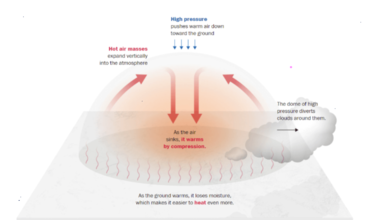
The system forms over a large area in the atmosphere, and causes extremely hot and dry weather conditions. It traps hot air and prevents it from flowing to rise and cool. This air then becomes compressed and heats up, leading to a dome-shaped area of hot air that can persist for several days or even weeks.
How A Heat Dome Forms
- A strong high-pressure system develops in the upper atmosphere
- Air sinks toward the ground and becomes compressed
- Compression increases temperatures
- The hot air expands and becomes trapped like a lid over the region
- Winds struggle to push the system away, allowing heat to build up
Effects Of A Heat Dome
Heat domes can lead to:
- Record-breaking temperatures
- Prolonged heatwaves
- Increased risk of dehydration and heatstroke
- Drought conditions
- Wildfires
- Stress on power grids and water supplies
Studies have proven that the incidence of heat domes is increasing in prevalence due to climate change.
How Heatwave Differs From Heat Dome
According to the Met Office, a heatwave is an “extended period of hot weather relative to the expected conditions of the area at that time of year, which may be accompanied by high humidity”.
On the other hand, a heat dome is a specific, stagnant, high-pressure atmospheric system that parks itself over a region. It traps hot air near the ground like a “lid on a pot”, and can typically last anywhere up to several weeks compared to a heatwave that sustains itself for just days or weeks.
Heatwaves In Europe
Climate change is increasingly driving heat conditions across the globe. According to the EU’s Copernicus Climate Change Service, 2025 was the third-hottest year on record, both globally and in Europe. The past three years – 2024, 2023, and 2025, in that order – were the hottest ever recorded globally.
Last year, temperatures exceeded 40°C in dozens of nations, pushing countries into drought, igniting wildfires, and killing thousands.
Can Fasting Help You Live Longer And Look Younger?
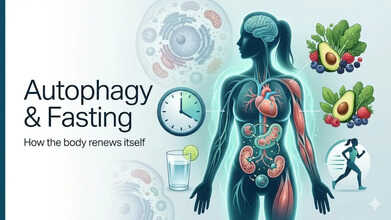
Autophagy can protect one from inflammation. (Photo credit: AI generated)
When it comes to weight loss, many try their own ways to drop the extra kilos. While portion control is advised, there are many who turn to starvation just to drop the extra kilos. In 2016, Japanese scientist Yoshinori Ohsumi won the Nobel Prize for his findings on autophagy. These findings facilitated a better understanding of conditions like dementia and Parkinson's disease. Autophagy refers to natural regeneration, which occurs at a cellular level. It reduces the chances of contracting diseases while also increasing lifespan.
Since then, drugmakers have been working towards coming up with a drug that can stimulate the process; wellness and diet experts have been willing to find a way to naturally induce the process by restricting carbs, fasting, and engaging in high-intensity exercise.
What do scientists have to say?
Experiments were also conducted on mice, and it was found that the ones who were put on genetic tools, fasting, or drugs had a tendency to live longer and remain in better overall shape. However, it is still unclear how the same effect can be replicated in humans. In mice, for instance, the effects of fasting on the brain are evident within 24 hours. In other body parts, such as the liver, the effects occur more quickly. Despite knowing that fasting is good for health, experts are unsure about the ideal duration of fasting for maximum health benefits. Researchers say that fasting does not induce autophagy, but it does have other health benefits.
What is autophagy?
Autophagy is derived from "self" and "phagein," which means "to eat." The process involves cells degrading and recycling their components. It provides fuel for energy and building blocks for cell renewal. Post-infection, it can destroy viruses and bacteria. Cells use the process to get rid of damaged organelles and proteins, and it helps counteract the adverse effects of ageing.
Autophagy was discovered in the 1960s, but its importance was recognised after Yoshinori Ohsumi's research. Researchers said that what they discovered protected against diseases like Huntington's, Parkinson's, and some forms of dementia. It also seemed beneficial in the context of infection control, along with protecting against excessive inflammation. New lifestyle books now suggest that the process can be switched on by making changes to diet and lifestyle or by observing a fast.
The impact on muscle mass
A book titled Glow 15 by Naomi Whittel shares a 15-day programme including 16-hour fasts three times a week. It shares a plan that reduces protein intake on some days, involves eating carbs later, and combines all this with high-intensity exercise. In the basic tests themselves, volunteers at Jacksonville University in Florida experienced several health benefits. Some of the participants lost about 3.5 kilos in 15 days. Others saw improvements in lean muscle mass, blood pressure, and a reduction in fine lines. Researchers said that none of these changes could cause harm to health.
Is fasting safe for all?
Researchers note that fasting too much is not a good idea for anyone. Before making drastic or major changes to lifestyle or diet, it is advised to check with a doctor first. Experts look at autophagy with optimism, and studies show that proteins together form clumps in the nerve cells of Alzheimer's and Parkinson's patients.
- Follow Us :


© 2024 Bennett, Coleman & Company Limited