
- Health Conditions A-Z
- Health & Wellness
- Nutrition
- Fitness
- Health News
- Ayurveda
- Videos
- Medicine A-Z
- Parenting
Listeria Outbreak That Recalled Frozen Foods From Walmart Leaves 4 Dead, And 19 In Hospital
Credits: Canva
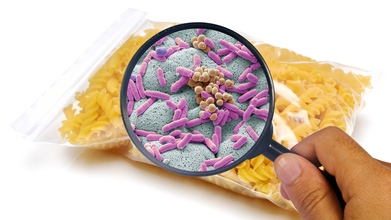
The US is again gripped in the news due to yet another listeria outbreak due to the Trader Joe's Cajun Style Blackened Chicken Fettucine Alfredo. On Friday, the Centers for Disease Control and Prevention (CDC) issued an update that showed that the recent listeria outbreak has led to 20 cases, including 19 hospitalizations and four deaths. As of now, the outbreak is spanned over 15 states.
The CDC noted that while the products that are linked to the outbreak may no longer be in the stores, it could be in consumers' fridges or freezers, if they have purchased recently. The update notes that recalled products must be thrown away or returned at the place of purchase.
The CDC update also notes that consumers must not eat the food and must clean their refrigerator, containers and surfaces that may have touched the affected surface of the contaminated food. As these bacteria can survive in the fridge due to cold temperature and also spread on to other foods or surfaces.
The Marketside meatball linguine was also recalled from Walmart. As of now the products bearing the "best by" dates of:
- September 20
- September 24
- September 27
What Is Listeria?
As per the US Food and Drug Administration (FDA), listeria is a type of disease-causing bacteria that can be found in many places. These places include soil, water, sewage, rotting vegetation, and animals. It can also survive and in fact grow in under refrigeration. It is caused by Listeria monocytogenes, which can thrive in unsanitary food production conditions and lead to contamination of food. People who consumed the contaminated food could develop a disease called listeriosis.
L. monocytogenes is transmitted when food is harvested, processed, prepared, packed, transported or stored in manufacturing or production environments contaminated with L. monocytogenes. Environment can also become contaminated by raw materials, water, soil, and incoming air. Pets can also spread the bacteria in the home if they eat food contaminated with L. monocytogenes.
Listeria: What Are The Symptoms?
There are two ways in which Listeriosis can present:
Non-invasive gastrointestinal listeriosis: the milder form, limited to the digestive system.
Invasive listeriosis: the more dangerous form, which occurs when the bacteria spread beyond the intestines to other parts of the body.
Symptoms
Non-invasive listeriosis mostly has short-lived symptoms:
- fever
- muscle aches
- nausea
- vomiting
- diarrhea
These symptoms usually last for 1 to 3 days.
Invasive listeriosis is a more severe form and could be life-threatening. The symptoms include:
- headache
- stiff neck
- confusion
- loss of balance
- seizures.
This type is more dangerous towards newborns, adults over 65, and people with weakened immune systems.
Who Is Most at Risk?
There are certain groups who are at more risk than others for Listeriosis, they are:
- Pregnant women and their unborn or newborn babies
- Adults aged 65 and older
- People with weakened immune systems
- Pregnant Women and Newborns
400K WHO-Trained Polio Workers Mobilized To Vaccinate 45 Million Children In Pakistan
Credits: WHO
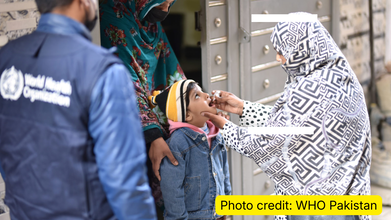
One of the world's largest public health campaigns against polio has been launched for Pakistan, where around 400,000 World Health Organization or WHO-trained frontline workers have been mobilized to vaccinate 45 million children. This is the country's first nationwide polio campaign of 2026. This is in collaboration with Polio Eradication Initiative, these frontline workers are going door to door across cities and remote settlements, carrying oral drops that is the only protection against a virus which has no cure. Polio. It can even cause life long paralysis.
With over three decades of effort, polio cases in Pakistan reduced by 99.8 per cent, from roughly 20,000 cases in the early 1990s to 31 causes in 2025. The country along with Afghanistan, remains among the last places where wild poliovirus still circulates. This makes this campaign even more critical to global eradication of polio.
Read: Pakistan And Afghanistan Are The Only Countries Where Polio Remains An Endemic, Says WHO
Frontline Workers Reach The Remotest Of Settlements
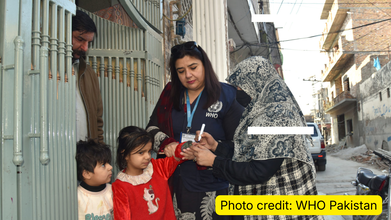
“We climb mountains and walk through the snow for hours with great difficulty. There is also a risk of snow falling on us from the mountains. Yet we do not give up. We reach our assigned area to vaccinate all children and protect them from polio,” said Rabia, a vaccinator from Upper Chitral, quoted by the Polio Eradication Initiative.
During the February drive, Rabia trekked steep terrain to visit 146 households and vaccinate 85 children in remote areas.
In nearby Booni, another worker, Momina, described the work as both service and responsibility. “I thank Allah that I have gotten this opportunity to serve and I am trying my best to eradicate polio in my country,” she said, according to the initiative.
Zeenat, deployed in Khayaban-e-Sir Syed, spent long days navigating crowded neighbourhoods and climbing multiple floors to reach children inside apartment buildings. She covered 242 homes, administering oral vaccine drops to every eligible child.
“I am a mother too and I have also gotten my own children vaccinated for polio. Thank God, they are healthy and protected now,” she said in remarks shared by the Polio Eradication Initiative. “This disease has no cure. I want all parents in the country to vaccinate their children with polio drops so they don’t fall prey to paralysis.”
Health workers also marked children’s fingers after vaccination, a standard monitoring method to ensure no child is missed.
Two Drops, One Goal: Ending Polio
“The vaccine is very important for children in Pakistan because polio can infect children and paralyze them. This is why we go house-to-house to vaccinate them so that no child is paralyzed,” said Rawalpindi worker Neelum, as reported by the outlet.
Health authorities say the campaign reflects a simple but urgent public-health truth: eradication depends not just on vaccines, but on reaching every last child.
What Is Polio?
It is an illness caused by a virus that affects nerves in the spinal cord or brain stem. It can lead to a person being unable to move certain limbs, which can also lead to paralysis. Furthermore, it can also cause trouble breathing, and lead to death.
The polio virus is a naturally occurring virus that has been around since prehistoric times, as per the WHO. This disease can be found in humans and is spread through the faecal-oral route, which means it is transmitted when someone ingests food or water contaminated by human faeces.
Poliovirus is a small, single-stranded RNA virus that belongs to the Enterovirus subgroup of the Picornaviridae family and was first recognized as a distinct condition by English physician Michael Underwood in 1789. The virus was identified in 1909 by Austrian immunologist Karl Landsteiner.
About 5% of people with poliovirus get a mild version of the disease called abortive poliomyelitis. It has flu-like symptoms and can last for 2 to 3 days. The symptoms include:
Fever
Headache
Muscle Aches
Sore Throat
Stomachache
Loss of appetite
Nausea
Vomiting
A more severe form is the nonparalytic polio, affecting 1% of those infected which may have the symptoms such as:
Neck pain or stiffness
Aches or stiffness in arms or legs
Severe headache
The most serious form is paralytic polio, while the symptoms start with those of nonparalytic polio and can progress to more severe signs including:
Intense pain
Extreme sensitivity to touch
Tingling or pricking sensations
Muscles spasms or twitching
Muscle weakness progressing to a limp paralysis
Measles Outbreak In UK: NHS Is Failing To Vaccinate Children, Warn Experts
Credits: Canva
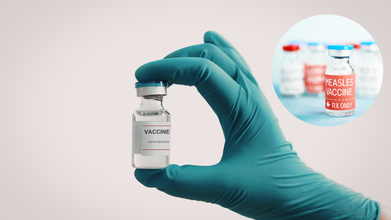
Measles Outbreak In UK: After 34 children were infected by a "fast spreading" measles outbreak in several north London schools, in Enfield, focus has been shifted on vaccination drive. A local doctor who was reported by the BBC informed that all children who contracted the illness were not fully immunized. This has brought back the attention on vaccination. Children across England are increasingly at risk of measles as immunization coverage drops, prompting MPs and health experts to demand urgent reform of how vaccines are delivered.
Read: North London Measles Outbreak: 34 Cases Confirmed In Unvaccinated Children From Enfield
Measles Outbreak In UK: Falling Uptake Sparks Calls Of Vaccination System Overhaul
According to The Guardian, concerns intensified after vaccination rates in some areas fell to levels comparable with lower-income countries. Public health specialists now believe further outbreaks similar to the recent north London cluster are inevitable because fewer than 60% of five-year-olds in some locations have received both recommended doses of the MMR vaccine.
In Enfield, where 60 children recently contracted measles and 15 required hospitalization, the MMR uptake stands at 64.3%. The World Health Organization recommends 95% coverage to prevent outbreaks.
Measles Outbreak In UK: "System Is Clearly Falling"
Labor MP Ben Coleman warned the current approach relying mainly on GP surgeries and schools is not sufficient.
“The long-term decline in uptake of MMR and growing number of very worrying measles outbreaks, like the one in Enfield just now, show that that system is clearly failing,” he told The Guardian.
“Children are at risk of hospitalization and even of dying from measles… Pharmacies are somewhere families often visit and they’re being wasted as a resource. We can’t afford complacency.”
Experts are urging authorities to allow pharmacies to administer routine childhood vaccinations to improve access. Currently, GP staff typically deliver the first and second doses at 12 and 18 months, while schools host catch-up drives.
Measles Outbreak In UK: Doctors Back Pharmacies Administering Vaccines
Pediatric specialists believe widening access could help families who miss appointments.
“With appropriate training and support, enabling pharmacists to deliver MMR vaccines could be particularly helpful for families who have missed routine appointments,” Prof Steve Turner, president of the Royal College of Paediatrics and Child Health, told The Guardian.
The National Pharmacy Association also supported reform, stating that the decade-long decline shows “the current system is simply not working.”
Vaccination expert Prof Helen Bedford added that some schools, including certain faith schools, do not participate in catch-up programmes, making alternative access points essential.
Measles Outbreaks Are Likely To Recur
Scientists warn measles spreads rapidly in communities with low coverage.
Prof Andrew Pollard of the Oxford Vaccine Group said there was “a real risk of further spread both locally and in other parts of London,” telling The Guardian outbreaks may repeatedly return as unvaccinated children accumulate.
A government spokesperson urged families to vaccinate children promptly and noted a new campaign encouraging parents to ensure routine immunisations are up to date. Officials say childhood vaccines prevent roughly 5,000 deaths and 228,000 hospitalizations each year in England.
Youngest Organ Donor Of 10-month From Kerala Gives Life To Four People

Credits: X
Kerala on Sunday bid an emotional farewell to 10 month old Aalin Sherin Abraham, the state’s youngest organ donor, days after her organs helped save five critically ill patients. The infant was laid to rest with full state honors at a church in Pathanamthitta district.
Police personnel offered a ceremonial guard of honor as hundreds gathered for the funeral. Kerala Health Minister Veena George and Union Minister Suresh Gopi attended the service along with grieving relatives and residents.
Chief Minister Pinarayi Vijayan described the parents’ decision as a rare act of compassion during unimaginable grief. In a public tribute, he said the child had given a new lease of life to five people and reflected the true spirit of humanity.
Actor Kamal Haasan also wrote to the family, saying the child would now continue to live on through the lives she saved.
Accident Led To Tragedy
Aalin Sherin Abraham, daughter of Arun Abraham and Sherin Ann John, suffered critical injuries in a road accident on February 5. She was travelling with her mother and grandparents when an oncoming vehicle rammed into their car near a junction.
While her family members were seriously injured, the infant’s condition remained extremely critical. She was first treated at nearby hospitals and later shifted to a specialized facility in Kochi.
After days of intensive treatment, doctors declared her brain dead on February 12. In the middle of their grief, the parents consented to donate her organs.
The state government later announced a ceremonial funeral in recognition of the decision, which drew widespread praise from medical professionals and the public.
Green Corridor Enabled Rapid Transport
Following the consent, authorities launched an urgent effort to transport the organs to multiple hospitals. Since helicopter transfer was not permitted at night, the police created a green corridor from Kochi to Thiruvananthapuram.
Traffic restrictions and manual signaling allowed the ambulance to travel nearly 230 kilometers in 3 hours and 20 minutes.
Doctors said the rapid transport was crucial to preserve viability. The liver was transplanted into a six month old infant at a private hospital. The kidneys were given to a 10 year old child at the Government Medical College. The heart valve was transferred to a hospital inside the Thiruvananthapuram Medical College campus. The corneas were donated to an eye bank at a private hospital.
Tributes Pour In Across State
The incident triggered an outpouring of grief and admiration across Kerala.
Governor Rajendra Vishwanath Arlekar said he was deeply moved by the parents’ decision and called it a gift of life and hope to others.
In his message, Kamal Haasan wrote that the child lived in her mother for months and in her parents’ love for ten months, and would now help other children live healthier lives.
Many residents described the gesture as heartbreaking yet inspiring, highlighting the importance of organ donation awareness.
Medical experts also said the case could encourage more families to consider organ donation, especially in pediatric cases where waiting lists are often long.
Aalin Sherin Abraham’s story, they said, is a reminder that even the shortest life can leave a lasting impact by saving many others.
- Follow Us :


© 2024 Bennett, Coleman & Company Limited