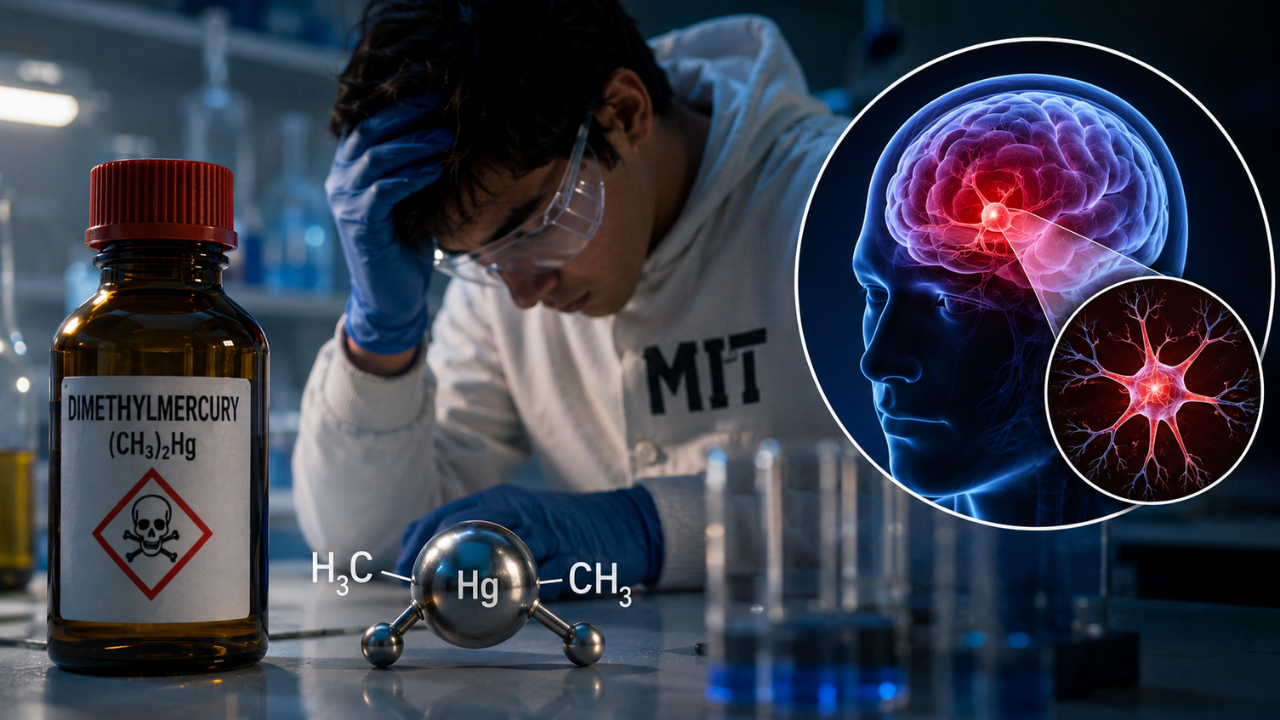
A chemistry lab at the Massachusetts Institute of Technology (MIT) was shut down and subjected to hazardous-material testing after a graduate student revealed that they may have synthesised dimethylmercury, an extremely toxic form of organic mercury. The student went to an emergency department after reporting the possible exposure. MIT said the student was not authorised to work with dimethylmercury and that the chemical was not part of their research. Since the incident, Building 18 has been closed for testing and decontamination, while precautionary cleaning has also been carried out in the student's residence hall. Even though the student remained under medical supervision, MIT later said that the student's initial blood test showed no sign of mercury exposure. So, why did a slight possibility of this chemical trigger such a major response? What Exactly Is Dimethylmercury? Dimethylmercury is an organomercury compound in which mercury is bonded to two methyl groups. The colourless liquid is considered extremely toxic and hazardous. Unlike some toxic substances that mainly become dangerous when swallowed or inhaled, dimethylmercury can be absorbed through the skin. Its exposure routes include inhalation, ingestion and absorption through skin. Additionally, its ability to pass through protective materials is one reason laboratory safety experts have historically treated it with extreme caution. The US Occupational Safety and Health Administration says dimethylmercury is “readily absorbed through the skin” and warns that a severe toxic dose can involve less than 0.1 mL of the liquid.Also read: AC Becomes ‘Must-Have’ For Offices As London Faces Fifth Heatwave; Here’s Why It Still Raises Dehydration Risk Even Tiny Amounts Of Dimethylmercury Can Be Extremely Dangerous The danger comes partly from the molecule's physical and chemical properties. Dimethylmercury is lipid-soluble to break biological barriers and enter the body efficiently. Once absorbed, mercury can ultimately reach the nervous system and cause severe and irreversible neurological damage. It is also extremely volatile, meaning its exposure is not limited to direct skin contact. It can also generate toxic vapour that one may inhale and get poisoned. Once poisoned, the effects can be deceptive because symptoms may not appear immediately.That delay can make even a minor exposure especially dangerous as the person may not realise they have been poisoned until significant neurological damage has occurred.Also read: How To Get Rid Of Heavy Metals In Your Body? Mercury Attacks The Nervous System Mercury is particularly dangerous to the nervous system as it can interfere with cellular processes and damage neurons. Severe mercury poisoning can cause symptoms like loss of coordination, sensory disturbances, weakness, speech problems and other neurological abnormalities. Dimethylmercury is even more dangerous as it is capable to enter the body efficiently, producing delayed neurological toxicity. Researchers and safety authorities therefore treat even a slight exposure as an emergency rather than waiting for symptoms to develop. Historic Mercury Poisoning Case Of 1996 The chemical's notorious reputation was further cemented after the death of Karen Wetterhahn, a chemistry professor at Dartmouth College. In 1996, Wetterhahn accidentally spilled a very small amount of dimethylmercury onto her gloved hand. At the time, she was wearing latex gloves that were considered adequate laboratory protection. But the chemical penetrated the gloves and was absorbed through her skin. Months later, she developed neurological symptoms including problems with balance and speech. She was diagnosed with severe mercury poisoning and died in 1997. The case led laboratories to reconsider how dimethylmercury should be handled and highlighted the inadequacy of ordinary latex gloves against the chemical.