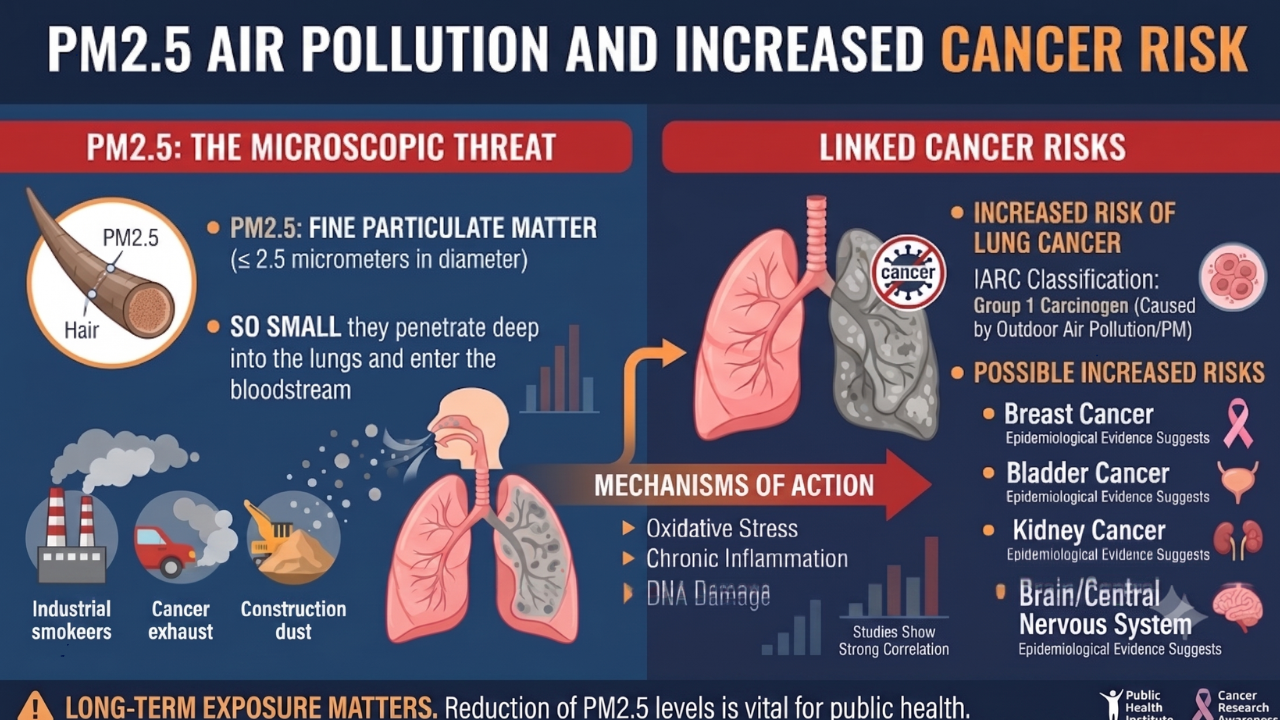
Particulate matter sized under 2.5 microns or 0.0025 millimeters (PM2.5) accounted for the largest share of air pollution-induced cancer cases worldwide, according to a new study.The study, published in the journal Nature Health, showed that PM2.5 was attributable to 8.82 million of the 109 million cancer cases identified between 2000 and 2020. PM2.5 exposure was the dominant contributor to cancers of the respiratory, reproductive and endocrine systems.What Did The Study Find?Ambient air pollution is known to pose a global threat to public health. Although the carcinogenic potential of fine particulate matter (PM2.5), ozone (O3) and nitrogen dioxide (NO2) is a growing concern, comprehensive global assessments of their cancer risks remain limited.The study, led by researchers from the Chinese Academy of Sciences, China, evaluated the effects of long-term exposure to PM2.5, O3 and NO2 on cancer incidence and quantified their attributable burdens worldwide, encompassing 109 million cases from 952 locations between 2000 and 2020.The results identified PM2.5 as the dominant contributor. The researchers found that globally, each 10 microgram per cubic meter increase in PM2.5, ozone and nitrogen dioxide levels was associated with an increased risk of cancer by 16 per cent, 4.23 per cent and 11.7 per cent, respectively.Exposure to nitrogen dioxide was attributable to 6.67 million incident cases, while exposure to ozone was attributable to about 2.6 million incident cases during the study period. Women were found to be consistently more vulnerable to most malignancies.PM2.5 Linked to Cancers Beyond the LungsThe study also showed that PM2.5-related cancer-inducing gene mutations extend beyond the respiratory system, particularly to cancers of the thyroid, esophagus, colon and rectum, and breast.Further, each 10 microgram per cubic meter increase in PM2.5 was associated with a 17.9 per cent higher risk of kidney cancer and a 21.1 per cent higher risk of bladder cancer.Biologically, PM2.5 exerts broad cancer-related impacts, possibly due to its small size and its ability to drive multiple processes, including systemic oxidative stress, DNA damage and immune dysregulation, the researchers said.Study Uses Global Cancer DataThe study uses high-quality, globally representative cancer datasets involving populations from low-, middle- and high-income countries and therefore ensures generalizability of the findings, the researchers said."These findings provide critical impetus for public health policy initiatives aimed at mitigating the global cancer burden,” said the researchers in the paper.Air Pollution and Cancer RiskAccording to WHO data, almost all of the global population (99%) breathe air that exceeds WHO guideline limits and contains high levels of pollutants, with low- and middle-income countries suffering from the highest exposures.In 2016, the International Agency for Research on Cancer (IARC) classified outdoor (ambient) air pollution as a Group 1 carcinogen, primarily linked to lung cancer.As per an April 2026 study by The Union for International Cancer Control (UICC), the risks associated with air pollution are similar to those caused by smoking tobacco. Exposure to air pollution can lead to cancer, stroke, respiratory and cardiovascular diseases, and other health issues.Beyond lung cancers, air pollution has been linked to breast, colorectal, liver, kidney, brain, cervical and ovarian cancers, as well as childhood leukaemia.Studies also suggest that long-term exposure to high levels of PM2.5 may be associated with a 21% increase in the risk of dying from cancer, and new evidence suggests that the risk of dying from air pollution exposure is increased for lung, breast, liver, colorectal and kidney cancers.