
- Health Conditions A-Z
- Health & Wellness
- Nutrition
- Fitness
- Health News
- Ayurveda
- Videos
- Medicine A-Z
- Parenting
Right Before Approval, FDA Again Scrutinizes Novavax Covid-19 Vaccine
Credits: Canva
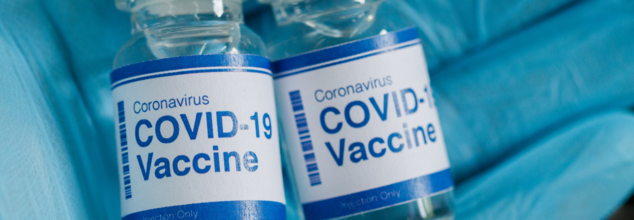
The uncertainty around the Novavax's COVID-19 vaccine has been exacerbated by the Trump administration. The new government has imposed new requirements on the nation's only traditional protein-based vaccine. These new requirements have led to many confusions about vaccine updates, including other vaccines too, which await approval.
The Wait For Full Approval Is Too Long
Novavax is the maker of the protein-based COVID-19 vaccine, which was on track to receive full approval from the US Food and Drug Administration (FDA) by April 1. However, the approval process was paused because of Dr Sara Brenner, the FDA's acting commissioner. The reason for delay has raised many questions about the interference, including political, especially after Dr Peter Marks, FDA's longtime vaccine chief had left following disagreements with Health Secretary Robert F Kennedy Jr. These events have further led to the apprehensions of uncertainty regarding the vaccine's future.
As of now, Novavax's vaccine is only authorized for emergency use. Unlike mRNA vaccines form Pfizer and Moderna, which have full approval, the Novavax vaccine holds the EUA or the Emergency Use Authorization, which allows it to be distributed during public health emergencies. However, once the emergency ends, the FDA can remove these vaccines from market unless full approval is granted.
What Caused The Delay?
The FDA had initially planned to approve Novavax's vaccine by its April 1 target date. However, sources familiar with the situation revealed that Trump appointees influenced the delay. Since then, Novavax has been in discussions with the FDA to determine additional requirements for approval. In the meantime, the FDA's recent comments have fueled concerns that Novavax’s vaccine may be treated as a “new product” due to its updates to match last year’s coronavirus strain. This would require new clinical trials, a process unlikely to be completed before the fall.
ALSO READ: Novavax Says FDA Approval Back on Track for Its COVID Vaccine
This approach to Novavax’s vaccine approval stands in stark contrast to the FDA’s treatment of the mRNA vaccines, where annual strain updates have been handled in a way similar to flu vaccines, requiring only small-scale tests to demonstrate the vaccine’s continued effectiveness against new strains. Dr. Paul Offit, a vaccine expert, argued that it would be unnecessary to treat these annual updates as “new products” requiring full trials, as long as the updated vaccines show that they produce protective antibody levels.
Role Of HHS Secretary
Of course Robert F Kennedy Jr will have a role to play, being the Health Secretary, and a known vaccine skeptic. Despite claiming in recent speeches that he is not anti-vaccine, Kennedy’s past associations with anti-vaccine groups have raised alarms. His nonprofit, Children’s Health Defense, has been involved in campaigns questioning vaccine safety, and Kennedy himself has made public statements suggesting that vaccines can cause autism—a long-debunked claim.
His actions have also contributed to the uncertainty that surrounds the Novavax's approval today and the overall direction of US vaccine policies.
Is Novavax Different From Other Vaccines?
What sets Novavax apart from other COVID-19 vaccines is its traditional approach. While Pfizer and Moderna’s mRNA vaccines use genetic instructions to create a temporary version of the virus’ spike protein, Novavax’s vaccine contains lab-grown copies of the spike protein itself. This approach has been used for decades in vaccines for diseases like hepatitis B and shingles, making it a more familiar method for people who may be hesitant about mRNA vaccines.
Iran war: Indian Govt Considering Temporary Price Hike For Essential Medicines
Credit: Canva
Amid continued escalations in the Middle East conflict, the Indian government is considering a temporary price hike between 10 and 15 percent for essential medicines, according to a media report.
The surge in prices for select medicines could lead to higher drug prices but potentially benefit Indian pharmaceutical manufacturers facing the brunt of the Iran war.
“The immediate net consumer impact could be 3-5 percent higher prices, or roughly similar to what consumers paid before the late-September cuts in GST rates,” said the report by Economic Times, citing top industry executives aware of the government’s discussions.
The proposal was reportedly floated after several top drugmakers raised concerns about the sharp increase in prices of solvents and active pharmaceutical ingredients (APIs) due to global supply disruptions.
The price hike is expected to remain for up to four months and will be rolled back once the input cost stabilizes, the report said.
Further, it cited a senior government official saying that they have received the industry proposal for a price hike, but the decision to implement depends "on how long the geopolitical tension in West Asia lasts".
Increasing Raw Material Costs Drive Up Medical Device Prices
HealthandMe had earlier reported that the ongoing conflict has already spiked prices for medical devices—specifically plastics for syringes and catheters—due to the rising cost of raw materials. If disruptions persist, it can also warn of potential shortages.
“A shortage of liquid helium could impact the installation of new MRI scanners, each of which requires around 1,500 liters for the initial magnet fill. Supply disruptions linked to the war may delay new installations and push up costs, as helium prices are likely to rise amid tighter availability,” Dr. Harsh Mahajan, Mentor FICCI & Founder Mahajan Imaging & Labs, told HealthandMe.
The expert noted that there is no immediate concern for existing MRI machines. It is because most currently installed scanners use K4 technology with zero boil-off systems, allowing them to operate efficiently without frequent helium refills.
“Typically, a top-up is needed only once every three years, when the magnet’s cold head is replaced. As a result, the existing installed base is expected to continue functioning without disruption in the near term,” Dr. Mahajan said.
Also read: Report Claims Mojtaba Khamenei ‘Incapacitated’: What Does This Mean Medically
Long-term Hormuz Blockade Can Affect Critical Medical Supplies
However, the rapidly deteriorating situations and a longer blockade of Hormuz can lead to “substantial price increases, longer lead times, and highly elevated freight costs, which are pressuring cost structures and planning cycles”.
According to Rajiv Nath, AiMeD, the evolving global supply chain dynamics require close monitoring to prevent impacts on production timelines and industry stability.
The Medical Technology Association of India (MTaI) also warned that the ongoing US/Israel-Iran conflict and disruption in the Strait of Hormuz directly threaten India’s access to critical and life-saving medical technologies.
"Modern healthcare systems operate on just-in-time inventory models with minimal buffer stock. When large consignments - like those shipped by sea - are delayed or stranded, there is simply not enough inventory in the system to compensate, even through costlier alternatives like air freight," Pavan Choudary, Chairman, MTaI, told HealthandMe.
He also noted that shipment delays beyond March 31 can lead to "budget lapse, forcing a fresh approval cycle - thereby compounding delays that often stretch to months". It is because many public institutions in India front-load procurement toward the financial year-end.
Amazon's New AI Tool To Accelerate Early-stage Drug Discovery

Credit: AWS
Tech giant Amazon’s cloud unit has launched a new AI-powered application, Amazon Bio Discovery, that will help scientists design and test novel drugs more quickly, bringing new medical treatments to patients faster.
Developed by Amazon Web Services, the new agentic AI application—a smart assistant that automates complex tasks—helps scientists select the right models for their research goals, optimize the inputs, and evaluate candidates for experimentation.
"AI agents make powerful scientific capabilities accessible to all drug researchers, not just those with computational expertise," said Rajiv Chopra, vice president of AWS Healthcare AI and Life Sciences.
"These AI systems can help scientists design drug molecules, coordinate testing, learn from results, and get smarter with each experiment. This combination of cutting-edge AI and the robust, secure infrastructure AWS has built for regulated industries allows scientists to accelerate antibody discovery in ways that weren't possible before," Chopra added.
How Amazon Bio Discovery Will Help Boost Drug Discovery
With the help of Amazon Bio Discovery, scientists can run complex computational workflows without writing code.
Notably, the platform also gives scientists direct access to a broad catalog of specialized AI models called biological foundation models (bioFMs) that are trained on vast biological datasets. These models generate and evaluate potential drug molecules, known as candidates, helping scientists accelerate antibody therapies during the early stages of drug discovery.
Also read: India Must Integrate Technology To Build Preventive, Holistic Healthcare: Experts
Amazon Bio Discovery also enables scientists to securely feed prior experimental data from their organization's lab results into the application. They can use their own lab data to train custom models with just a few clicks—no need to build complex training pipelines or write custom code.
Amazon Bio Discovery also provides three key capabilities:
- a benchmarked library of AI models and analysis packages,
- an AI agent that helps researchers design experiments,
- integrated lab partners that test the most promising antibody candidates and route results back to the scientists.
Amazon Bio Discovery: Early adopters
Amazon Bio Discovery provides complete data isolation and gives customers ownership over all their proprietary data and intellectual property.
According to AWS, Bayer, the Broad Institute, Fred Hutch Cancer Center, and Voyager Therapeutics are among early adopters, and 19 of the top 20 global pharmaceutical companies already use its cloud services.
In a collaboration with Memorial Sloan Kettering Cancer Center, AWS said the platform used multiple models to generate nearly 300,000 novel antibody molecules and narrow them to 100,000 candidates for lab testing by partner Twist Bioscience, compressing work that can take months into weeks.
Surging AI Adoption in Drug Development
Drugmakers and technology companies have stepped up efforts to use AI to accelerate drug development.
Recently, Danish pharmaceuticals group Novo Nordisk, maker of the popular Ozempic and Wegovy anti-obesity drugs, announced a "strategic partnership" with OpenAI to accelerate the development of new medications.
Read More: Telangana, Astrazeneca India To Launch AI-powered Lung Cancer Screening In Public Hospitals
Novo Nordisk is banking heavily on AI to test new treatments and vaccines and bring them to market faster for less money.
In 2024, Boston Consulting Group and Merck announced GenAI Collaboration with Merck. The collaboration will initially focus on disease networks and pathways for chronic and degenerative diseases.
Fitness First: Study Claims A Common Drug Can Mimic Benefits Of 'Intense Workouts'
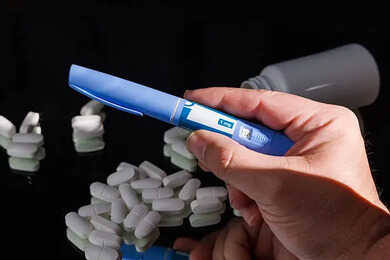
Metformin is a commonly used drug for type-2 diabetes. (Photo credit: iStock)
Diabetes patients rely upon metformin for controlling their blood sugar and insulin levels. Now, a new study claims that this common diabetes drug has many other health benefits to offer, and these can mimic the benefits of 'intense workouts.' The diabetes drug metformin is used by millions around the world who are struggling with this lifestyle disorder—it releases weight-regulating compounds in the body, the same ones that are released during workouts in inactive people. American scientists found that the drug can have a positive impact on a sedentary lifestyle—find out how.
Also Read: The 'Cicada' COVID Variant: A New Name, A Familiar Landscape
What is metformin?
Metformin is the most common drug for the management of type 2 diabetes. It helps insulin work better, thereby regulating blood sugar spikes. This drug is usually prescribed when diet and workouts alone are not sufficient for weight management. According to a study by experts at the University of Miami Miller School of Medicine’s Sylvester Comprehensive Cancer Center, metformin may replicate the benefits of workouts in people who follow a sedentary, inactive lifestyle. In the case of prostate cancer patients, men who do not work out because of their treatment benefited from metformin use, as the drug raises levels of a molecule that supports weight loss. In the case of patients who cannot work out properly, the effect can be game-changing.
Are workouts necessary during cancer treatment?
Exercising is one of the best ways to avoid obesity and other metabolic disorders. It is also one of the best ways to stay strong during cancer treatment, as it regulates weight, heart health, and blood sugar. This helps cancer patients feel stronger even during treatment and recovery. However, many cancer patients cannot work out regularly because of hormone therapy-related fatigue. Metformin use, in this case, can prove helpful for patients.
How does metformin mimic the benefits of workouts?
Exercising benefits the body by releasing hormones such as oxytocin and dopamine. Researchers from the Sylvester Comprehensive Cancer Center explored whether these could be triggered without exercise and whether metformin could do that. They noted that while the drug cannot fully replace workouts as part of a healthy routine, there is a need to understand how a widely used drug can be beneficial for metabolic health during prostate cancer treatment.
N-lactoyl-phenylalanine, or Lac-Phe, is a molecule that spikes after an intense workout session, and it also regulates appetite and calorie burning. Scientists found that Lac-Phe levels were higher in metformin users even when they were not working out. The Sylvester team noted that prostate cancer patients often struggle with poor blood sugar control, heart disease risk, and weight gain due to hormone therapy. They then took blood samples from 29 people and found that the patients who took metformin had similar Lac-Phe levels to people who were engaged in strenuous workouts. This was noted even when the patients were not exercising. However, metformin did not have an impact on prostate tumours.
The study was published in the EMBO Molecular Medicine journal.
- Follow Us :


© 2024 Bennett, Coleman & Company Limited