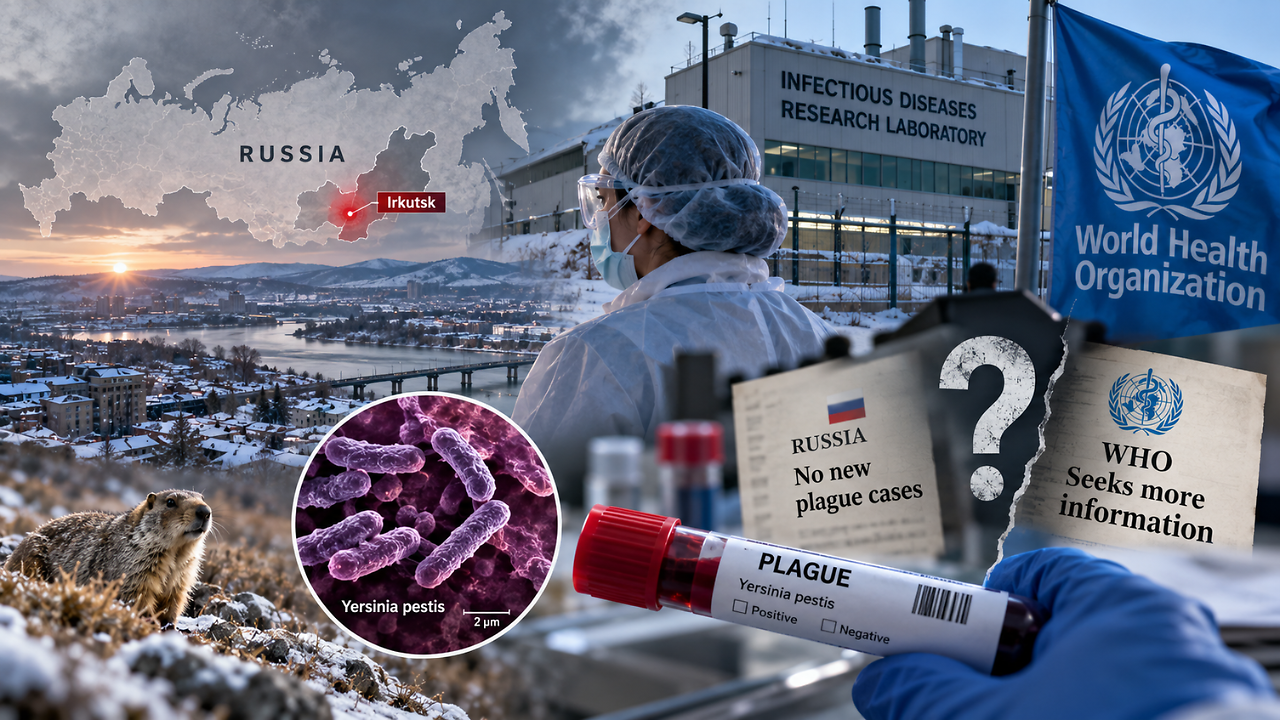
Days after the death of Darya Shipilova, a 28-year-old laboratory technician in Irkutsk's Anti-Plague Research Institute, sparked global headlines about a possible pneumonic plague outbreak, reports of a suspected second case instilled concern in global health bodies and citizens. Russia responded to the reports of the second plague case in Siberia, while the World Health Organization (WHO) says it still lacks enough information to determine what caused the death of the laboratory worker.Initial reports suggested she could have contracted pneumonic plague following a possible laboratory exposure, although Russian authorities have not confirmed that diagnosis.Russia Denies Second Plague CaseAlso read: Second Plague Death Reported As Russia Denies OutbreakLocal media reported the second death after Baikalsk authorities issued a Telegram warning on October 3 about “unofficial information” of a confirmed plague case in Shelekhov, The Daily Mail reported.“Due to unofficial information about a confirmed case of plague in a person in the city of Shelekhov, we ask you to limit visits to Shelekhov and nearby settlements until the circumstances surrounding this threat are clarified,” the administration said.The post was deleted about two hours later, according to local media Lyudi Baikala. There is no official confirmation that the person had plague or died from Yersinia pestis.Russia's public health watchdog, Rospotrebnadzor, however, has maintained that Shipilova died from pneumonia of unknown or undetermined origin, rather than plague.The agency said nearly 5,000 laboratory tests conducted among people connected to the incident had found no dangerous pathogens. More than 90% of the people who were placed under medical observation had completed monitoring.Rospotrebnadzor also said Shipilova had been vaccinated and had immunity against the dangerous infections she worked with. It said there was no epidemic risk in the region.The Kremlin has also rejected reports of a second suspected case. Kremlin spokesman Dmitry Peskov said the majority of media reports surrounding the incident were false and urged people to rely on official statements from Rospotrebnadzor.According to Reuters, “There is a great deal of media coverage, and the vast majority of what the media are reporting about this situation is false information,” Peskov said.WHO Investigates Lab Worker's Death Also read: Russia Tells WHO No Plague Cases In Irkutsk, But Lab Worker's Death Remains UnexplainedDespite Russia's reassurances, the WHO says important questions about the lab worker's death still remain unanswered. WHO Director-General Tedros Adhanom Ghebreyesus said the organisation has requested details of the laboratory testing carried out on Shipilova and her contacts, the reasons behind the public-health measures and the current health status of those monitored.The WHO has also asked Russia to verify reports that a second employee developed pneumonia of undetermined cause.“As we don’t yet have the full picture of this event, we are not able to conduct a full risk assessment,” Tedros said. He stressed that timely, complete and transparent information is necessary to establish what happened and assess any potential public-health risk.Maria Van Kerkhove, WHO director of epidemic and pandemic management, said the agency does not yet know the causative agent behind Shipilova's death.“Right now, we don't know the causative agent of how this woman died. And that's really what we want to better understand,” she said.Bioweapon Claims There's also uncertainty which has prompted questions in the US about whether the incident could involve a biological weapon.US President Donald Trump was asked on October 7 whether he believed the Russian lab worker's death was linked to a bioweapon, US President Donald Trump said: “We don't think so. We're going to find out soon enough, but we don't think so.” He also said his administration was in “very deep discussions” about the incident and that he had a call with Russian President Vladimir Putin scheduled.US officials, meanwhile, have continued monitoring the situation. CDC Director Erica Schwartz said the agency was prepared to monitor and screen travellers.Secretary of State Marco Rubio said Washington was monitoring reports of possible plague but said they were not a “cause for alarm”. “There’s very limited travel between the US and Russia, obviously, but like anything else, something like that gets out, it could quickly spread,” Rubio said.“So we're watching and monitoring it closely. I don't think it's cause for alarm – but it is cause for focus and a cause to just keep an eye on it. And we're doing that.”Meanwhile, neighboring countries including Mongolia, Kyrgyzstan and Uzbekistan have reportedly tightened border health measures.