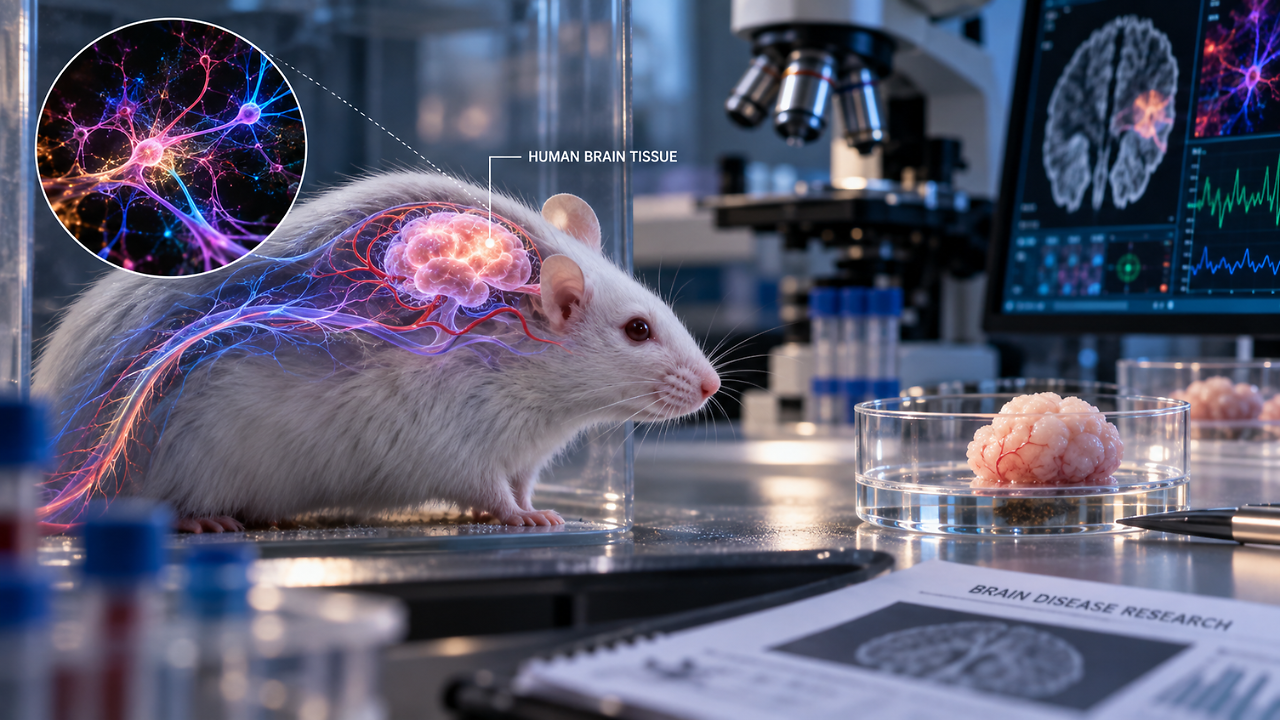
Stanford University scientists have grown lab-made human brain tissue inside mice, successfully creating a new kind of animal model whose constitution is the closest to those of humans. This could help researchers study brain development and neurological diseases in living organisms with a lot more accuracy. The study, published in Nature recently, discusses mice whose cerebral cortex was largely replaced by human brain tissue grown from stem cells. The human tissue expanded to occupy more than 90% of the space available for the mouse cortex and formed connections with the animals' nervous systems successfully. The researchers call them xenocortical mice. The breakthrough could provide scientists with a way to study human neurons in a living brain, something that cannot be done directly in people and is difficult to reproduce using conventional laboratory models. How Did Scientists Create A Part-Human Brain In Mice? The researchers first genetically engineered mice so that most of the cells destined to form their cerebral cortex and hippocampus would not develop. This created space for human brain tissue. Then they transplanted human cortical organoids, three-dimensional structures made from human stem cells, into the brains of newborn mice. The organoids were able to grow rapidly inside the animals. In successful transplants, the human tissue expanded nearly five-fold over a period of three months and eventually occupied more than 90% of the available cortical space. The human cells also developed different types of neurons and formed connections with the mouse brain and, in some cases, extended nerve fibres into the spinal cord. It is important to note that these are not mice with an entirely human brain. The animals still have a mouse nervous system, including their sensory organs and deeper brain structures. What has been humanised is the cortex, the outer part of the brain involved in functions including perception, learning, and complex information processing.Also read: Cefepime: Antibiotic Used For Pneumonia, UTI Linked To Higher Death Risk In Adults Why This Could Be A Milestone For Brain Disease Research? One of the biggest problems in neuroscience is that findings in mice do not always translate to humans. Human brain organoids grown in laboratory dishes have helped researchers study development and disease, but they lack many features of a living brain. They do not receive normal sensory information or interact with muscles and other organs. Putting human neural tissue inside a living animal provides that missing environment. The Stanford researchers tested the model by exposing the mice to a temporary lack of oxygen. The human cortical cells showed significant damage, and the animals developed movement and coordination problems. This provided a way to observe how developing human neural tissue responds to an injury inside a living organism. The researchers say the approach could eventually help investigate conditions including cerebral palsy, epilepsy, autism, schizophrenia and other neurodevelopmental or neurological disorders, while also providing a platform for testing potential treatments.Also read: India’s Hidden Stillbirth Burden: Lancet Study Finds 2.2 Lakh Pregnancy Losses Missed By Current Reporting Method Ethical Questions The experiment also raises difficult ethical questions. As scientists become increasingly capable of integrating human neural tissue into animals, researchers must consider whether increasingly sophisticated brain models could acquire unexpected characteristics or alter animal welfare. The Stanford team sought outside ethical review of the work. Experts have emphasised that there is currently no evidence that these mice possess human-like consciousness, but they also argue that ethical oversight will become important as these models become more complex.