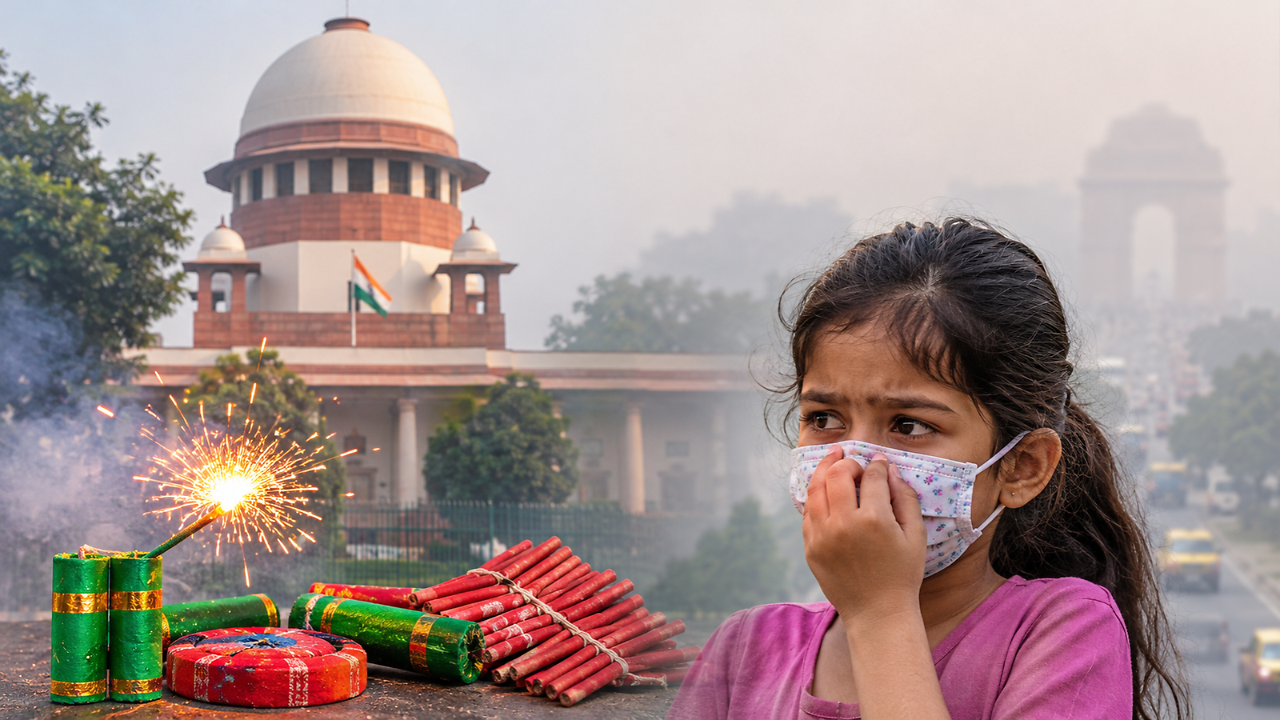
Amid worsening air pollution in Delhi, the Supreme Court on Monday allowed certified green crackers in Delhi-NCR on November 7 and 8, ahead of Diwali. The complete ban on firecrackers will return on November 9, the court said.The decision comes as Delhi's air quality deteriorates. The city's Air Quality Index (AQI) entered the 'very poor' category for the first time this season on Monday, reaching 312 at 9 am, according to the Central Pollution Control Board (CPCB). This was the morning reading, with the daily average due at 4 pm.An AQI of 301–400 is classified as 'very poor', while readings above 400 fall in the 'severe' category. The court imposed the following restrictions:Timings: Green crackers can be burst only between 6–7 am and 8–10 pm on November 7 and 8.No-cracker zones: Their use is prohibited within 300 metres of hospitals, nursing homes, health centres, old-age homes and educational institutions. These areas must be clearly marked.Manufacturers and traders must also furnish monetary security, which will be forfeited if they violate the court's order.Also read: Rising AQI In Delhi-NCR: Doctors Warn Of Lung And Heart Risks As Pollution BuildsWhat Are Green Crackers?Developed by the Council of Scientific and Industrial Research (CSIR) and the National Environmental Engineering Research Institute (NEERI), green crackers are designed to produce fewer emissions than conventional firecrackers.They are designed to generate lower particulate emissions and produce less noise through modified chemical formulations and dust-suppressing additives.Are Green Crackers Really Safe For Your Health?Read More: Landmark Study Links Air Pollution To Higher Hospital Admissions For Cancers & Mental Health Disorders: LancetGreen crackers may be less polluting than conventional fireworks, but they are not pollution-free. Their chemical combustion still releases particulate matter and gases that can affect respiratory health."Green crackers produce fewer emissions than conventional crackers, but calling them safe is misleading. CSIR-NEERI’s criteria require at least 30% lower particulate emissions, or 20% lower particulate emissions plus 10% lower gaseous emissions, compared with corresponding conventional crackers. These are emission benchmarks, not proof of an equivalent reduction in health risk," Dr. Vikas Mittal, Director and Pulmonologist at CK Birla Hospital, Delhi, told HealthandMe.He added that smoke from green crackers contains particles and irritant gases that can aggravate asthma and COPD. Children, older adults and people with existing lung disease are particularly vulnerable."Legal permission does not establish medical safety. For lung health, celebrating without firecrackers remains the safest choice," the expert said.Dr. Nikhil Rajvanshi, Consultant – Pediatric Pulmonologist, Allergy and Sleep Specialist at Rainbow Children's Hospital, Delhi, also cautioned against assuming that green crackers are pollution-free."They should not be mistaken for pollution-free products. They can still release particulate matter and harmful gases that irritate the respiratory tract. Children are particularly vulnerable because their lungs are still developing, and exposure can trigger coughing, wheezing, breathlessness and asthma exacerbations," he told HealthandMe.He added that children with pre-existing respiratory conditions are at even greater risk. Even reduced emissions can contribute to poor air quality when crackers are used collectively. Parents should prioritise avoiding exposure rather than assuming green crackers are completely safe for children's lungs.Do Green Crackers Contain Harmful Chemicals? A 2020 survey by Sumaira Abdulali of the Awaaz Foundation, which works to prevent environmental and noise pollution, raised concerns about chemicals in commercially available firecrackers in Mumbai.According to Frontline, all 28 crackers tested contained hazardous chemicals prohibited under the Hazardous Chemicals Rules.The Foundation also tested green crackers, including sparklers, chakris and anars, some carrying NEERI's green cracker certification mark.The tests reportedly detected barium nitrate, potassium nitrate and sulphur. Barium nitrate was among the chemicals prohibited by the Supreme Court in October 2018.