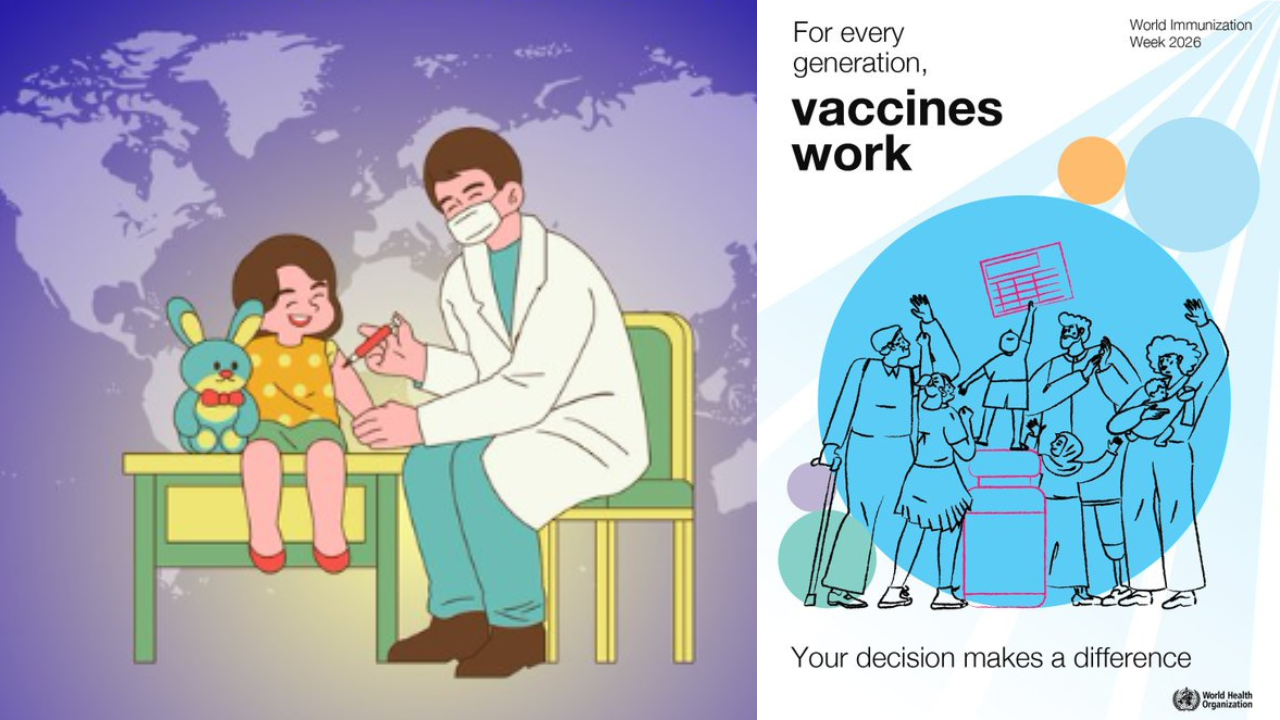
From polio to measles, vaccines have remained one of the most powerful tools in public health, saving six lives every minute, according to the World Health Organization (WHO), as it marked World Immunization Week today.World Immunization Week is observed every year from April 24 to April 30 to raise awareness about the importance of vaccines for saving lives.According to the WHO, vaccines have saved more than 150 million lives over the past 50 years."That’s 6 lives every minute, every day, for more than 5 decades," the WHO said.These lives were saved "not by accident, but because ordinary people made the decision to protect themselves, their children, and their communities from diseases like measles, diphtheria, pertussis, polio, and rotavirus".Currently, more than 30 life-threatening diseases and infections are prevented by vaccines.However, 20 million children missed at least one vaccine dose in 2024, leaving far too many at risk of preventable disease."Today, newer vaccines against malaria, HPV, cholera, dengue, meningitis, RSV, Ebola, and mpox are saving even more lives, and helping people at every stage of life live longer and healthier thanks to scientific advancements," the WHO added.World Immunization Week: OriginWorld Immunization Week was officially endorsed by the World Health Assembly in May 2012 to unify regional vaccination efforts into a single global campaign. Before 2012, it was observed on different days in different countries.World Immunization Week 2026: ThemeThe theme this year is “For every generation, vaccines work”. It promotes how vaccines have safely protected people, families, and communities for generations. It also calls on countries to sustain and expand vaccination coverage at every age, to safeguard the future. As the world is at the midpoint of the Immunization Agenda 2030, the priority remains reaching zero-dose children and advancing equity in the hardest-to-reach communities, particularly in countries grappling with conflict, instability, or fragile health systems, the WHO said.World Immunization Week: The Big Catch-UpThe Big Catch-Up, a campaign launched during World Immunization Week 2023, has been a multi-country effort to address vaccination declines driven largely by the COVID-19 pandemic. The campaign has delivered over 100 million vaccine doses to an estimated 18.3 million children aged 1 to 5 across 36 countries.Around 12.3 million were “zero-dose children” who had not previously received any vaccines, and 15 million who had never received a measles vaccine. The initiative concluded in March 2026 and is on track to meet its target of vaccinating up to 21 million children.However, agencies like Gavi, the Vaccine Alliance (Gavi), WHO, and UNICEF warn that many infants still miss out on lifesaving vaccines through routine immunization every year."By protecting children who missed out on vaccinations because of disruptions to health services caused by COVID-19, the Big Catch-Up has helped to undo one of the pandemic's major negative consequences," said Dr Tedros Adhanom Ghebreyesus, Director-General of the World Health Organization.In 2024, an estimated 14.3 million infants under the age of one globally failed to receive a single vaccine through routine immunization programmes.The WHO noted that the global resurgence of measles is a consequence of chronic gaps in routine immunisation. Measles outbreaks are rising across continents — from Europe to Africa to North America to Australia."This surge is driven by persistent gaps in measles vaccination through routine immunization programmes, compounded by declining vaccine confidence in some previously high-coverage communities," the WHO said.