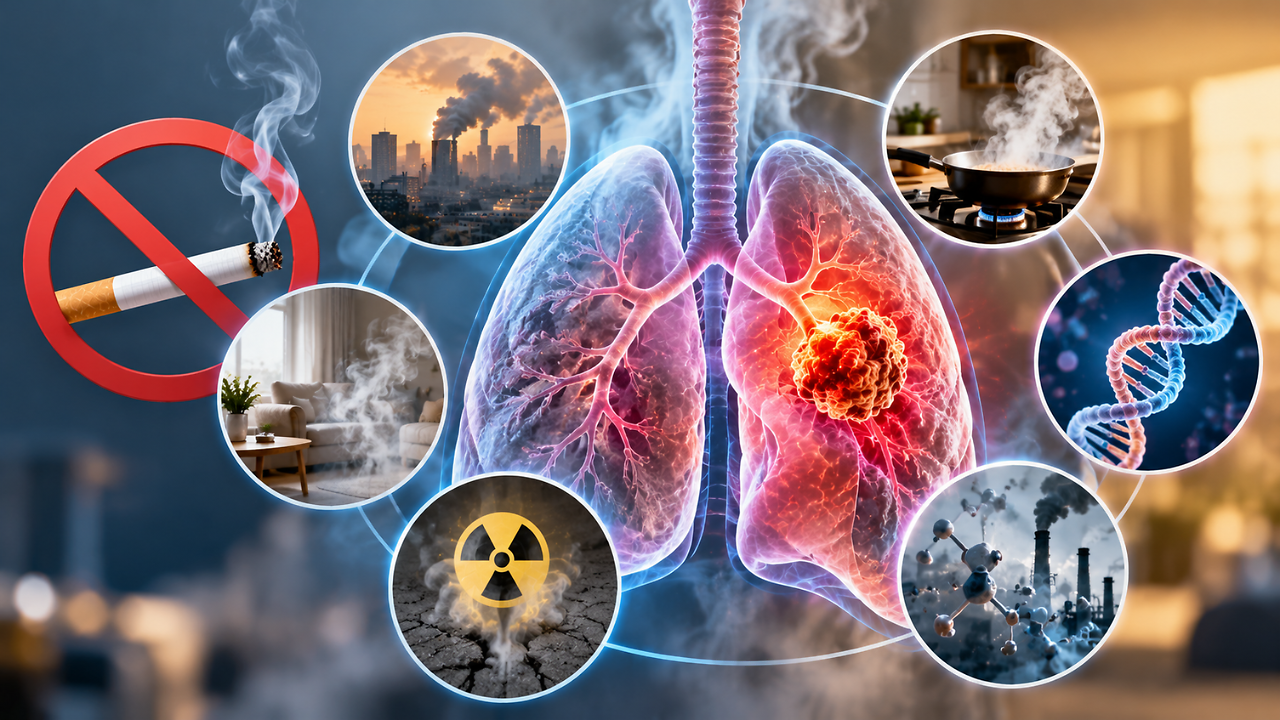
One of the most common contributing factors in lung cancer is smoking but a recent report suggests an alarming pattern in which cases among non-smokers are on the rise. Pope Leo XIV was recently diagnosed with lung adenocarcinoma, a type of aggressive cancer that develops in the cells lining the lungs. He had no history of smoking. The 71-year-old pontiff underwent surgery to have part of his right lung lobe removed. According to reports, he is out of the hospital and recovering well. Another case is of Stanford physician Bryant Lin whose stubborn cough led him to seek medical attention. After six weeks, he underwent an X-ray. The diagnosis stated that he had stage 4 lung cancer. Lin was less than a month away from turning 50, and he had never smoked a cigarette in his entire life. “Definitely a shock,” Lin recalled according to The Washington Post. By the time doctors identified the cancer in spring 2024, it had spread to his liver, bones and brain.According to the US Centers for Disease Control and Prevention (CDC), around 10% to 20% of lung cancers in the United States are reported in people who have never smoked or have smoked fewer than 100 cigarettes in their lifetime. That amounts to an estimated 20,000 to 40,000 cases annually.For these patients, their no-smoking history can delay diagnosis and treatment. Hence, researchers are now looking into how environmental exposures, genetic causes and the biology of tumours may contribute to lung cancer in non-smokers.Lung Cancer In People Who Have Never SmokedAlso read: Pope Leo XIV, Diagnosed With Lung Cancer, Undergoes Surgery As His Brother Battles Relapsed Multiple MyelomaSmoking remains the leading risk factor for lung cancer. But other reasons like exposure to radon, secondhand smoke, air pollution and asbestos can also increase risk. Family history plays a role, especially when a first-degree relative has cancer before age 50.Researchers are also examining genetic differences that may help explain why some people develop lung cancer despite never smoking.A study published in September identified a rare genetic mutation concentrated in the southeastern United States that was associated with a 60-fold higher risk of lung cancer among non-smokers. The finding focuses on a possible role for inherited susceptibility, but it does not explain most cases in this group.Lung cancer also has a different demographic profile among people who have never smoked. Women who have never smoked are more than twice as likely as their male counterparts to develop lung cancer.“Two-thirds of nonsmoking-related lung cancer happens in women, so there’s certainly an association with female sex,” said Jaclyn LoPiccolo, a medical oncologist at Dana-Farber Cancer Institute who co-authored the mutation study.She added, “Nonsmoking-related lung cancer is also more common in people of East Asian descent, but whether that’s a genetic or environmental association, we don’t yet know.”These Cancers Are Often Diagnosed LateAlso read: Pope Leo XIV Resumes Daily Activities After Lung Cancer Surgery: How Recovery Looks Like After Lung Lobe RemovalPeople who have never smoked may not recognise a persistent cough or other respiratory symptoms as signs of lung cancer. Doctors may initially consider more common explanations if the patient has no smoking history.Never-smokers are often diagnosed late at more advanced stages of the disease because their doctors initially consider lung cancer to be less likely.Haiying Cheng, a medical oncologist at Montefiore Einstein Medical Center in New York, said the stigma surrounding the disease can compound the problem. “A cancer diagnosis should never become a judgment about a patient,” Cheng said. She added that clinicians need to consider assumptions beyond smoking when it comes to lung cancer and focus on the patient’s risk profile and tumour biology. Lin is receiving antibody therapy targeting a cancer-driving mutation. He had a positive response to treatment.“The treatment has done wonders for me,” he said. “When I was a medical student or resident, I would have never thought a Stage 4 lung cancer patient could be very productive and have a high quality of life almost two-and-a-half years after diagnosis.”In the United States, the US Preventive Services Task Force recommends annual low-dose CT screening for adults aged 50 to 80 who have a smoking history. People who have never smoked are not included in these recommendations.As researchers dig deeper into lung cancer chances in non-smokers, there is growing interest in different screening recommendations. Taiwan, for example, has a national early-detection programme offering low-dose CT scans to non-smokers with a family history of lung cancer.Lin has urged his own sons to consider screening at a younger age. “I’ve got two sons, and I told them, ‘When you hit 45 or even 40, think about getting screened,’” he said.