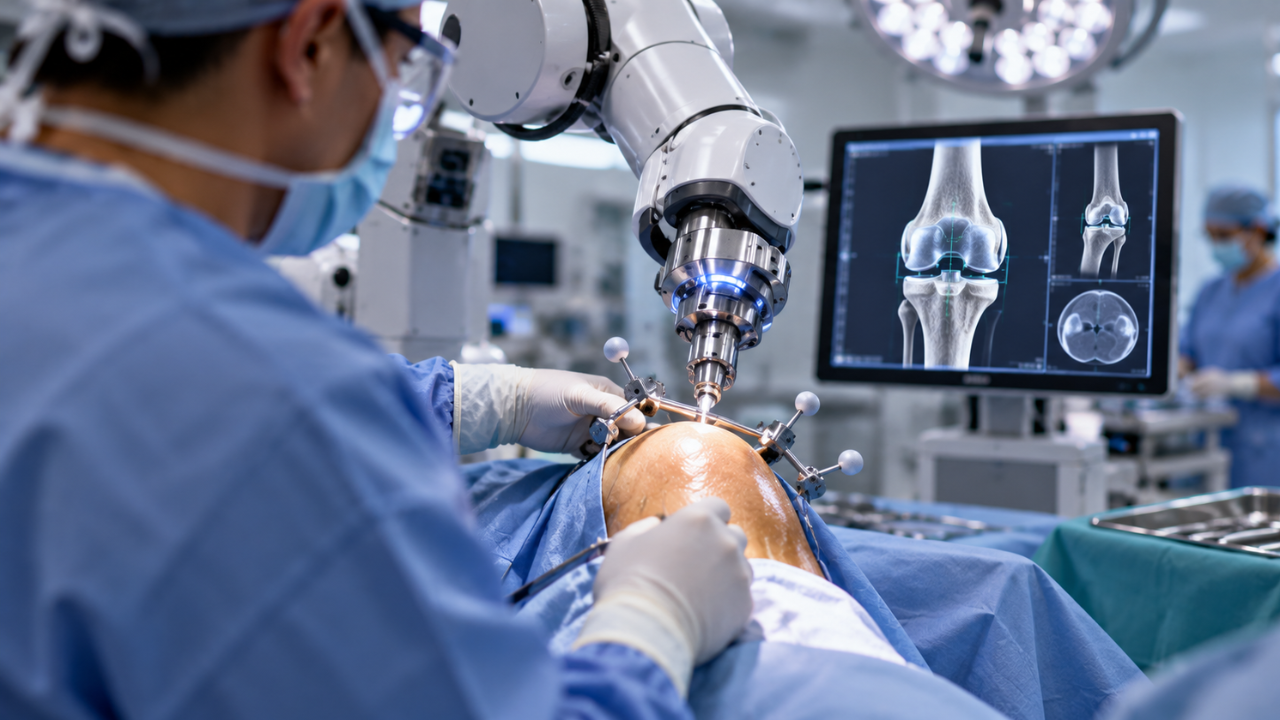
For many patients considering knee replacement, the greatest fear is not the operation itself but the pain that may follow. Robotic assistance has created genuine possibilities for making early recovery more comfortable. However, it is important to understand its role correctly: the robot does not perform the surgery independently, and it is not a pain-control device. It is a precision tool controlled by the surgeon. Before and during robotic-assisted knee replacement, the system helps create a detailed, patient-specific map of the knee. It allows the surgeon to plan bone cuts, implant size, position and limb alignment with a high degree of accuracy. The plan can also be adjusted during surgery after assessing the knee’s movement and ligament balance. The objective is not merely to produce a technically straight X-ray, but to reconstruct a stable, well-balanced knee suited to that patient’s anatomy.How Precision May Help With Early Post-Surgery Pain How can this affect pain? During a conventional knee replacement, instruments guide the surgeon in preparing the bone. Robotic systems establish defined boundaries for this preparation. This may help reduce unnecessary injury to surrounding bone and soft tissue, while enabling measured corrections rather than extensive releases of ligaments. Less tissue trauma and more accurate balancing can mean less inflammation, swelling and pain during the early postoperative period. Research has reported lower pain during movement, reduced early opioid requirements and quicker achievement of certain mobility milestones in some patients undergoing robotic-assisted knee replacement, helping them return to daily activities sooner. Greater consistency in implant positioning and fewer alignment outliers are also well-established advantages. Yet the evidence must not be overstated. Not every study has demonstrated a clinically meaningful difference in pain or function, particularly over the longer term. Robotics can improve the precision of surgery, but it cannot promise a painless recovery or a perfect result.Also read: Robotic Thyroid Surgery: Beyond The Scarless ApproachWhy Pain Management Goes Beyond The Robot Pain after joint replacement has several causes. It is influenced by the severity of arthritis, pre-existing deformity, muscle strength, general health, pain sensitivity, surgical technique and the patient’s participation in rehabilitation. Modern recovery therefore depends on a complete pathway. This may include local infiltration analgesia around the knee, an ultrasound-guided adductor canal block, appropriate oral medicines, ice, early mobilisation and structured physiotherapy. Robotic precision complements these measures; it does not replace them. Why The Surgeon Still Matters Patient selection and surgical judgement remain central. The surgeon must decide the appropriate alignment strategy, interpret ligament tension and respond to findings during the operation. Experience becomes especially important in severe deformities, previous surgery and complex or revision joint replacements. A sophisticated robot in itself cannot compensate for poor planning or inadequate rehabilitation. So, can robotics make recovery less painful? For selected patients, it can contribute to a more controlled operation and a smoother early recovery. The fairest expectation is “potentially less painful,” not “pain-free.” Patients should ask not only whether a hospital has a robot, but how the surgical team integrates precision technology, anaesthesia, pain management and physiotherapy into one recovery programme.