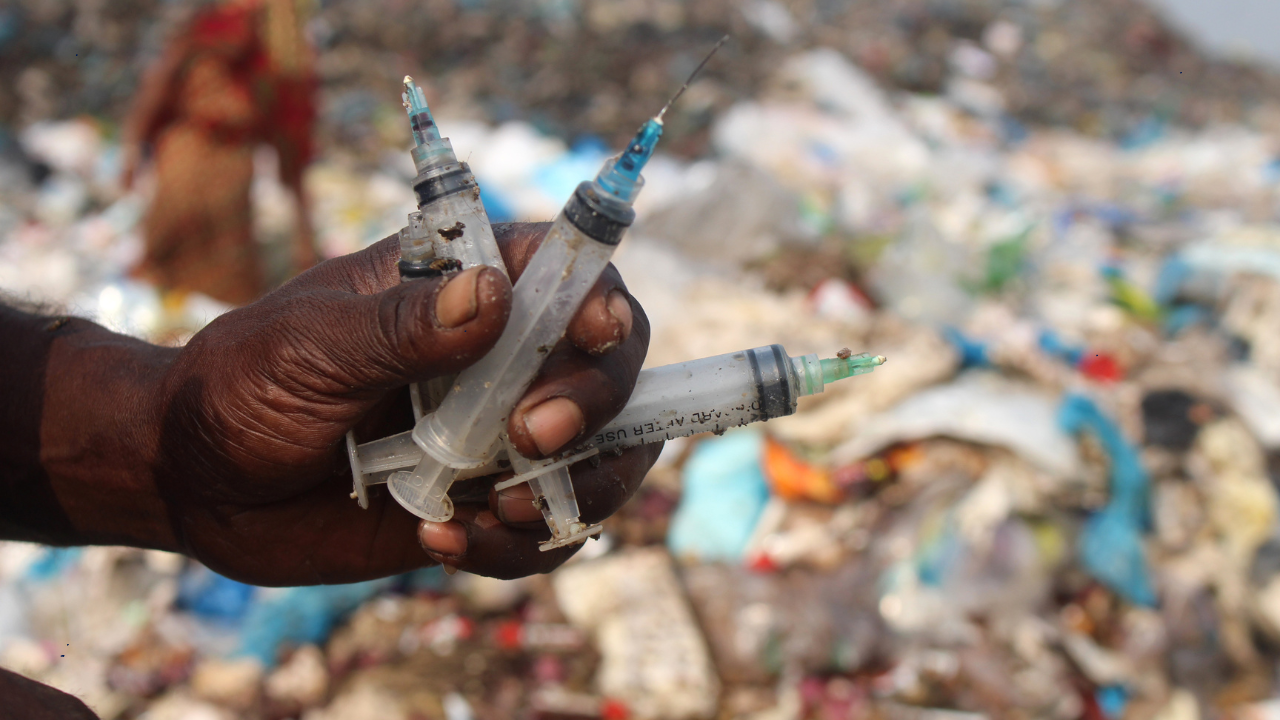
Earlier this week, in shocking news, an investigative BBC report showed that more than 330 children in Pakistan have contracted HIV due to the reuse of syringes in a hospital in Pakistan’s Punjab. The incident captured on camera was filmed over 32 hours inside THQ Taunsa Hospital in late 2025 and showcased persistent unsafe practices, including the reuse of syringes on multi-dose vials, and other unhygienic practices at the healthcare facility. In an interview with HealthandMe, Dr Ishwar Gilada, the President Emeritus of the AIDS Society of India, spoke about how reusing needles raises health risks. The Mumbai-based top infectious disease expert noted that the risk of HIV transmission is much less for reused syringes and that the risk is potentially higher for hepatitis B and hepatitis C. Dr. Gilada, the only Indian serving on the International AIDS Society (IAS) Governing Council, also stressed that the probability of transmission may vary depending on factors such as viral load and the amount of blood present. However, the danger is never zero, he said, stressing the importance of safe and single-use injection practices critical in every healthcare setting. Risks Of Reusing Syringes Dr Gilada noted that all the transfusion-transmissible infections can be transmitted, albeit with lesser chances than blood transfusion. Other than HIV, it can raise the risk of several infections, including: Hepatitis B, Hepatitis C, Syphilis, Malaria, Ebstein-Barr virus infection, Tetanus infection, Septicemia, Bacterial endocarditis.Also read: Reused Syringes Infect Over 330 Children in Pakistan With HIV: ReportImportantly, Dr. Gilada stated that even a tiny amount of infected blood can cause transmission. However, there is a simple principle in microbiology - the chances of transmission are directly proportional to the inoculum."The higher the inoculum, the more the chances. Lower inoculum lowers the risks, but the odds are not zero," the expert added. Does HIV Spread Through Reused Syringes? How? Dr Gilada said that the chances of infections are usually through freshly used needles. "In the needle that was used 15-20 minutes earlier, the blood clots in the bore of the needle. Usually, a drop of blood remains in used needles due to 'capillary action'. "When the same needle is pricked in the new patient, that drop gets mixed with his/her blood by 'surface tension'. The chance of getting HIV infection through such a mix-up is around 0.1per cent if the previous person had HIV," the expert said. However, he added that "it will also depend on the HIV viral load of the source person. Those with high viral load can lead to higher chances, but if the source person is on ART and is virally suppressed, the chances are near zero". Also read: Why India Must Shift Towards Prophylaxis Care For Hemophilia How Can One Prevent? Dr. Gilada said that prevention is only through good hygiene practices, such as:Using spirit to wipe the body part to be injected, Needles should be disposed of in impervious containers. The containers should be disposed of in local municipal facilities Recycling of any type of needles should be a strict no.