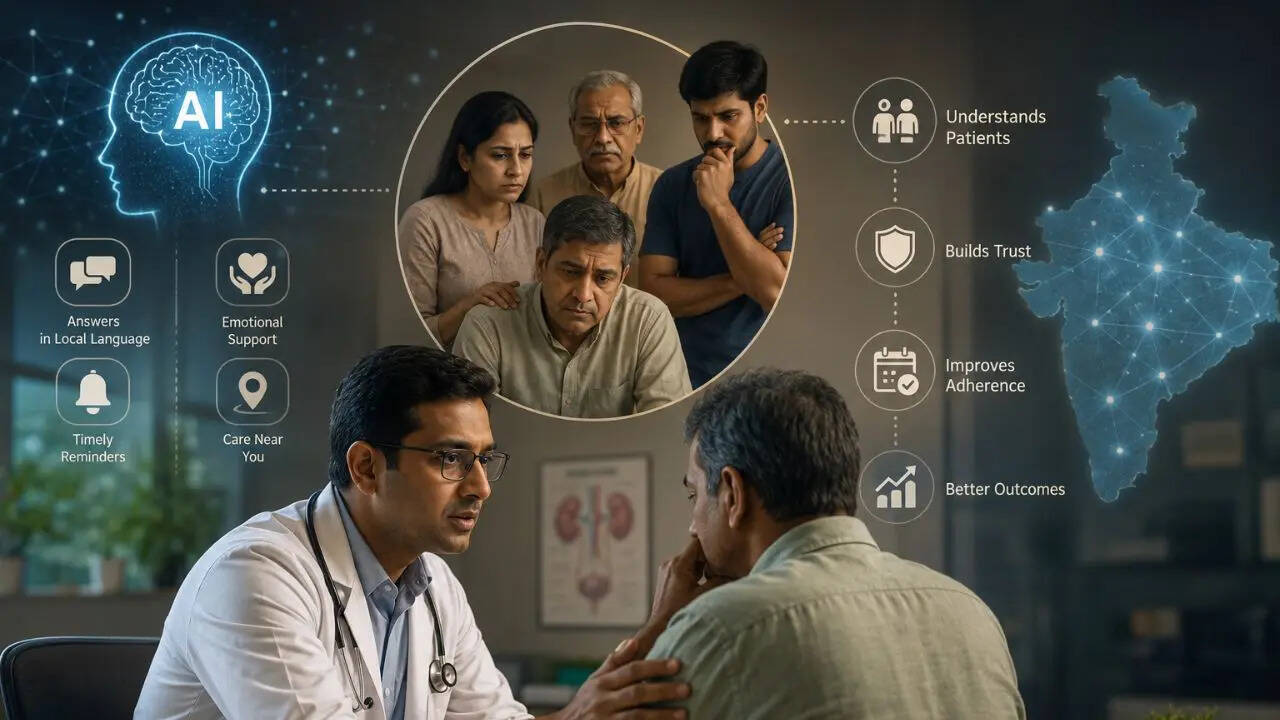
One of the patients I operated on recently had every reason to undergo surgery as early as possible. His reports were clear. His diagnosis was straightforward. From a medical standpoint, there was little ambiguity about the next step. Yet he did not schedule the surgery. Not because he did not trust me or because he wanted another opinion. He simply was not ready. When we spoke again, it was not his cancer that was worrying him, but whether he would be able to leave a normal life after surgery. He was worried about whether his relationship with his wife and becoming a burden on his children. Somewhere along the way, he had also spent a few nights reading forwarded messages and YouTube comments that convinced him life after prostate surgery would never be the same again. None of those fears appeared in his MRI. None of them were mentioned in his blood reports. But every one of them had the power to delay the treatment that could save his life. This is not a rare story in Indian hospitals. It is, in fact, an everyday one. In a country where families, not individuals, usually carry a diagnosis together, these moments happen in almost every cancer ward, every single day. No scan, blood test or surgical robot can detect them. As clinicians, we learn to recognise these patterns almost instinctively. We know which patient is quietly terrified despite appearing calm. We know when a wife is more anxious than the patient himself. We know when a family has understood the diagnosis and when they are simply too overwhelmed, or too far from a good hospital, to process it. The conversation around artificial intelligence in Indian healthcare is missing something important. Efficiency Is Not Where AI Will Matter Most Most discussions here focus on efficiency, and understandably so. India carries a genuine shortage of doctors relative to its population, and the government has been working to close that gap by pushing toward the World Health Organisation's recommended doctor-to-patient ratio. Against that backdrop, it is natural that AI gets framed as a force multiplier: it will reduce documentation, summarise records, automate hospital workflows, help one doctor do the work of three. All of that is valuable, especially for a country of our size and diversity. But efficiency is not where AI will have its greatest impact on Indian healthcare. Its greatest opportunity lies in understanding and supporting human behaviour, at a scale our clinics were never built to handle. India has, over the last few years, quietly built the infrastructure to make this possible. Through the Ayushman Bharat Digital Mission, the country has created one of the largest digital health identity systems anywhere in the world, with digital health accounts now numbering in crores, connecting patients, hospitals, laboratories and pharmacies through a common digital framework. Clinical decision-support tools built on this backbone are already being rolled out across tens of thousands of hospitals, cross-referencing symptoms and treatment protocols while leaving the final call with the doctor. That last part matters more than it might seem. The scaffolding exists. What we build on top of it is still an open question, and it is a question doctors cannot afford to sit out.Also read: Ayush Ministry, IndiaAI Join Hands To Boost AI-Driven Innovation In Traditional Medicine Imagine the Version That Was Built Around the Patient Imagine if the patient who went home after meeting a doctor did not have to rely on midnight searches and forwarded videos to make sense of his diagnosis. Imagine if he could ask questions in Kannada, Hindi, or any other language he was most comfortable in, and get answers grounded in his own treatment plan, not someone else's story from an online forum. In a system where a single specialist may be the only uro-oncologist within reach of several districts, that kind of early flag can be the difference between a curable case and one that is not. None of this replaces medicine. It strengthens it. And this is precisely why Indian doctors need to play a much bigger role in shaping healthcare AI, not as advisors brought in at the end, but as co-architects from the start.Also read: Bryan Johnson's New 2.6M Women's Health Project Centers on Girlfriend's Menstrual Blood Why This Has to Be Doctor-Led, and Why It Has to Be Indian Technology companies are exceptionally good at building software. But they don't spend every day sitting across from a patient whose biggest obstacle is overcoming everything that comes with it: the fear of becoming a financial burden on the family, the silence that comes from a diagnosis nobody wants to say out loud at home, the distance between a district hospital and the nearest oncology centre. Doctors witness those moments every day. We know where patients hesitate. We know which questions never get asked, often because asking them feels like admitting weakness in front of the family. We know where a well-meaning relative's advice, or a health forward on WhatsApp, can undo weeks of careful counselling in a single evening. Those observations are incredibly valuable, and right now, most of them stay locked inside consultation rooms. An AI model trained largely on Western clinical and behavioural data will not automatically understand what it means to deliver a cancer diagnosis in a joint family setup, or why a patient in a smaller town might trust a local health worker's word over a hospital pamphlet, or why "cost of treatment" is often the real first question a patient wants answered but is too hesitant to ask directly. These are not edge cases in India. They are the norm. If Indian doctors don't help shape these systems, we will end up importing tools that are clinically sound but culturally tone-deaf, and patients will simply stop using them. If we want artificial intelligence to genuinely improve healthcare in India, this is where we should begin: not with diseases, but with journeys. Not with technology for its own sake, but with a deeper understanding of how Indian patients and Indian families actually navigate illness. We already have the digital foundation for it. What we need now is for enough doctors, across enough specialities and enough parts of the country, to insist on being in the room when these systems are designed, not just when they are ready to be deployed.