
- Health Conditions A-Z
- Health & Wellness
- Nutrition
- Fitness
- Health News
- Ayurveda
- Videos
- Medicine A-Z
- Parenting
Not Just Bald Spots, Are Beard And Eyebrow Transplants The Next Millennial Beauty Obsession
Credits: Pinterest/iStock
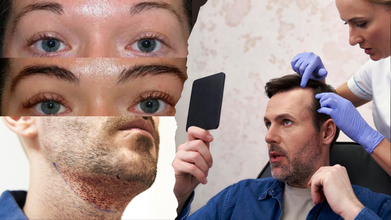
Beards that look sharp on Instagram, eyebrows that frame the face just right, even fuller lashes, hair is no longer about the scalp anymore. Millennials are becoming more and more interested in beard and eyebrow transplants in order to achieve their desired look. The demand is no longer niche, say surgeons, thanks to grooming culture, social media, and new technology making these once-rare procedures mainstream. What this actually means is that hair transplants are moving away from being corrective bald spot fixings to being a cosmetic option, nearly like fillers or Botox.
For decades, hair transplants were linked almost solely to scalp baldness, furtively discussed and reserved for men fighting male pattern hair loss. Skip forward to 2025, and the discussion has widened exponentially. Now, beard, eyebrow, and even body hair transplants are not merely available but increasingly popular across gender and age boundaries. What was once a niche or even an extreme surgery has entered mainstream cosmetic and reconstructive medicine.
Cultural grooming and identity trends have redefined hair restoration demand. Thick eyebrows, which were plucked thin back in the 1990s and early 2000s, are now the standard of beauty. Social media and celebrity culture have further fueled the popularity of full brows, encouraging both men and women to undergo eyebrow transplants to obtain definition and fullness.
Beards also went from being an afterthought to a strategic style choice. A thick, even beard has long been considered a sign of masculinity and confidence, and frustrated men are increasingly seeking out surgical solutions. According to board-certified plastic surgeon Dr. Mayank Singh, "Hair restoration is no longer just restricted to the scalp these days. There has been a significant increase in demand for beard, eyebrow, and body hair transplants in recent years." Though most still equate transplants with hair loss, the surgery has developed into one of the most rapidly expanding trends in cosmetic medicine.
Who Is Selecting Beard And Eyebrow Transplant Procedures?
The demographic spread is wider than one might expect. Women with naturally thin brows, those who lost eyebrow hair due to alopecia, thyroid disorders, or chemotherapy, and even individuals with facial scars are seeking eyebrow restoration not just for beauty but for function—eyebrows help protect the eyes from sweat and debris.
Beard transplants, on the other hand, are most prevalent among males between their 20s and 40s. Some simply desire a fuller beard for looks, others are covering areas of thinning, and for many transmen, beard transplantation is a key aspect of gender identity confirmation. Such reasons are more than fashion, bordering on self-concept, confidence, and cultural significance.
What Is The Artistry Behind Transplants?
Unlike hair transplants on the scalp, face hair transplants require an added degree of accuracy. Transplanted hair angle, direction, and density need to be in sync with natural growth direction and the person's facial structure. Eyebrows are especially fussy. One millimeter of error can make all the difference in expression and balance.
That's the reason why decent clinics place equal stress on surgery and art. Since Dr. Singh explains, not all demands are possible, "Dramatic demands—such as for unnaturally thick body hair or transplants to unusual places—call for serious thought. Ethical professionals always consider safety, long-term results, and if the look will be natural."
More Than Vanity What Is The Medical and Practical Motivation For These Procedures?
Although most of these procedures are done for aesthetics, the medical indications are equally significant. Loss of eyebrow hair through burns, trauma, or autoimmune disorders can impact function as well as appearance. Beard transplants, likewise, can replace hair destroyed by scarring or trauma. Here, the procedure is more about making a person look and act normal again and gaining confidence rather than sheer fashion.
Are Body Hair Transplants The Outer Edge of the Trend?
One of the more unexpected trends is the request for body hair transplants. Chest, arm, and even lower body hair restoration have been requested. Although not common, they highlight how grooming standards differ across cultures and individuals. For surgeons, though, these types of unusual cases raise ethical concerns. Priority must be placed on ensuring procedures are safe, medically warranted, and provide realistic results.
Permanency and Aftercare
One of the most important questions patients have is if hair that is transplanted is permanent. The answer is yes—since donor hair comes from the scalp, a region that is genetically thinning-resistant, so no thinning will occur. The hair will grow normally once it is transplanted in its new position.
That being the case, aftercare is a little different. Eyebrow transplants, as an example, employ scalp hairs that grow longer and faster, needing to be trimmed regularly. Beard transplants require strict short-term aftercare to avoid infection and graft survival but, once healed, become a routine part of grooming. Body hair transplants vary depending on location but in most cases work by the same principle of permanence.
Role of Social Media and Pop Culture
The boom in such procedures cannot be divorced from the role of pop culture. Trends in grooming, especially those amplified on TikTok and Instagram, have made cosmetic treatments the new norm. Celebrities with thick brows or highly groomed beards provide aspirational benchmarks which filter into day-to-day style.
But it's not simply about keeping up appearances. For many patients, the choice is more about identity, self-expression, and confidence issues. Facial and body hair transplants occupy a different position than scalp hair transplants on the continuum between aesthetic enhancement and empowerment.
Balancing Demand With Responsibility
The rapid growth of these operations has positioned it as one of the most rapidly expanding segments of cosmetic medicine. Nonetheless, surgeons caution. Unrealistic expectations or requests that are based only on fleeting trends may result in disappointment. Ethical practitioners, as Dr. Singh insists, know when to turn down a case, "The goal is always to balance patient expectations with long-term safety and natural-looking results."
With advancing technology, facial and body hair transplants should become even more advanced, with reduced recovery periods and more natural results. Gone are the days when this was whispered about; now it's widely talked about, with clinics claiming record levels of patients consulting for beard, eyebrow, and off-the-scalp procedures.
Hair transplantation's evolution captures a larger trend in the way we think about cosmetic medicine. It's no longer merely a matter of curing baldness but achieving a style that matches one's personality, self-image, and confidence. From facial-framing eyebrows to beards representing virility and maturity, hair restoration is redefining what it means to assume command of one's appearance.
The emergence of beard, eyebrow, and body hair transplants is a reflection of how far hair restoration has advanced. Historically confined to baldness on the scalp, today it extends to aesthetics, identity, and function in equivalent proportion. Whether motivated by medical necessity, cultural factor, or simply personal fashion, these surgeries are yielding results that are permanent, natural, and frequently transformative.
Dr Mayank Singh is a board certified plastic surgeon , also a Fellow of ISHRS , exclusively into hair restoration for over 15 years and the Founder of CROWN, New Delhi.
German Study Shows Squirrels May Be Harboring Mpox Virus

Credit: Canva
Squirrels could be natural hosts of the mpox virus (MPXV) -- that causes monkeypox disease -- according to a recent study by German researchers.
The team from the Helmholtz Institute for One Health (HIOH) identified the fire-footed rope squirrel (Funisciurus pyrropus) as a likely natural reservoir of the MPXV.
The study published in the journal Nature revealed that sooty mangabeys – a primate found in West Africa -- can contract mpox by eating infected squirrels. The disease may present mild lesions, but it can also cause more severe skin lesions or even be fatal.
"Identifying the animal sources of the virus and the exposure routes that lead to inter-species transmission are key steps towards understanding spillover mechanisms and developing effective prevention measures to mitigate the risk of transmission to humans," said Livia V. Patrono, one of the senior authors at HIOH.
Squirrels Suspected MPXV Hosts
While squirrels have long been suspected as potential reservoirs for MPXV, their role was confirmed after an investigation of an mpox outbreak among wild sooty mangabeys (Cercocebus atys) in Côte d'Ivoire.
During the outbreak, reported in early 2023, nearly one-third of the primates showed clinical signs of disease, and four infants died.
The team conducted viral genome sequencing and found that the infected monkeys carried a virus that was nearly identical to an MPXV strain identified in a fire-footed rope squirrel found dead 12 weeks earlier nearby.
Further, the team analyzed fecal samples from the mangabeys. A sample collected eight weeks before the outbreak's onset contained DNA from both the virus and the rope squirrel. This provided strong evidence of interspecies transmission at that moment.
Sooty mangabeys have been previously observed catching and eating fire-footed rope squirrels, which provide a direct route for the transmission of viruses.
Mpox Continues To Spread Globally
Although mpox is no longer a public health emergency, outbreaks of clade I and clade II strains of the mpox virus are continuing in many countries around the world, especially in Africa.
Last week, Madagascar announced the country's first death from mpox, a 3-year-old girl from the island nation’s eastern city of Toamasina.
The WHO has also confirmed that two cases of the recombinant strain – combining genomic elements of clades Ib and IIb of the monkeypox virus (MPXV) – have been identified to date: one in the United Kingdom and one in India.
Mpox is an infectious disease caused by the monkeypox virus (MPXV), part of the Orthopoxvirus genus, which also includes the virus that causes smallpox.
It spreads through close physical contact, including sexual contact, and in some cases through contaminated materials or respiratory droplets.
Symptoms typically include fever, swollen lymph nodes, rash, and/or lesions.
The global health body has also urged all countries to “remain alert to the possibility of MPXV genetic recombination.” It has also urged for continued epidemiological surveillance, sequencing, vaccination of at-risk groups, and infection prevention and control measures.
This AI Tool Predicts Women’s Breast Cancer Risk Up to Four Years
Credit: Canva
An international group of scientists has created an artificial intelligence tool that can estimate a woman’s likelihood of developing breast cancer within the next four years.
The AI tool, known as the BRAIx risk score, analyzes mammogram images to generate an individualized risk assessment and flag women who may face a higher chance of developing the disease.
It may not only show the current risk but also predict the future risk, enabling early detection and treatments for a better outcome.
According to the findings published in The Lancet Digital Health journal, nearly one in 10 women ranked in the top 2 percent of risk by the AI tool were diagnosed with breast cancer within four years. This was despite previously receiving a clear screening result.
“These risk scores enable future development of personalized screening pathways to transform population breast cancer screening and save lives,” said corresponding author Helen M. L. Frazer of the University of Melbourne.
Frazer noted that identifying women who appear cancer-free but carry very high risk -- comparable to those with inherited BRCA1 or BRCA2 mutations -- will unravel both hereditary and non-hereditary causes of breast cancer.
From one-size-fits-all screening to personalization
Breast cancer screening programs have significantly lowered mortality rates -- by roughly 40-50 percent among women aged 50 to 74. However, most screening systems still apply the same approach to all women, regardless of individual risk.
Traditional screening tools use genetics, breast density, and questionnaires to estimate breast cancer risk. On the other hand, new AI-based screening tools, such as BRAIx personalizes screening by gathering information already present in breast scan images to better identify who is at higher risk.
“Our results show that conventional mammographic density is a far weaker predictor of breast cancer risk than the BRAIx risk score, even for interval cancers,” the researchers said in the paper. Interval cancers are aggressive tumors diagnosed after a negative mammogram.
The BRAIx Tool
The BRAIx risk score was developed using mammograms from nearly 400,000 women. To prove its efficacy, the AI tool was tested on data from almost 96,000 women from Australia and then confirmed in an independent Swedish population of over 4,500 women.
The findings showed that:
- The BRAIx risk score estimated breast cancer risk more accurately than the traditional risk factors, such as breast density, country of birth, and even family history.
- For the top 2 percent of women with the highest BRAIx risk score, the probability of a cancer diagnosis within 4 years was 9.7 percent -- a risk level exceeding that typically seen in women with inherited BRCA1 or BRCA2 mutations.
The BRAIx risk score can:
- Make breast screening more personalised,
- Improve early cancer detection,
- Reduce false alarms,
- Save lives without increasing costs
Global Breast Cancer Burden
Breast cancer continues to be the most common cancer among women worldwide.
A recent study published in The Lancet Oncology journal predicted that the number of new cases of the deadly disease will reach more than 3.5 million globally in 2050 -- rising by a third from 2.3 million in 2023.
Annual deaths from the disease will also rise by 44 percent -- from around 764,000 to 1.4 million.
However, not smoking, getting sufficient physical activity, lowering red meat consumption, and having a healthy weight can help prevent over a quarter of healthy years lost to illness and premature death from breast cancer.
COVID Survivors At Nearly Fivefold Risk Of Kidney Failure: Study
Credit: Canva
People who survived a COVID-19 infection can be at significant risk for kidney disease, acute kidney injury, and chronic kidney disease. compared to individuals who were not infected, according to a study.
The study, published online in the journal Communications Medicine, revealed that COVID patients have
- a 2.3-times higher risk of acute kidney injury
- a 1.4-times higher risk of chronic kidney disease
- a 4.7 times higher risk of kidney failure
“While we’re in the post-pandemic era, this shows that COVID-19 history is an important variable when considering the long-term impact of the infection on kidney function and disease,” said first author Yue Zhang, who was at Pennsylvania State University, US, while conducting the study. Zhang is currently a postdoctoral scholar at Johns Hopkins Bloomberg School of Public Health.
How Was The Study Conducted?
For the study, data on over 3 million working-age adults in the United States were analyzed.
The team compared the effect of influenza, another common viral infection that affects kidney health, and people with a history of COVID infection on kidney infections.
Using a machine learning model, the individuals were followed between 180 and 540 days for the emergence of new acute or sudden kidney disease.
The results showed that:
- Both COVID and the flu can worsen kidney health
- Flu caused a mild and temporary effect
- COVID increased the risk of acute kidney injury for a longer duration
- COVID survivors developed kidney disease within a few hours to a few days
- COVID patients had a longer-term chronic and end-stage kidney disease.
How COVID Worsens Kidneys Health
The Penn State researchers explained that kidney cells express high levels of the primary protein receptors that SARS-CoV-2 uses to enter and infect cells. Kidney cells also produce specialized enzymes that help viruses enter cells.
According to Kidney Health Australia, an acute COVID infection can impact the kidneys with fevers and respiratory symptoms, and/or worsening blood sugar control.
The US National Institutes of Health stated that renal dysfunction is an increasing clinical indicator of COVID propagation.
Citing several studies, the NIH said that the most common clinical manifestation is proteinuria -- found in more than half of the COVID patients. In addition, hematuria, elevated blood urea nitrogen, and elevated serum creatinine are other common features in Covid survivors with poor kidney health.
Nasr Ghahramani, Professor of Medicine at Penn State College of Medicine, stressed the need for COVID survivors, especially those with diabetes and high blood pressure, to take "more frequent and more prolonged monitoring of their kidney function" to enable early detection and better outcomes.
- Follow Us :


© 2024 Bennett, Coleman & Company Limited