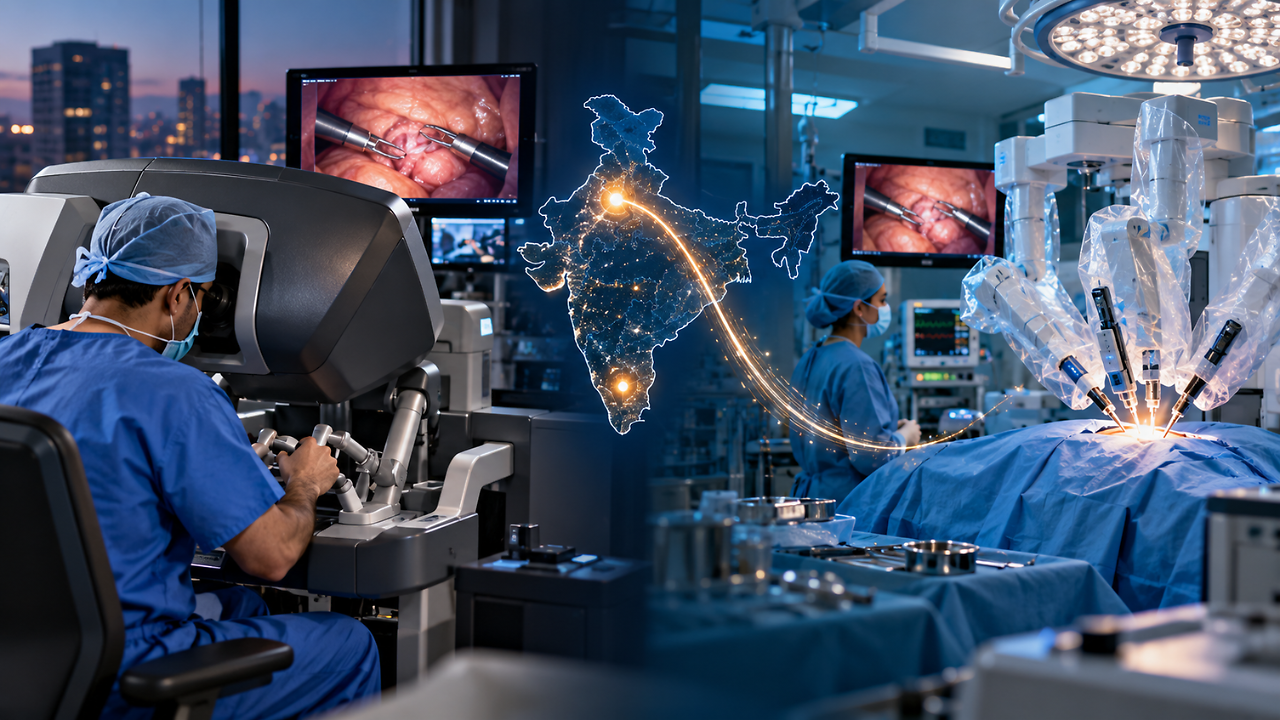
A surgeon, sitting hundreds of kilometres away, can now operate on a patient undergoing complex procedure by controlling a robotic system. This is no longer just an inexplicable futuristic idea. India has already seen a major development in robotic telesurgery, as doctors explore whether advanced surgical systems can help connect specialist surgeons with patients in different cities where such expertise may not be accessible. According to data presented at the Society of Robotic Surgery (SRS) India 2026 conference in New Delhi, the development comes as robotic surgery itself is expanding rapidly across India. Delhi NCR has emerged as the country's leading hub for robotic surgery. Addressing the SRS India 2026 Conference virtually, Union Minister for Health and Family Welfare Shri J.P. Nadda said "Today India stands at an exciting juncture in the healthcare innovation, with our strength in technology, Artificial Intelligence, digital health and a rapidly expanding ecosystem of surgical robotics, we have opportunity, not nearly to adopt the technology of the future but innovate ,develop and lead. India is increasingly becoming an important global destination for healthcare innovation and advance surgical technology. I congratulate organizers for bringing this important international conference to India."Delhi NCR Sees Five-Fold Increase In Robotic Surgeries According to the conference data, 39 hospitals in Delhi NCR now have robotic systems, while 11 hospitals have more than one system. The number of robotic-assisted procedures in the region has also increased from 2,257 in 2021 to 10,937 in 2025. Across India, the growth in robotic surgical procedures increased from 8,912 in 2021 to 44,857 in 2025. Urology accounted for about 30.2% of robotic procedures in Delhi NCR in 2025, while general surgery-benign procedures made up around 33% and gynaecology 22.1%. Dr. Vivek Bindal, Organising Chairman, SRS India and Principal Director & Head, Department of Minimal Access, Bariatric & Robotic Surgery, Max Hospital, New Delhi, said, “Delhi NCR has emerged as a leading force in India’s robotic surgery journey, with the highest concentration of robotic-system installations in the country and a rapidly expanding volume of procedures. The presence of robotic systems across 39 hospitals, including 11 hospitals with multiple systems, reflects the depth of expertise and institutional adoption that has developed in the region."He added, "Delhi has reached this position because of the combined efforts of pioneering surgeons, high-volume hospitals and multidisciplinary teams that have steadily integrated robotic technology into complex surgical care. What we are witnessing is not simply an increase in machines or procedures, but the emergence of Delhi as a centre that is helping shape the future of robotic surgery in India."Also read: Robotics Set to Transform Every Medical Specialty, From Diagnostics to Therapy in India: Jitendra SinghIndia's First Government-Institution Robotic Telesurgery Prof. Dr. Anup Kumar, Professor & Head, Department of Urology, Robotics & Renal Transplant, VMMC & Safdarjung Hospital, New Delhi, recently performed India's first government-institution robotic telesurgery in urology. The reconstructive procedure was performed remotely from Gurugram to Preeti Kidney & Urology Hospital in Hyderabad. The accomplishment has raised the possibility of specialist surgeons operating on patients who are located in smaller cities with limited resources and access.Also read: 22-Year-Old Woman Undergoes Robotic Heart Surgery After Two Strokes and Months of Delayed Treatment Scope For Telesurgery India's major cities have increasingly developed robotic surgery infrastructure and specialist teams. But access to highly specialised surgeons is not evenly distributed across the country. If remote robotic surgery can be safely scaled, a specialist in a major medical centre could operate on a patient in another city through a connected robotic system. Dr. Anup Kumar said, “India is now at a defining moment in robotic surgery. The rapid rise in robotic procedures—from 8,912 nationally in 2021 to 44,857 in 2025—shows how quickly the technology is being adopted and how clinical expertise is expanding across the country. India is moving beyond being a technology adopter and is developing the experience, infrastructure and surgical capabilities required to become a global force in robotic surgery. If this momentum continues, India has the potential to emerge as a global leader by 2030 and compete with, and potentially surpass, established leaders such as the US. This is a proud moment for Indian healthcare and a significant opportunity to place India at the forefront of the next generation of surgery.”Robotic telesurgery could also have other advantages besides bridging location gaps. The technology could support remote surgical training, tele-mentoring and collaboration between specialists when needed. The SRS India 2026 conference also showcased a cross-border robotic telesurgery demonstration between India and China. Dr. Vivek Bindal led the demonstration, with surgeons at Max Super Speciality Hospital, Vaishali, remotely operating a robotic console nearly 5,000 kilometres away in Chengdu, China during pre-clinical procedures. How Can This Technology Become Routine? Remote surgery requires more than a robotic surgical machine and a fast internet connection. The international consensus recommendations published in the World Journal of Surgery in 2026 address issues including connectivity, cybersecurity, surgeon training, credentialing, emergency preparedness and regulation. There also needs to be a clear plan for what happens if the connection fails or the patient develops an unexpected complication during surgery. For India, the technology could eventually help narrow the gap between where specialist surgeons are located and where patients live. But for that to happen, telesurgery will need strong infrastructure, trained teams, reliable connectivity and carefully defined safety protocols.