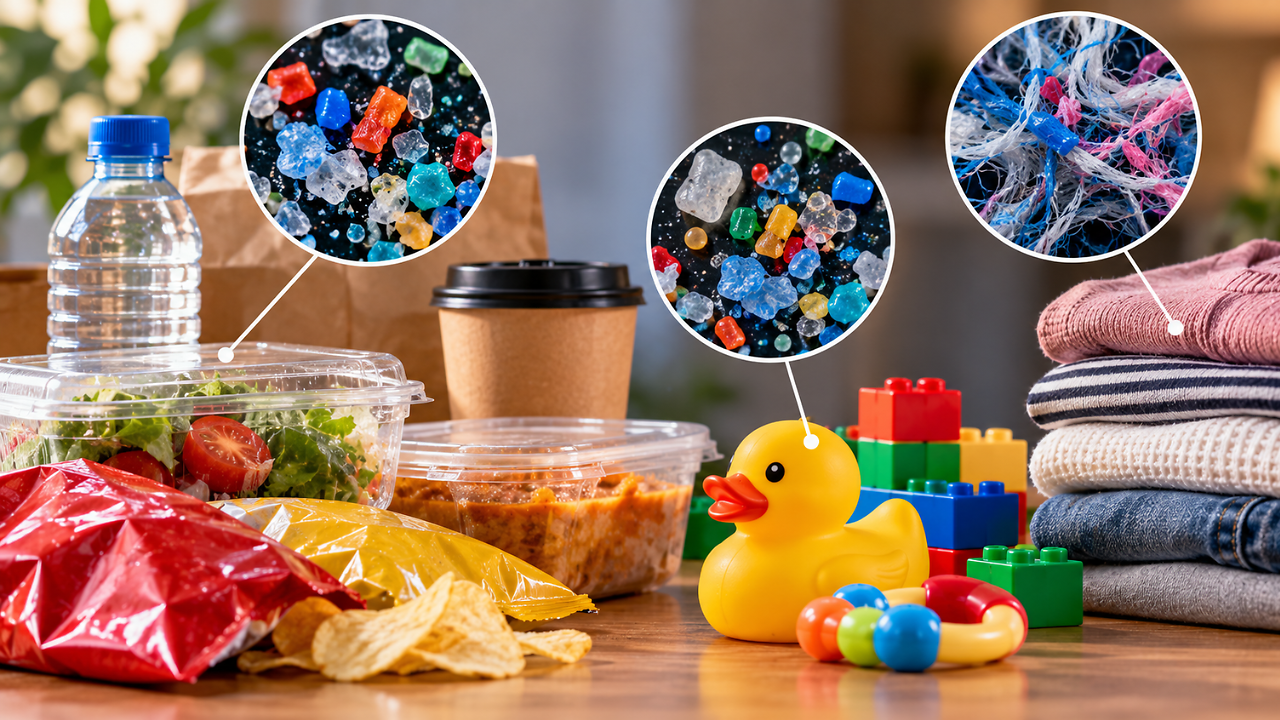
Plastics are everywhere today. It is woven into our clothes, tucked into children's toys, used in food containers, and found in almost every household products. A new analysis has raised concerns about the chemicals used to make these products and the health hazards due to constant exposure. According to an investigation reported by CNN, nearly 93% of known plastic chemicals used in everyday products were classified as posing a high risk to human health. The analysis looked at plastics used in food-contact materials, toys, clothing and textiles, household products, and hygiene and medical products. The findings highlight how widespread exposure to hazardous chemicals can affect our health and how much remains unknown about their long-term effects. Exposure To Plastic Chemicals A researcher at Environmental Justice Foundation, Naima Fenderl’s Poison Plastics: How Chemicals in Everyday Plastics are Harming Your Health released recently and revealed astounding facts about plastic chemicals. She said, “We looked at what these plastic chemicals can do to the body along with exposure levels to calculate overall health risk.” The analysis found that: Nearly 92% of chemicals in food-related plastics were considered high risk.Almost 89% of children's toys contained high-risk plastics.Around 93% of textiles and clothing involved dangerous chemicals.More than 92% of common household products contained high-risk chemicals.Nearly 93% of hygiene and medical plastics contained potentially dangerous chemicals. The chemicals are not necessarily the plastic itself. Many are additives that are used to make plastics flexible, durable, heat-resistant, or less likely to catch fire.Also read: Botox And Fillers: UK Watchdog Says Clinics Should Check Mental Health Before Injecting Health Problems Caused By Plastic Chemicals Some plastic chemicals have been linked to cancer, genetic changes and problems affecting the hormonal, reproductive and organ systems. Among the chemicals of concern are bisphenols, phthalates, and PFAS, which can be used in different plastic products. Some of these chemicals can interfere with the body's endocrine system, which controls hormones involved in metabolism, reproduction, growth, and development. The concern is important for children and during pregnancy because hormonal systems and organ development may be more vulnerable to certain chemical exposures. The report also highlighted the challenge of lack of sufficient data to certainly assess health risks posed by these plastic chemicals. Almost 80% of the 3,552 chemicals in plastics people often use everyday lacked sufficient data to understand health risks. “We simply do not have a clue what harm those chemicals might be causing us and our kids,” Dr. Philip Landrigan, director of the Global Observatory on Planetary Health and the Program for Global Public Health and the Common Good at Boston College told CNN. He added, “We don’t even know the names or composition of a lot of the chemicals that are in consumer products — the chemical industry presumably has that information, but it’s not publicly available.”Also read: World Environment Day 2025: Everyday Habits That Are Harming The Earth And Your Health Microplastics Are Part Of The Problem Too Chemical exposure is only one part of the plastic problem. Tiny plastic particles, known as microplastics, and even smaller nanoplastics, can also enter our bodies through food and water. University of Columbia released an analysis of plastic bottled water based on a laser-based highly sensitive imaging technique. It found an average of around 240,000 plastic particles per litre, with most nanoplastics. These particles can come from the bottle, the cap, manufacturing, and handling. Opening and closing the bottle repeatedly can also create friction between the cap and bottle neck, releasing tiny plastic fragments. Larger particles are generally expected to pass through the digestive system. But nanoplastics are small enough to cross biological barriers. Research has found that plastic particles can reach the circulatory system and other tissues, but scientists still do not know exactly which particles cross these barriers most easily, how much accumulates in the body or what level of exposure causes harm. What Is The Solution? Quitting using plastic entirely is not practical for most people. Instead, reducing avoidable exposure could be a sensible approach. Avoid heating food in plastic containers, particularly when the container is not designed for high temperatures. Using glass or stainless steel for hot food and drinks can also reduce reliance on plastic food-contact materials. Filtration or boiling of drinking water may help reduce some microplastics. But doctors believe that heat may only alter some plastic particles, not destroy them completely.