
- Health Conditions A-Z
- Health & Wellness
- Nutrition
- Fitness
- Health News
- Ayurveda
- Videos
- Medicine A-Z
- Parenting
Weight Loss Jabs: What Happens To Your Body When You Stop Taking Them?
Credits: Canva
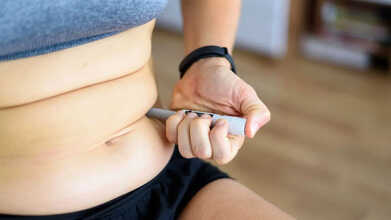
Weight-loss jabs, or GLP-1 receptor agonists, have provided many people with results that diets alone could not achieve. For those struggling with constant cravings, these medications have quieted the persistent “food noise” that often drives overeating. They have transformed not only body shapes but also self-confidence and daily habits.
Yet questions remain: can people safely stop taking these drugs, and what happens to the body when they do? These are still largely unknown, as the drugs are relatively new. GLP-1s mimic a natural hormone that controls hunger, but the long-term effects are only beginning to be understood. Additionally, for the estimated 1.5 million people in the UK paying privately for these injections, maintaining treatment can be costly.
Two women, Tanya and Ellen, share their personal experiences with the BBC on weight-loss jabs and what life was like when they attempted to stop.
Weight Loss Jabs: Tanya Hall’s Experience
Tanya, a sales manager in the fitness industry, initially started taking Wegovy to challenge her own perceptions about weight and authority. She often felt overlooked or undervalued because of her size, and hoped that losing weight would change how others treated her, as per BBC.
Early in treatment, Tanya experienced side effects including nausea, headaches, sleep issues, and hair loss, which she describes as clumps coming out. Despite this, she steadily lost weight—six stone (38 kg) over 18 months—and the injections quieted the relentless urge to eat.
However, every time she tried to stop, her appetite surged within days, leaving her horrified at her own eating. Now, Tanya continues the medication, feeling it has become essential to maintaining her weight and the confidence it brings.
Weight Loss Jabs: What Happens To Your Body When You Stop Taking Them?
Wegovy’s manufacturer, Novo Nordisk, stresses that treatment decisions should be made with medical guidance and that side effects must be considered. Lifestyle GP Dr. Hussain Al-Zubaidi likens stopping GLP-1s abruptly to being hit by a “tsunami” of hunger.
Research shows that within one to three years of stopping these medications, people can regain 60–80% of the weight they lost. This highlights how these drugs work not just by reducing appetite temporarily but by fundamentally altering hunger cues.
Weight Loss Jabs: Ellen Ogley’s Journey
Ellen turned to Mounjaro after reaching a critical point in her life. Her weight had put her at risk during surgery, and emotional binge eating dominated her daily habits. Once on the medication, Ellen noticed her compulsive eating completely stopped.
Over 16 weeks, she lost 3 st 7 lb (22 kg) and began tapering off the injections over six weeks. She focused on developing a healthier relationship with food, creating balanced meals, and incorporating exercise into her routine. Despite some weight creep after stopping, she has since lost a total of 51 kg and now feels confident her habits are sustainable.
Weight Loss Jabs: The Importance of Support
Dr. Al-Zubaidi emphasizes that exiting GLP-1 treatment safely requires guidance and long-term support. NICE recommends at least a year of tailored advice after stopping injections to help individuals maintain their weight and prevent relapse, as per BBC.
For patients paying privately, such structured support may not always be available, increasing the risk of regaining weight. Lifestyle, mindset, and environmental factors play a significant role in long-term outcomes.
Tanya has chosen to continue with her medication, aware of the pros and cons, while Ellen has closed that chapter and built a sustainable routine for life after Mounjaro.
Weight-loss jabs can dramatically change appetite and body weight, but stopping them can be challenging. The transition off these drugs requires careful planning, support, and lifestyle adjustments. As Tanya and Ellen’s experiences show, the journey varies by individual, and long-term strategies are essential to maintaining health and weight loss results.
Eli Lilly, the manufacturer of Mounjaro, states that patient safety is its top priority and that it continually monitors and reports information on treatment outcomes to regulators and prescribers.
Flu Cases Surge Across The US: How Long Does The Super Flu Remain Contagious?

Credits: Canva
Flu Symptoms: Seasonal infections are spreading across the United States just as the holiday travel rush gets underway, worrying health officials about fresh spikes during family get-togethers. Flu and norovirus cases are rising in several states, while COVID-19 continues to circulate at lower but consistent levels. Together, these illnesses are adding strain on hospitals as millions of people plan to travel in the days ahead.
Flu: What Is Super Flu?
“Super flu” is not a clinical term, but it is often used to describe a flu season that feels more aggressive or spreads faster than usual. This is typically linked to a dominant strain of influenza A. The current surge is being driven by a mutated influenza A strain known as H3N2 subclade K. Health officials say this strain has become the leading flu variant in the US, accounting for roughly 89 percent of H3N2 samples analysed since late September, according to genetic sequencing data from the Centers for Disease Control and Prevention (CDC).
This variant emerged after the 2025–26 flu vaccine was formulated, meaning the vaccine may not be as closely matched as in earlier seasons. While the shot still offers protection against severe disease, experts note that the mismatch could allow the virus to spread more easily.
Flu Symptoms 2025: What Symptoms Should People Watch For?
The symptoms seen in the current flu wave are largely familiar. People may develop fever, chills, extreme tiredness, cough, and body aches. Doctors, however, caution that the wider spread could result in more serious cases, particularly among people who are at higher risk.
CDC estimates indicate that the US has already seen about 4.6 million flu cases this season, along with nearly 49,000 hospital admissions and around 1,900 deaths. Flu activity increased sharply in mid-December, with test positivity jumping from 8.1 percent to 14.3 percent within a single week.
Flu Symptoms 2025: How To Reduce The Risk
Doctors recommend staying home when feeling unwell, washing hands often, especially to limit norovirus spread, and considering vaccination against flu and COVID-19. Even when the strain match is not ideal, experts stress that vaccines remain crucial in reducing the risk of severe illness, hospitalisation, and death.
Flu Cases In The US: How Contagious Is Superflu?
In terms of how easily it spreads, it behaves much like regular flu, which is known to be highly contagious.
Someone with flu can pass on the virus from around one day before symptoms appear and continue to be contagious for five to seven days after becoming sick. Children, older adults, and those with weakened immune systems may remain infectious for a longer period.
The virus mainly spreads through respiratory droplets released when an infected person coughs, sneezes, speaks, or breathes near others. It can also spread through contact with contaminated surfaces, followed by touching the mouth, nose, or eyes. Crowded indoor settings, poor airflow, and close contact make transmission far more likely, which explains why flu spreads quickly during peak season.
What makes a so-called “super flu” seem more contagious is not a new way of spreading, but higher case numbers, quicker community transmission, and stronger symptoms, all of which increase coughing, fever, and the amount of virus released.
These 3 Persistent Changes In Your Feet May Be A Sign Of High Cholesterol

Credits: Canva
Raised cholesterol levels do more than strain the heart. They can sharply limit blood circulation to the arms and legs, increasing the risk of serious health problems. High cholesterol is already known to raise the chances of heart attacks and strokes, which makes recognising early warning signs especially important.
Low-density lipoprotein, commonly known as LDL or “bad” cholesterol, builds up along artery walls. Over time, this build-up narrows the blood vessels and increases the likelihood of blockages that can lead to cardiac arrest. According to the NHS, diets high in fatty foods, frequent alcohol intake, and a lack of physical activity are among the main reasons cholesterol levels rise.
Why Symptoms May Appear in the Feet
Although cholesterol is often detected through medical tests, warning signs can sometimes surface in unexpected parts of the body, including the feet. Paying attention to these changes can help doctors identify peripheral artery disease, or PAD, which develops when fatty deposits restrict blood flow. This has been reported by Surrey Live.
The British Heart Foundation explains that as circulation worsens, the body struggles to supply enough oxygen, nutrients, and blood to the skin and surrounding tissues. This problem is most noticeable in the feet, as they are the farthest point from the heart.
Three Serious Foot Symptoms Linked to High Cholesterol
There are three major signs of high cholesterol that may show up in the feet:
- Pain
- Ulcers
- Gangrene
Other PAD Symptoms to Look Out For
People with peripheral artery disease may also notice additional changes, such as:
* Loss of hair on the legs or feet
* Weakness or numbness in the legs
* Toenails that grow slowly or become brittle
* Open sores on the feet or legs that take a long time to heal
* Changes in skin colour, including pale or bluish tones
* Skin that looks shiny
* Erectile dysfunction in men
* Loss of muscle mass in the legs
Lowering cholesterol levels is essential to reduce the risk of PAD and other complications associated with high cholesterol.
It is important to confirm high cholesterol with a healthcare professional, as many people experience few or no symptoms.
A blood test remains the most reliable way to detect high cholesterol, which often goes unnoticed without screening.
When Symptoms Become an Emergency
Symptoms such as foot pain, ulcers, and gangrene may signal a severe form of PAD known as critical limb ischaemia. The British Heart Foundation warns that this condition needs urgent medical treatment to help prevent limb loss.
If a doctor suspects high cholesterol, the NHS advises that a blood test will usually be recommended.
How Cholesterol Is Tested
There are two main ways cholesterol levels can be checked:
* A blood sample taken from the arm
* A finger-prick test
If results confirm high cholesterol, a GP will talk through ways to bring levels down, which may include changes to diet or prescribed medication.
Diet Changes That Can Help
Adjusting what you eat is often one of the most effective ways to reduce cholesterol, as diet is a common cause of high levels. One practical step is to cut back on saturated fats and replace them with unsaturated fats.
Saturated fats are commonly found in foods such as fatty cuts of meat, butter, cheese, and lard. Unsaturated fats, on the other hand, are present in vegetables, nuts, seeds, and plant-based oils.
Apart from that, increasing physical activity can also help manage cholesterol and support overall heart health.
UK health guidelines recommend that adults aim for at least 150 minutes of moderate-intensity activity each week, or 75 minutes of vigorous exercise. Doing more activity, or increasing intensity, can reduce the total time needed. Moderate exercise means your heart rate rises and breathing becomes heavier, but you should still be able to talk without struggling for breath.
One practical way to reach the 150-minute target is to stay active for 30 minutes a day, on at least five days each week.
Flu Symptoms 2025: NHS Warns People With Certain Conditions Face Higher Risk

Credits: Canva
People living with long-term health conditions are among those being urged by the NHS to take a key step as concerns around flu continue to grow. Hospital admissions linked to influenza reached 3,140 by the end of last week, marking the highest level ever recorded for this point in the season and an 18% rise compared to the previous seven days.
NHS Urges People With Long-Term Conditions To Take Action Amid Flu Concerns
Sharing an update on X this afternoon, the NHS said: “Flu can be serious for those at high risk, including children, older adults and people with long-term conditions. 18 million people have had the free NHS flu vaccine, and it’s not too late to get protected. Book via your GP, pharmacy or the NHS App.”
Flu Vaccine Eligibility: Why Flu Vaccination Matters
Flu vaccines are designed to protect against influenza, which can be dangerous and, in some cases, life-threatening for certain groups. Each autumn or early winter, the NHS rolls out these vaccinations for people who are more likely to develop serious complications if they catch the virus.
Flu Vaccine Eligibility: Who Was Eligible From September 1?
Based on guidance from the UK Health Security Agency (UKHSA), six main groups became eligible for the flu vaccine from September 1 this year, with another six groups added from October 1.
From September 1, eligibility included:
- Pregnant women
- All children aged two or three years old on August 31, 2025
- Children with specific long-term health conditions, aged six months to under 18 years
- Primary school children, from reception through Year 6
- Secondary school children, from Year 7 to Year 11
- All children in clinical risk groups aged six months to under 18 years
Flu Vaccine Eligibility: Who became eligible from October 1, 2025?
From October 1, 2025, the following groups were also eligible:
- Everyone aged 65 and over
- Adults aged 18 to 65 with long-term health conditions
- Care home residents
- Carers receiving Carer’s Allowance, or those caring for an elderly or disabled person
- People living with someone who is immunocompromised
- Frontline health and social care workers
How And Where To Get Vaccinated?
The NHS App can be used to check vaccination eligibility. Flu jabs are available through GP practices, selected pharmacies, maternity services, and care homes.
The NHS also notes that health and social care workers may be offered the vaccine at their place of work. Flu vaccinations can be given at the same time as other jabs, including COVID-19 and shingles vaccines.
Commenting on the recent rise in cases, NHS National Medical Director Professor Meghana Pandit said yesterday: “While some parts of the country will be breathing a sigh of relief with flu cases not rising as quickly as feared, we are nowhere near out of the woods yet.
“Combined with the impact of strikes, a stream of winter viruses means many hospitals will be on high alert in the days ahead. But it remains vital that people continue to come forward for NHS care as normal.
“If you need urgent help, dial 999 in an emergency, or use NHS 111 for other care needs. And if you are eligible, please come forward for a jab, it’s not too late.”
Government Appeals To The Public
Health and Social Care Secretary Wes Streeting also addressed the situation, saying: “Flu continues to put significant strain on the NHS, with record numbers of patients in hospital, and frontline services remaining under enormous pressure. I’m appealing to the public to protect yourself and your loved ones by getting your flu jab.
“I want to thank NHS staff who are going above and beyond at the toughest time of year. Thanks to their hard work and careful planning, ambulance handovers are around eight minutes quicker than this time last year.”
- Follow Us :


© 2024 Bennett, Coleman & Company Limited