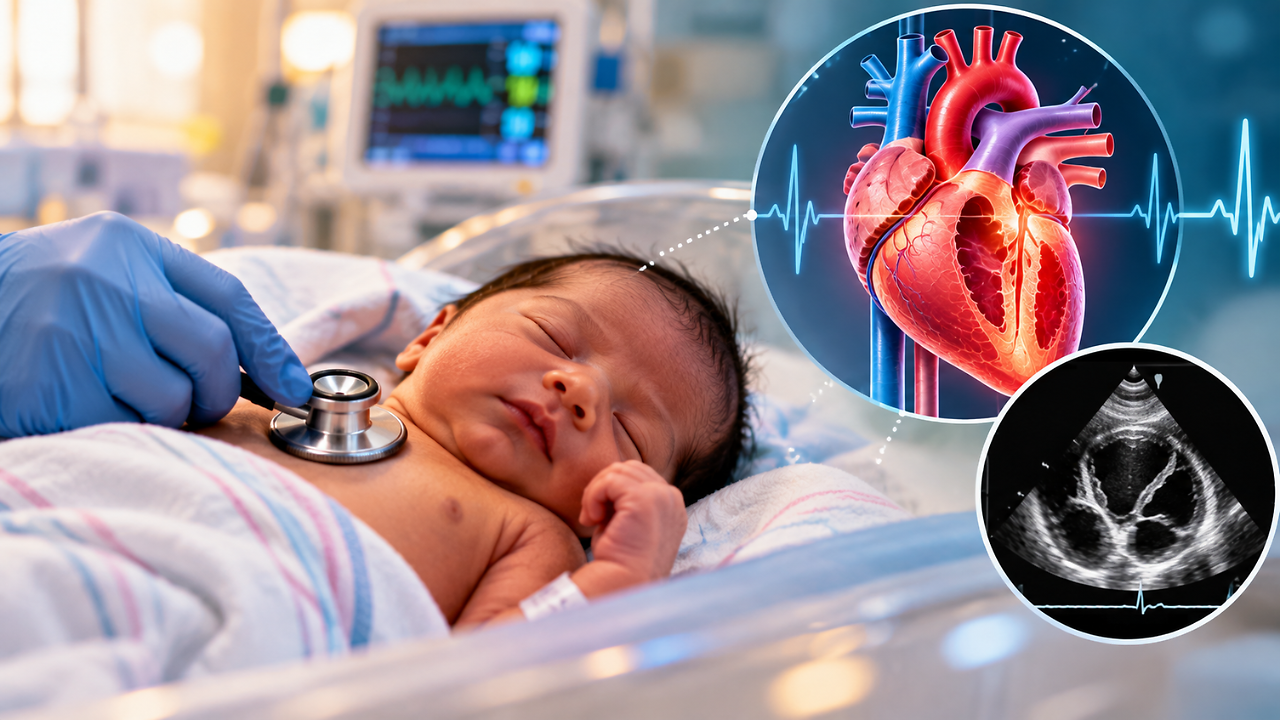
Congenital heart disease (CHD) is not just a paediatric cardiac problem. It is a major public-health challenge. CHD is among the most common birth defects, affecting approximately 8–12 babies per 1,000 live births. In India, with a birth prevalence of around 9 per 1,000, this translates to approximately 2.4 lakh babies being born with CHD every year. Indian consensus guidance has also estimated that CHDs may account for approximately 10% of infant mortality in the country. These numbers make one thing clear: we cannot treat congenital heart disease only after a child becomes sick. We need to find it earlier. And that is where newborn screening becomes a public-health priority. The problem is not only CHD. It is missed CHD. One of the biggest challenges is that a baby with a serious heart defect may look completely healthy at birth. Some critical congenital heart defects may have no obvious signs during the initial newborn examination. A baby may feed normally, have a normal colour and appear ready to go home—only to deteriorate days later when the circulation changes after birth. By then, what could have been a planned referral can become an emergency. This is why “the baby looks fine” cannot be considered a heart check.Also read: Elderly Diabetic With Rock-Hard Arteries Undergoes Advanced Calcium-Breaking Heart Procedure, Avoids High-Risk SurgeryEvery newborn needs more than a visual assessment A careful newborn examination remains essential, but it cannot identify every critical heart defect. This is where pulse oximetry can add another layer of protection. Pulse oximetry is a simple, non-invasive test that measures oxygen saturation. When performed alongside clinical examination, it can help identify babies with critical congenital heart disease who may otherwise be missed. Importantly, pulse oximetry does not diagnose every form of CHD and a normal reading does not rule out all heart defects. It is a screening tool—not a substitute for clinical assessment or echocardiography. Indian studies have demonstrated the potential value of combining clinical examination with pulse oximetry. In one study of asymptomatic newborns, pulse oximetry alone detected 80% of critical CHD cases, clinical examination detected 60%, while combining the two identified all cases in that study.This is where public health policy matters The question should no longer be: “Can we screen some babies?” The question should be: “How do we ensure that no baby is missed simply because screening was not available?” India has already demonstrated that population-level screening can work. Kerala's state-wide newborn programme incorporated pulse oximetry screening into government delivery centres. By 2019, more than 157,000 newborns had been screened, with the programme identifying 134 cases of CHD, including 74 critical cases. This is the kind of approach that needs to move from individual hospital initiatives towards standardised newborn-care pathways across the country. At Cloudnine Hospitals, we have screened more than 3 lakh babies so far. Through this screening, we identified 92 cases of Critical Cyanotic Congenital Heart Disease (CCCHD). These findings highlight the value and cost-effectiveness of routine pulse oximetry screening in newborns.Also read: Menopause & Heart Health: Why This Transition Can Be A Turning Point for A Woman’s Cardiovascular FutureScreening without referral is not enough However, screening is only the first step. A public-health programme must connect the entire chain: Screen → Confirm → Refer → Treat → Follow up A baby who screens positive needs timely access to echocardiography, paediatric cardiology, neonatal stabilisation and, when required, cardiac intervention. This is one of India's biggest challenges. Paediatric cardiac services, specialists, diagnostic facilities and transport systems are unevenly distributed, particularly between urban and rural areas. Indian literature has highlighted the gap between the enormous number of babies who may require cardiac care and the country's capacity to provide timely specialised treatment. Therefore, universal screening without a strong referral and treatment network cannot solve the problem. Early diagnosis changes the equation The good news is that the story of CHD is no longer one of inevitable poor outcomes. With timely diagnosis and access to appropriate treatment, more than 90% of people born with CHD can survive into adulthood with good long-term outcomes. Treatment may include monitoring, medicines, catheter-based procedures, surgery or staged interventions, depending on the defect. The challenge, therefore, is increasingly about closing the gap between what modern medicine can achieve and what a child actually receives. A child cannot benefit from a life-saving cardiac intervention if the heart defect is never detected, if the diagnosis is delayed, or if the family cannot reach the right centre in time.Also read: Stopping Ozempic, Wegovy, Mounjaro Linked To 22% Higher Heart Attack, Stroke Risk: StudyThe message to parents is simple Parents should know that congenital heart disease is not always visible at birth. During pregnancy, recommended antenatal scans can help identify several structural heart abnormalities. After birth, a thorough newborn examination and, where available and appropriate, pulse oximetry screening can provide additional opportunities to detect critical heart disease. Parents should also seek prompt medical attention if their baby develops: Difficulty or rapid breathingBluish or greyish lips or skinPoor feeding or tiring during feedsExcessive sweating while feedingPoor weight gainUnusual lethargy or recurrent episodes of illnessThese signs do not necessarily mean that a baby has CHD, but they should never be ignored. From awareness to action For too long, congenital heart disease has been viewed primarily as a specialist problem. It is time to view it as a newborn-health priority. If approximately 2.4 lakh Indian babies are born with CHD every year, then early identification cannot remain dependent on whether a particular hospital has a screening protocol or whether a family happens to reach a cardiac centre in time. We need standardised newborn screening, trained healthcare professionals, reliable referral pathways, accessible paediatric cardiac services and long-term follow-up. This is what public-health action looks like. Don’t Miss a Beat “Use Heart for Action” should mean more than awareness on World Heart Day. For newborns, it should translate into action at the point where it can make the greatest difference—before a silent heart defect becomes a life-threatening emergency. Each can be an opportunity to detect a problem earlier. We cannot prevent every congenital heart defect. But we can work towards preventing a missed diagnosis from becoming a missed opportunity to save a child's life. Because every newborn deserves a heart check—and when it comes to a baby's heart, we cannot afford to miss a beat.