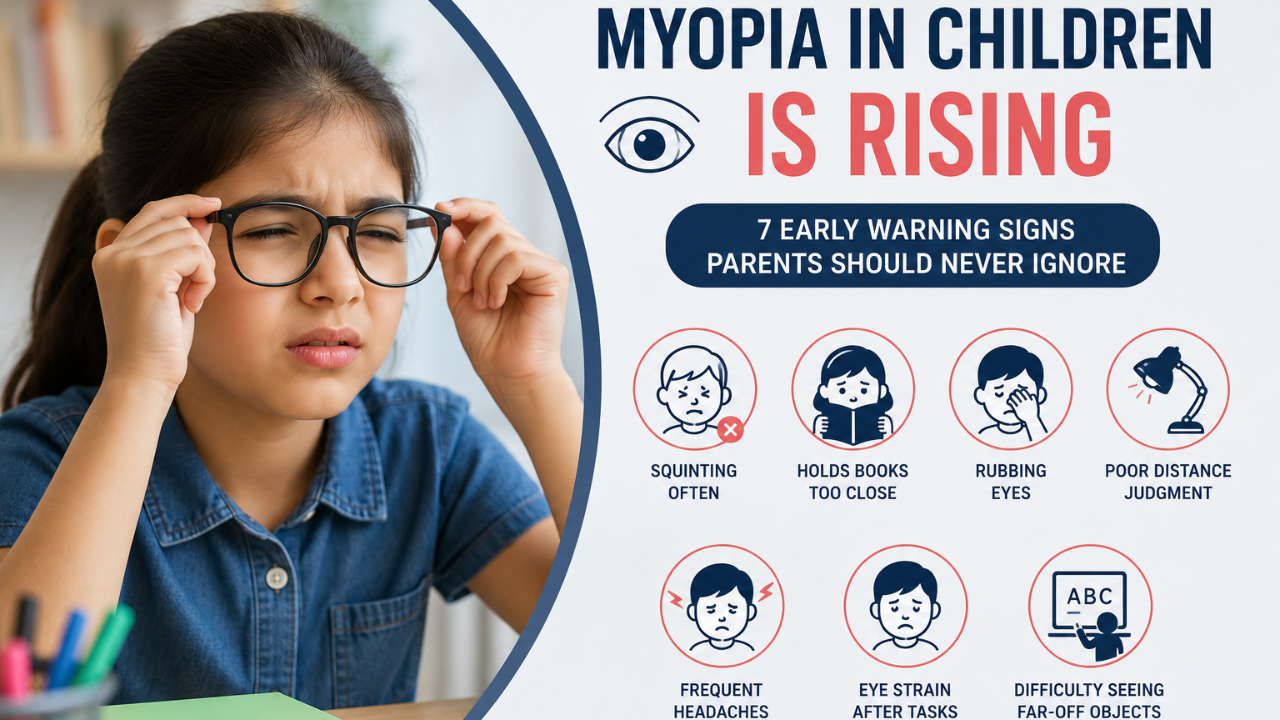
Eye specialists worldwide are raising the alarm, as myopia, or nearsightedness, is on the rise among children at a rate that is making eye doctors and pediatricians reconsider how they assess young patients. What used to be a mild inconvenience that could be corrected with a pair of glasses is now being treated as a long-term health concern. High myopia in childhood is associated with an increased risk of serious eye conditions later in life, including retinal detachment, glaucoma and myopic macular degeneration. This is not just an anecdotal change. Public health professionals say the development is likely due to a variety of causes, including more time spent on screens, less time outdoors, and more strenuous academics, which most online work is entangled with. The good news is that myopia can be controlled if it is discovered early. Optometrists have an expanding toolbox of options, including customized contact lenses, Ayurvedic eye drops, and more time spent outdoors, that can help to delay its advancement in children. The trick is to catch it early. Seven warning flags to look out for as a parent 1. Squinting To See Distant Objects Because myopia often develops gradually, many parents don't realize their child is struggling to see clearly until a school vision screening flags it or until the child is already several dioptres into nearsightedness. A child who consistently squints to read the whiteboard, to watch TV from across the room, or to notice a buddy coming towards them is usually making an instinctive attempt to make a murky image clearer. Squinting alters the shape of the eye's opening for a brief period, which can help bring things that are far away into marginally better focus — but it's a signal, not a solution. 2. Sitting Too Close To TV Or Screens A child who always sits inches from the screen, holds tablets or books very near to their face, or asks for a front-row seat at school may be compensating for trouble seeing things far away.Also read: El Salvador Becomes First Country In Central America To Eliminate Trachoma: WHO 3. Regular Headaches Or Eye Strain Children who have difficulty focusing on things that are far away have eyes to work harder all day. This added stress may manifest as frequent headaches, especially after school, screen time, or reading. 4. Poor Performance In School or Attention Kids don’t usually say, “I can’t see the board. Instead, a sudden dip in grades, difficulties reproducing notes or seeming distracted and uninterested in class can be an ignored symptom of undetected vision problems. 5. Holding Books Or Devices Unusually Close Similar to sitting close to screens, a child who holds a book, tablet, or phone very near their face may be doing so instinctively to bring text into focus. 6. Rubbing Eyes Frequently Or Excessive Blinking While rubbing eyes and blinking can have many causes, when paired with other signs on this list, they can indicate visual fatigue from the eyes constantly trying to compensate for blur.Also read: Tadalafil: Common Male-Potency Drug May Raise Glaucoma Risk In Men, Finds Study 7. Complaints That Things "Look Fuzzy" From A Distance Sometimes the sign is simply the child telling you directly — that the street signs look blurry, that they can't see the ball until it's close, or that faces "look fuzzy" from across the room. These direct complaints are often the clearest signs that your child is experiencing visibility issues. While rubbing eyes and blinking can have many causes, when paired with other signs on this list, they can indicate visual fatigue from the eyes constantly trying to compensate for blur. Why Early Detection Matters Pediatric eye specialists usually advocate regular vision examinations beginning in early childhood and continuing through the school years, as this is the age when myopia most typically first develops and progresses the fastest — between 6 and 12 years of age. If any of the following indicators are noticed, parents are recommended to schedule a full eye exam with an optometrist or eye specialist rather than waiting for the next standard school screening. Common lifestyle adjustments include more unstructured outdoor time, regular breaks during near-work tasks (following the general “20-20-20” guideline of looking at something 20 feet away for 20 seconds every 20 minutes), and proper lighting for reading and homework, alongside professional treatment options.By Dr Mandeep Singh Basu, Ayurvedic Eye Specialist, Dr Basu Eye Care Centre