
- Health Conditions A-Z
- Health & Wellness
- Nutrition
- Fitness
- Health News
- Ayurveda
- Videos
- Medicine A-Z
- Parenting
Can Just 10 Minutes of Exercise Reduce Depression?

Credit: Canva
A new Nature Human Behaviour (2026) study suggests that single-session psychological exercises lasting less than 10 minutes can lead to measurable decreases in depression symptoms even one month later.
Depression is one of the most common mental health disorders in the world. Every year, hundreds of millions of people suffer from depression, and many are unable to get therapy because of cost, stigma and the dearth of mental-health professionals.
Symptoms include excessive sadness, depression often includes fatigue, changes in appetite, sleep disturbances, difficulty concentrating and feelings of hopelessness. Treatment requires professional guidance for diagnosis and management.
A 10-Minute Intervention With Lasting Effects
Researchers conducted one of the largest randomized controlled trials testing short mental-health exercises and recruited 7,505 adults in the United States who were suffering from symptoms of depression and randomly assigned them to one of several short digital interventions or to a control group.All the brief interventions took less than 10 minutes to complete and were designed to teach practical coping skills that are commonly used in psychotherapy. Some exercises helped participants to reframe negative thoughts, while others focused on motivation, goal-setting or making sense of things by helping others. Participants completed surveys measuring their well-being immediately after the session and again one month later.
The results were striking: while many exercises boosted motivation and hope immediately, two interventions - Interactive Cognitive Reappraisal and Finding Focus - showed measurable reductions in depression symptoms even after a month. On average, participants experienced about a four percent greater reduction in depression scores compared with the control group.
Although the improvement may appear small, researchers note that brief, scalable interventions could reach millions of people who currently lack access to mental-health care as they can be completed in a few minutes and delivered online, these exercises may allow people to take initial steps toward better mental health, especially those waiting for professional help or unwilling to ask for help.
The scientists also stressed that these activities are not intended to substitute for therapy, but should be seen as readily available tools to help with emotional health.
Exercise and Mental Health: A Growing Body of Evidence
Previous research also shows that a quick burst of activity can make you feel better from other research too. A British Journal of Health Psychology 2024 study found that just 10 minutes of daily mindfulness practice significantly improved well-being and reduced symptoms of depression and anxiety among more than 1,200 participants from 91 countries.
Similarly, the US National Institutes of Health (2019) reviews suggest that the physical activity itself may help improve mood and depressive symptoms, strengthening the relationship between movement and mental health.
Collectively, these findings suggest that even small doses of mental or physical activity may lead to psychological benefits.
A Small Step That Can Make a Difference
Depression can make people feel trapped and out of control. The good news of the new research is that it suggests that big changes aren’t always necessary to move forward.
Sometimes, doing a small task, like spending 10 minutes learning a new coping skill or doing a quick mental exercise, is enough to change the way you think and gradually improve mood.
As researchers investigate these brief interventions, one thing is becoming clear: when it comes to mental health, few minutes matter more than we think.
Is the Gym Building Your Brain More Than Your Body?

Credit: AI
Exercise at the gym is usually seen as helping people build muscle, lose weight, and generally become physically fit. Nevertheless, contemporary research indicates that exercise is not only good for changing someone's physique but also has a significant impact on someone's brain functioning. Thus, a gym visit is an activity that not only develops your muscles but also strengthens your brain to the same extent.
As soon as people start exercising, endorphins, which are sometimes called the "feel good" hormones, start being released into the body. They help to ease stress, anxiety, and depression while also having a positive impact on mood. Exercise also increases the flow of blood to the brain, which delivers more oxygen and nutrients and promotes proper brain functioning.
The Relationship Between Fitness And Brain Efficiency
Also read: Your Joints Are Working Overtime. Are You Helping Them or Hurting Them?
Moreover, regular workouts help one sleep better. As you know, adequate rest is critical for the brain as it is necessary for its restoration and for developing new memories. In addition, a person who has developed his/her own fitness plan will learn to demonstrate discipline, patience, and set up goals. Achievements in the gym become a source of strength and confidence in other spheres of life.
Although increasing physical strength is one of the most useful outcomes of visiting the gym, the psychological benefits are also very useful. Physical well-being contributes to mental health and allows us to get more energized, concentrated, and emotionally balanced. Regardless of the reason why people work out—whether they want to get in shape, relieve some stress, or perform better at school or work—the visit to the gym will definitely be beneficial.
To conclude, the gym is not only the place to develop physical strength; it is the place where the brain develops as well. By improving our moods, memories, attention, and discipline, exercising shows that we build far more than just physical health.
Your Joints Are Working Overtime. Are You Helping Them or Hurting Them?

Credit: iStock
We spend a lot of time worrying about skin, hair, weight, and even gut health, but we often ignore our joints.
We depend on our joints for every step, squat, staircase climb, and grocery run. Knees alone absorb forces several times body weight during ordinary activities. Globally, an estimated 595 million people were living with osteoarthritis in 2020, roughly 1 in 13 people on the planet, and a 132% increase in total cases since 1990. Alarmingly, many of us are making lifestyle choices that place unnecessary stress on our joints long before we hit our forties or fifties.
While ageing is the main cause of joint pain, stiffness, and reduced mobility, these issues are increasingly showing up in younger adults, too.
Here are five common habits that could be quietly working against your joint health.
Mistake #1: Improper Footwear Choices
It is really important that your footwear has adequate cushioning or support. The impact of every step travels upward through your ankles, knees, hips, and lower back. Your footwear plays the role of a shock absorber. Gradually, repetitive stress placed on your feet contributes to discomfort, especially if you spend long hours standing, walking, commuting, or exercising.
It is important to choose footwear that suits your activity level. If you exercise regularly, make sure your shoes match the type of movement you are doing, and replace them once the support wears out.
Mistake #2: Going All-In on Cardio and Calisthenics Without Guidance
Social media has made fitness more accessible than ever. It's also convinced a lot of people that every workout needs to be intense. High-volume jumping drills, excessive running, deep-impact movements, and advanced calisthenics performed without proper progression can overload joints, tendons, and ligaments. Unlike muscle, the cartilage cushioning your joints has no blood supply and very limited ability to repair itself once damaged, which is why overuse injuries can have lasting consequences rather than simply healing with time.
Joint problems are often linked to poor exercise choices, but inadequate recovery can also impact them. Not giving enough rest, nutrition, or recovery time causes tissues to suffer due to the stress being placed on them, leading to aches, pains, and overuse injuries.
Focus on gradual progression, proper technique, adequate recovery, and a balanced routine that includes strength training, mobility work, and rest days.
Mistake #3: Constantly Cracking Your Knuckles and Joints
While knuckle cracking is not directly responsible for arthritis, habitual and forceful joint manipulation can irritate surrounding soft tissues and become a repetitive stress habit over time.
Medical attention may be required if cracking is accompanied by pain, swelling, locking, or instability.
Mistake #4: Ignoring the Nutrition Side of Joint Health
Many diets fall short on two nutrients that matter a lot for musculoskeletal health: calcium and vitamin D. Calcium builds and maintains bone strength. Vitamin D helps the body absorb and use it. Inadequate intake of either results in weaker bones, in turn causing poor joint health. Excess body weight adds another layer to this. Not just as an added mechanical load on the joints, but because fat tissue actively releases inflammatory compounds that can accelerate cartilage breakdown. This makes joint health a metabolic issue, not just a structural one.
Calcium sources include milk, yoghurt, paneer, cheese, ragi, sesame seeds, tofu, almonds, and green leafy vegetables. Vitamin D sources include safe sunlight exposure, egg yolks, fatty fish, and fortified dairy products.
Mistake #5: Sitting for Most of the Day
Long hours at a desk, extended scrolling sessions, and prolonged sitting can weaken the muscles that support the joints. This leads to stiffness, poor posture, and mobility issues. Inactivity can also set off a compounding cycle: as joints become less stable and more uncomfortable, people tend to move less to avoid pain, which leads to further muscle weakening, reduced joint support, and faster deterioration over time. Standing up regularly, taking walking breaks, stretching between meetings, and using the stairs keep joints mobile and well-supported.
The Bottom Line
Joint health is the result of small decisions made consistently over time: the shoes you wear, how you exercise, what you eat, and how much you move. Most joint problems don't appear overnight, and many of the habits that lead to them can be corrected before they become long-term issues.
(Dr. Deepak Gautam - Sr. Consultant Orthopedic & Robotic Joint Replacement Surgeon, Apollo Hospitals Navi Mumbai)
Beyond Weight Loss: Scientists Discover How Exercise Can Help Reverse Muscle Aging
Credit: AI
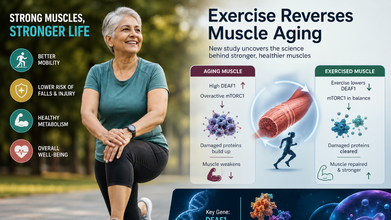
A new study has uncovered how physical activity can help aging muscles repair themselves, explaining why regular exercise remains one of the most powerful tools for healthy aging physiologically.
Exercise Can Help Reverse Muscle Aging: Study
Researchers from Duke-NUS Medical School, working with collaborators from Singapore General Hospital and Cardiff University, found that exercise retains and restores a natural cellular repair system that usually weakens with age.
Their findings, published in the Proceedings of the National Academy of Sciences (PNAS), identify a gene called DEAF1 as a muscle aging element, suggesting it could become useful in therapies for preventing age-related muscle loss.
About The Study
Muscles are essential for regulating metabolism, blood sugar levels, and supporting overall health. However, muscle strength begins to decline as you age, increasing the risk of falls, fractures, and slower recovery from illness or injury.
A cellular growth pathway called mTORC1 plays an important role in maintaining healthy muscles by regulating protein production. But in aging muscles, this pathway becomes overworked.
According to the study, DEAF1 levels increase as muscles age, driving excessive mTORC1 activity and disrupting the balance between building new proteins and clearing away damaged ones. This accelerates muscle deterioration.
Under normal conditions, DEAF1 is kept under control by proteins known as FOXO. However, FOXO activity naturally declines with age, allowing DEAF1 levels to rise unchecked and reduce the muscle's ability to repair itself.
Read more: Bryan Johnson's Autoimmune Gastritis Sheds Light On Iron Deficiency In Americans
Exercise Restores Muscle Health
Exercise can reverse this imbalance significantly if the muscles are still optimal and responsive.
Assistant Professor Tang Hong-Wen, lead author of the study from Duke-NUS Medical School said, “Exercise can reverse this process, correcting the imbalance. Physical activity activates certain proteins which lower DEAF1 levels, bringing the growth pathway back into balance. This allows aging muscles to clear out damaged proteins, rebuild themselves properly, and help them stay stronger and more resilient.”
The researchers believe the results extend beyond normal aging. DEAF1 also affects muscle stem cells, which are responsible for repairing damaged tissue but naturally become less effective with age.
Targeting the gene could potentially improve muscle recovery after surgery, illness, or conditions such as cancer, particularly in people who are unable to exercise.
“Exercise tells muscles to 'clean up and reset.' Lowering DEAF1 helps older muscles regain strength and balance, almost like hitting the rewind button. With millions of older adults at risk of muscle decline, understanding DEAF1 could lead to new ways to protect muscles and improve quality of life,” said Priscillia Choy Sze Mun, first author of the study.
Healthy muscles are essential for far more than movement. They help maintain balance, support metabolism, regulate blood sugar, and enable people to stay independent as they age.
The study also confirms that regular exercise not only strengthens muscles but also helps retain their ability to repair themselves at the cellular level. In short, staying physically active remains one of the most effective ways to protect muscle health and promote healthy aging.
- Follow Us :


© 2024 Bennett, Coleman & Company Limited