
- Health Conditions A-Z
- Health & Wellness
- Nutrition
- Fitness
- Health News
- Ayurveda
- Videos
- Medicine A-Z
- Parenting
186 H3N2 Outbreaks As Hospitalization Rates Double On Canada

Credits: iStock
H3N2 flu is spreading in Canada, and hospitalization has nearly doubled up. The Health Canada data shows that influenza is up by almost 30 per cent. The week ending December 13, Canada saw 11,646 new cases of flu, which equals to 27.7 per cent of all tests conducted in the country were positive. Now, as compared to the week before, there is an increase of 71 per cent, which saw 6,799 new cases and a positivity rate of 20.2 per cent.
The hospitalization rate has also gone up from 3.6 people per 10,000 of the population to 6.2 in this week. The number of reported outbreaks is now up from 91 to 186 and 44 regions across 11 provinces and territories reported influenza.
Which Flu Strain Is Hitting Canada Hard?
Doctors explain that subclade K enhances the ability of the virus to slip through our immune protection. However, it does not mean that vaccination offers no protection against the flu. In fact, experts and doctors have been emphasizing the need to get yourself vaccinated to help you protect from the worst effects of the virus.
“If you look at deaths and severe illness with flu, the vast majority both in adults and in children are unvaccinated,” said Dr Fahad Razak, internal medicine physician and professor at the University of Toronto.
“Yes, you may get sick, even if you are vaccinated, it’s that the severity, the chance that you’re going to end up in hospital and worst-case scenario in the ICU or die does seem to be significantly protected against by being vaccinated.”
Health Canada too noted that vaccination can prevent anyone infected with influenza from developing any further complications.
Are Any Other Countries Impacted?
UK and US are among the other countries impacted with the subclade K or the super flu. The National Health Service (NHS), UK, has already sent out a 'flu jab SOS' to vulnerable people.
NHS has confirmed that the super flu is circulating in England this year, and due to less immunity, it is making it easier to spread across people. The UK Health Security Agency (UKHSA) has urged people to get a flu jab. As per the early data, this year's vaccine has offered good protection despite the new strain.
Daniel Elkeles, chief executive of NHS Providers, said that the major concern is that H3N2 is associated with a more severe illness and superflu could be "a very nasty strain of flu". He said that UK could be experiencing a "tidal wave" of illness.
The main strain circulating this winter is a drifted H3N2 variant, which the UKHSA says has left the community with “less natural immunity.” H3N2 strains tend to cause more serious illness in older adults than H1N1 strains and are linked to higher hospitalizations and deaths. This pattern adds further strain to the NHS during the winter months.
How To Know If It Is Flu Or COVID?
Dr Rupa Parmar, a GP and medical director at Midland Health tells The Mirror, that shortness of breath could be a key symptom that could differentiate between the two.
Dr Parmar highlights that it is a key indicator for COVID. "Shortness of breath is rare in both a cold and the flu, but as COVID more so affects the lungs due to inflammation, it is a common symptom."
The NHS website supports her advice, noting that breathlessness is a symptom more often tied to Covid, not the flu or a common cold. This kind of breathing difficulty is usually associated with infections like Covid or respiratory syncytial virus (RSV).
'No Direct Link Between Lung Disease And Air Pollution,' Says Minister; But Studies Say Something Else
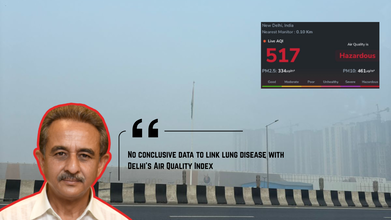
Credits: Wikimedia Commons and AQI.in
Delhi yet again woke up to a thick smog blanketed Saturday morning. The AQI stood at 380 for the city, which puts it under the 'very poor' category, as of 7am, according to the Central Pollution Control Board (CPCB). Several parts of the city also recorded with in the 'severe' limits of air pollution, with multiple stations recording AQI above 400. These areas include Anand Vihar and Sarai Kale Khan recorded 428 AQI, ITO recorded 429, Akshardham recorded 420, Ashok Vihar recorded 407, and Rao Tularam Marg recorded 403.
While GRAP Stage IV is enforced in the capital to combat the pollution problem, amid this, Minister of State for Environment and Climate Change Kriti Vardhan Singh told the Rajya Sabha on Thursday that there is no direct correlation between higher Air Quality Index or AQI levels and lung diseases. He said that there is no "conclusive data" to establish such a link. However, he did say that air pollution is one of the "triggering factors" for respiratory ailments and associated diseases.
What Do Doctors And Research Say On The Link of Lung Diseases And Air Pollution
"Lung cancer is no longer a smoker’s but a breather’s disease," said Dr Arvind Kumar, chairman, Lung Transplant, Chest Surgery and Oncosurgery at Medanta, Gurugram, as reported by The Indian Express. He treated a 31-year-old patient from Ghaziabad with lung cancer, who had never smoked in her life.
"Younger non-smokers are being diagnosed. And there are as many women as men. This indicates that lung cancer is no longer a smoker’s but a breather’s disease. While we talk of particulate matter, the ambient air in the urban environment is full of carcinogenic gases. And this is emerging as a real threat to everybody," the doctor said.
Dr Shivanshu Raj Goyal, a pulmonologist and Associate Director Pulmonary Medicine at MAX Healthcare in Gurugram and Delhi, in an Instagram video said that breathing this toxic air is equivalent to smoking 20 cigarettes in a day. The doctor starts his video with a rather strong statement, "At present, no one in Delhi-NCR is a non-smoker."
The doctor also states that on an average, a person breathes around 20,000 times in a day, so it means we are inhaling the toxic air at least 20,000 times a day.
As per a 2017 study titled Pulmonary Health Effects of Air Pollution, it is clear that lung cancer could be exacerbated due to exposure to a variety of environmental air pollutants with greatest effects due to particulate matter (PM), ozone, and nitrogen oxides.
As per Action on Smoking and Health (ASH), a cigarette contains nicotine, and tar, which is composed of chemicals like benzene, benzopyrene, and the gas includes carbon monoxide, ammonia, dimethyl nitrosamine, cadmium, formaldehyde, hydrogen cyanide and acrolein. Some of these marked irritant properties are also carcinogen, meaning, it can cause cancer.
Whereas Air Pollution contains pollutants like particulate matter PM 10 and PM 2.5, ozone, nitrogen dioxide, carbon monoxide, cadmium and sulfur dioxide. Air pollution, which is often a byproduct of combustion or released from vehicle exhaust also contain formaldehyde, benzopyrene, and benzene. As per the World Health Organization (WHO), the pollutants contain carcinogens, and the outdoor air pollution is in fact classified as Group 1 carcinogen.
Read: Breathing Delhi's Toxic Air Is Like Smoking 20 Cigarettes A Day
Common Chemicals We Inhale When We Breathe Delhi's Toxic Air And When We Smoke A Cigarette
Carbon Monoxide: a poisonous, flammable gas that is colorless, odorless, tasteless, and slightly less dense than air.
Benzene: a colorless and highly flammable liquid with a sweet smell, and is partially responsible for the aroma of gasoline.
Cadmium: a soft, silvery-white metal (atomic number 48) that is toxic and naturally found in the environment, but human activities have increased its levels. It is used in products like batteries, pigments, and coatings, and exposure can occur through tobacco smoke, contaminated food, and occupational inhalation. Cadmium is a known human carcinogen that can damage the kidneys and bones.
Formaldehyde: a colorless, flammable gas with a strong odor, whose exposure could cause cancer.
Benzopyrene: a group of organic compounds known as polycyclic aromatic hydrocarbons. It is a colorless crystalline solid found in sources like cigarette smoke, coal tar and is a known carcinogen that can cause cancer and other health problems like skin rashes and bronchitis, and exposure requires medical attention for any symptoms.
James Van Der Beek's Dramatic Weight Loss Was Not Cancer Related; It Was A 'Stomach Virus'

Credits: Wikimedia Commons, Instagram
James Van Der Beek, known best for Dawson's Creek, in a sit-down TV interview with Today, opened up about his cancer diagnosis. However, in this interview, he clarified that his weight loss was not cancer related. He shared that his family got a standing ovation during September's Dawson's Creek reunion, but he had to miss the event because he was "hit with some stomach bugs". However, he was able to join the event via Zoom call.
He clarified while he was diagnosed with stage 3 colorectal cancer last year, his weight loss was not cancer related, but due to a stomach virus. "I feel much, much better than I did a couple months ago," he said.
“I’d lost so much weight because of the stomach virus, yeah. No, it was not cancer related. Although with cancer everything’s like, ‘Why don’t we super-size that stomach virus?'” he said.
What Stomach Virus Makes You Lose Weight?
While there are no confirmed reports on what the stomach virus was, stomach flu caused by viruses like Norovirus and Rotavirus are common, however, it is the parasitic infections like Giardiasis and bacterial infections like Campylobacter that makes one lose weight.
Giardiasis
This is a common illness caused by a parasite that could result in diarrhea and stomach cramps. This spreads through contaminated water, food, and surfaces, and from contact with someone who has it. Antibiotics can treat this.
The microscopic parasite called Giardia found especially in contaminated water could take up residence in your small intestine and feed off the nutrients there. One of the long term effects is weight loss from the chronic diarrhea and nausea.
Campylobacteriosis
Campylobacter is among the most common infections caused by a bacterium in humans, often as a foodborne illness. It usually happens when someone eats undercooked poultry, or drinks unpasteurized milk or contaminated water. The bacteria can make people ill with diarrhea, with nausea as a common symptom. Weight loss too is one of the clinical symptoms of this illness.
James Van Der Beek Cancer Diagnosis
James Van Der Beek was diagnosed with stage 3 colorectal cancer after he began noticing changes in his bowel habits in the summer of 2023. At first, he brushed off the symptoms, assuming they were linked to his coffee intake. However, when the changes did not go away, he decided to consult a doctor.
A colonoscopy later confirmed the cancer diagnosis. The news came as a shock, especially since Van Der Beek had no known family history of colorectal cancer and believed he was in excellent health due to his active lifestyle and balanced diet.
What Is Colorectal Cancer?
Colorectal cancer develops in the colon or rectum and often begins as small, non-cancerous growths known as polyps. Over time, some of these polyps can become cancerous, interfering with digestion and the body’s ability to process waste.
It is one of the more common forms of cancer and can be difficult to detect early because symptoms may not appear right away. When they do, they often include blood in the stool, persistent changes in bowel habits, abdominal discomfort, and unexplained weight loss. According to the Mayo Clinic, early screening plays a critical role in detecting the disease when it is most treatable, and lifestyle choices can significantly influence risk and outcomes.
James Van Der Beek: What Kind Of Cancer Has The Actor Been Diagnosed With?

Credits: Canva
More than a year after Dawson’s Creek star James Van Der Beek revealed that he had been diagnosed with stage 3 colorectal cancer, the actor has shared a new update on how the illness has changed his outlook on life in unexpected ways. Speaking to host Craig Melvin on the December 19 episode of Today, James reflected on the moment he first heard the diagnosis.
“As soon as I found out, I remember thinking, ‘This might end up being the best thing that ever happened to me,’” he said. “There was this quiet voice in my head telling me that this diagnosis would push me to make changes I would never have made otherwise.”
As James Van Der Beek opens up about his health journey, many are asking: what kind of cancer was he diagnosed with?
James Van Der Beek Cancer: What Kind Of Cancer Has He Been Diagnosed With?
James Van Der Beek was diagnosed with stage 3 colorectal cancer after he began noticing changes in his bowel habits in the summer of 2023. At first, he brushed off the symptoms, assuming they were linked to his coffee intake. However, when the changes did not go away, he decided to consult a doctor.
A colonoscopy later confirmed the cancer diagnosis. The news came as a shock, especially since Van Der Beek had no known family history of colorectal cancer and believed he was in excellent health due to his active lifestyle and balanced diet.
What Is Colorectal Cancer?
Colorectal cancer develops in the colon or rectum and often begins as small, non-cancerous growths known as polyps. Over time, some of these polyps can become cancerous, interfering with digestion and the body’s ability to process waste.
It is one of the more common forms of cancer and can be difficult to detect early because symptoms may not appear right away. When they do, they often include blood in the stool, persistent changes in bowel habits, abdominal discomfort, and unexplained weight loss. According to the Mayo Clinic, early screening plays a critical role in detecting the disease when it is most treatable, and lifestyle choices can significantly influence risk and outcomes.
James Van Der Beek Cancer: Regular Screenings and Colonoscopies
As colorectal cancer often shows no symptoms in its early stages, routine screening is essential. Colonoscopies allow doctors to spot and remove precancerous polyps and detect cancer before it spreads. Early intervention has been shown to lower both the number of cases and deaths associated with the disease.
Data from the CDC highlights the importance of early detection, with survival rates varying widely by stage. While stage I colorectal cancer has a five-year survival rate of about 91 percent, that number drops sharply to around 14 percent for stage IV cases, according to the American Cancer Society. Health experts recommend beginning regular screening at age 45, or earlier for people with higher risk factors. Colonoscopy remains the most effective screening tool, as it examines the entire colon and allows for immediate removal of suspicious growths.
James Van Der Beek Cancer: What Was The Prognosis?
James Van Der Beek’s outlook following his stage 3 colorectal cancer diagnosis has been described as cautiously hopeful. His cancer was identified while still localized, a category associated with a significantly higher survival rate. According to the American Cancer Society, localized colorectal cancer has a five-year survival rate of approximately 91 percent.
James Van Der Beek Cancer: What Treatments Did James Undergo?
James Van Der Beek has chosen not to share detailed information about the specific treatments he has received for his stage 3 colorectal cancer. In general, treatment for this stage of the disease typically involves surgery followed by chemotherapy, and in some cases, radiation therapy.
Nutritional support also plays an important role, particularly because colorectal cancer and its treatments can affect digestion. While Van Der Beek has kept the details private, he has emphasized that he is actively addressing his diagnosis and prioritizing his overall health as part of his recovery.
- Follow Us :


© 2024 Bennett, Coleman & Company Limited