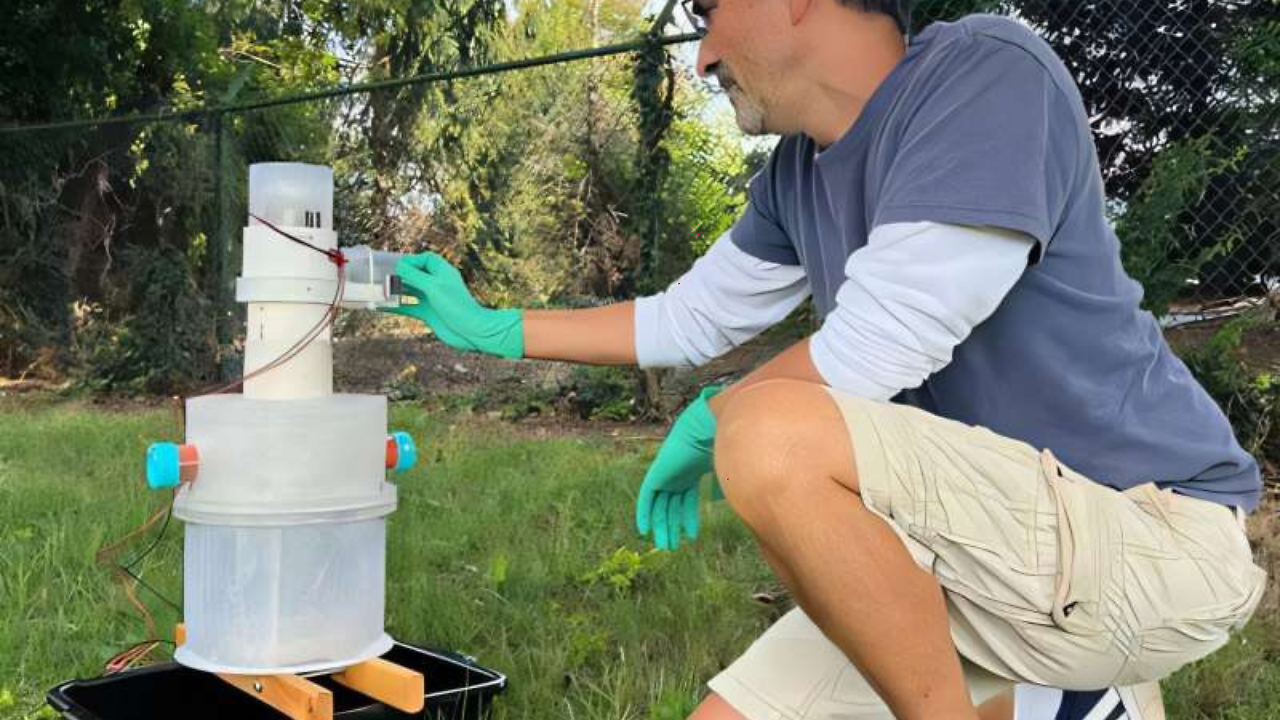
A team of US researchers has developed an unconventional surveillance tool: a 3D-printed “mosquito toilet” that collects mosquito waste for genetic analysis.The approach detected a complete West Nile virus genome and the first known evidence of a Hedwig-like virus in the Americas, along with several viruses that may be new to science and parasites.Researchers from the Rutgers University adapted an approach used to track genetic evidence in wastewater, including during the COVID-19 pandemic and for polio surveillance, to mosquitoes.How Does The Mosquito ‘Toilet’ Work?The team built what it called “a mosquito toilet” — a 3D-printed funnel coated with a superhydrophobic (water-repelling) material that causes liquid to bead up and slide into a collection tube, explained lead author and entomologist Dana Price from the School of Environmental and Biological Sciences.The researchers collected two groups of 50 wild Culex mosquitoes from a yard in New Brunswick, New Jersey, in 2021 and 2022. They placed each group in a screened container over the funnel and fed them a sugar solution. The mosquitoes produced drops of waste, which slid into a tube.The scientists used shotgun metagenomic sequencing, which sequences all genetic material present in a mixed sample. Computers then assembled the millions of fragments generated and compared them with known sequences in scientific databases.What Did The Mosquito Waste Reveal? The team captured tiny traces of mosquito waste and conducted genetic sequencing.The findings, published in the journal Microbiology Spectrum, revealed:A complete West Nile virus genomeThe first known evidence of a Hedwig-like virus in the AmericasSeveral viruses that may be new to scienceParasitesThe mosquito species that deposited the waste dropletsThe study suggests mosquito waste could become a surveillance tool, allowing scientists to search broadly for familiar pathogens as well as threats they don't yet know exist, Price said.Mosquitoes excrete small amounts of liquid containing genetic traces of viruses and other organisms. Because the waste contains far less mosquito tissue, and therefore less mosquito DNA, than a crushed insect, the scientists reasoned that viral material might be easier to find.A Full West Nile Virus GenomeThe 2022 sample contained a complete, high-quality genome of West Nile virus, which can cause serious neurological illness in people.The researchers identified the virus as belonging to the NY07 genetic variant previously found in the region. Such detail could help scientists track how genetic variants of a virus emerge, spread and change."What came out was an entire viral genome," Price said. "Rather than just positive or negative, we have genetic data."An Unexpected Virus In The AmericasThe researchers were even more intrigued by evidence of a Hedwig-like virus, which hadn't previously been reported in the Americas.Hedwig virus was first identified in Europe in snowy owl tissue, prompting scientists to name it after Harry Potter's famous white owl. Some of the infected birds also had West Nile virus.Scientists don't know whether Hedwig-like viruses make birds sick, facilitate West Nile infections or simply coexist with other viruses.The finding doesn't establish that the virus is a threat, Price said. It shows that it has been circulating where no one knew to search for it."We didn't even look for it specifically," Price said. "We just looked for everything, and we found Hedwig in there."A virus found for the first time in a region may have recently arrived or may have gone unnoticed for years. Because few broad mosquito-virus studies have been conducted in North America, organisms that seem geographically restricted may prove widespread.Price is currently working with health officials at the New Jersey Department of Environmental Protection to screen organ and tissue samples for the virus. The samples are collected from deceased birds during a postmortem examination.