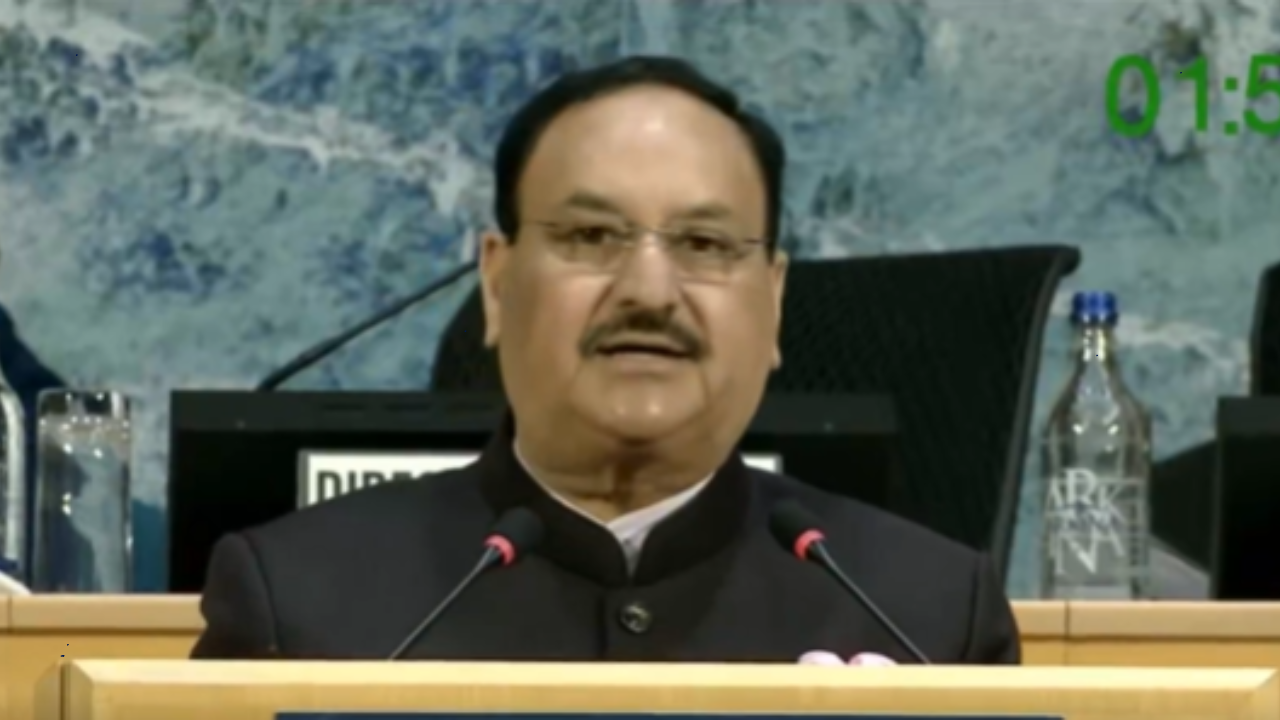
India has created more than 880 million digital health identities under the country’s flagship mission, the Ayushman Bharat Digital Mission, said Union Health Minister JP Nadda today while addressing the 79th World Health Assembly (WHA) in Geneva.Speaking at the plenary session, Nadda reaffirmed the country’s commitment to universal health coverage, digital health innovation, and global health solidarity.“Ayushman Bharat Digital Mission is strengthening India’s national digital health ecosystem by creating over 880 million unique digital health identities, which facilitate longitudinal health records and a seamless continuum of care,” he said.Expanding Universal Health CoverageHe noted that India is accelerating towards universal health coverage by expanding access to quality and affordable healthcare with a “whole-of-government” and “whole-of-society” approach.The Union Health Minister informed the Assembly that India has established over 1,85,000 Ayushman Arogya Mandirs across the country to provide comprehensive primary healthcare services closer to communities.The Minister also underlined the scale and impact of Ayushman Bharat Pradhan Mantri Jan Arogya Yojana, the world’s largest public health assurance scheme, covering nearly 600 million beneficiaries, particularly the most vulnerable sections of society.Also read: 15 Lakh Indian Chemists To Join May 20 Strike; Govt Says Jan Aushadhi, AMRIT Stores To Stay OpenFocus On Pandemic Preparedness And TechnologyFurther, Nadda emphasized India’s efforts towards pandemic preparedness and resilient public health systems. He stated that the government is continuously strengthening healthcare infrastructure and emergency response capacities to effectively address future public health challenges.He also highlighted the transformative role of technology in healthcare and stressed the growing role of Artificial Intelligence in healthcare in the country. The Minister informed delegates that India has recently launched the Strategy for Artificial Intelligence in Healthcare for India. He emphasized that “the future of AI depends on our collective ability to build ethical and human-centric systems.”Nadda reaffirmed India’s role as the “Pharmacy of the World” by highlighting the country’s leadership in the production of affordable generic medicines and vaccines.Recalling India’s contribution during the COVID-19 pandemic, he stated that under the Vaccine Maitri initiative, India supplied nearly 300 million vaccine doses to around 100 countries, reflecting the nation’s enduring commitment to global health cooperation and solidarity.The 79th World Health AssemblyRead More: No Ebola Case in India, Public Risk Low: Govt Steps Up Surveillance at Airports and SeaportsThe 79th WHA will be held from May 18 to May 23 in Geneva under the theme “Reshaping global health: a shared responsibility.”In his opening remarks at the Assembly, the WHO chief Tedros Adhanom Ghebreyesus referred to recent outbreaks of hantavirus and Ebola, as well as challenges including economic crises and climate change, stressing the need to “build a new global health architecture fit for the future.”Tedros said this year’s Assembly will consider a proposal for a member state-led, WHO-hosted joint process to reform the global health architecture, Xinhua News Agency reported.The 79th WHA will review over 60 agenda items, including technical issues such as noncommunicable diseases, mental health, universal health coverage, primary health care, and prevention and response to public health emergencies, as well as administrative issues such as financing, implementation, auditing, and oversight of the WHO’s 2026–2027 programme budget.As the WHO’s highest decision-making body, the annual WHA is usually held in May in Geneva. Its main functions include deciding WHO policies and reviewing and approving the budget program. This year’s Assembly is scheduled to conclude on .