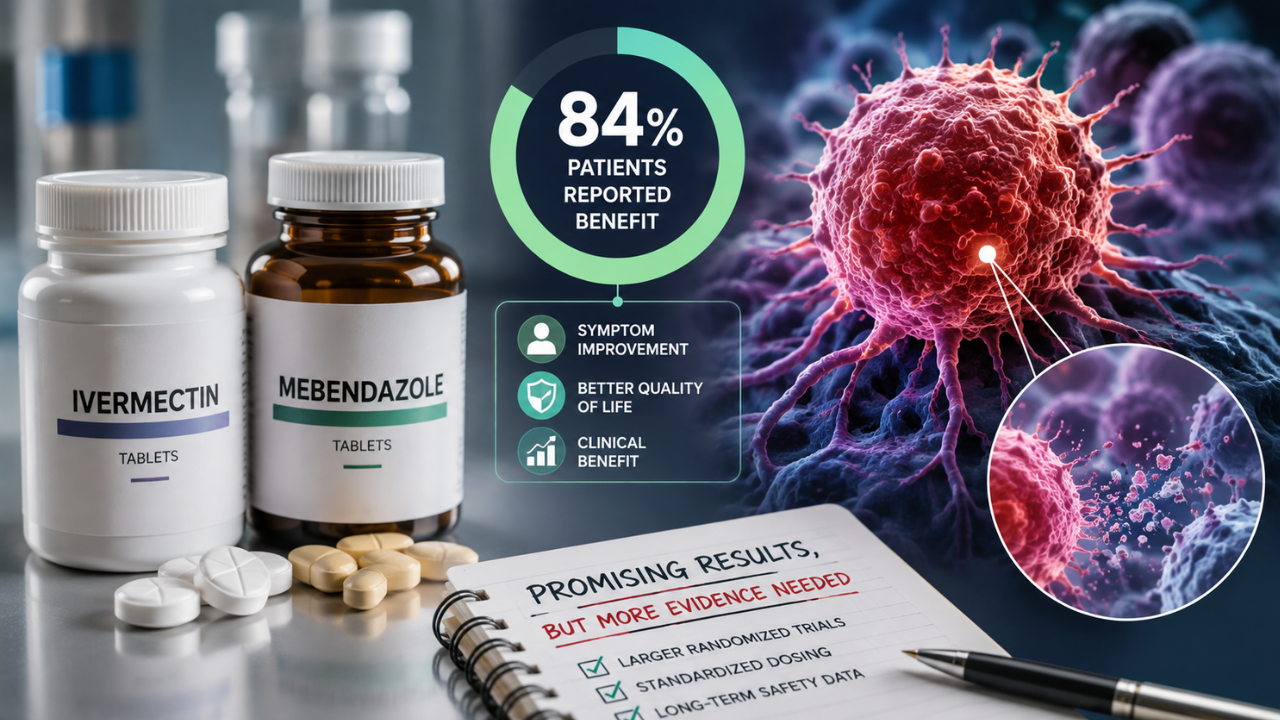
The potential benefits of Ivermectin and Mebendazole, two anti-parasitic drugs, for cancer treatment have sparked a debate. A recent real-world study stated that an astonishing 84.4% clinical benefit rate was reported among cancer patients who took these two drugs together. But the number does not mean that 84% of the patients improved with the help of thesedrugs. The findings come with significant limitations. Ivermectin-Mebendazole's Effects On Cancer Patients Published in Anticancer Research in June 2026, the study followed 197 cancer patients who had been prescribed ivermectin and mebendazole off-label through a US telemedicine platform. The patients received compounded capsules containing 25 mg of ivermectin and 250 mg of mebendazole. But only 122 patients, or 61.9%, completed the six-month follow-up. Among those who completed follow-up, 48.4% of the patients had no tumour regression or no sign of the disease. Another 36.1% showed no change, while in 15.6% of the patients, the disease had progressed. This generated the study's 84.4% Clinical Benefit Ratio. So, the number should not be interpreted as 84% of patients had their cancer tumours shrink or the disease disappeared. The researchers also reported that 25.4% of participants faced side effects, most of which were mild and mainly gastrointestinal. It is also important to note that patients were also receiving other treatments, including chemotherapy, radiation, and surgery, while nearly half reported using supplements. Many also made changes to their diets.Also read: Daraxonrasib: New Drug Approved For Pancreatic Cancer Shows Promise In Lung Cancer Treatment The Study Has Limitations This was a prospective observational study, not a randomised controlled clinical trial. There was no comparison group receiving standard treatment or a placebo. The cancer results were also self-reported through digital surveys rather than independently verified as part of the study. That makes it impossible to determine whether ivermectin and mebendazole caused the reported improvements. Patients were also receiving other cancer treatments and making changes to their diets or taking supplements. These factors could have influenced the outcomes. PubMed currently carries an 'Expression of Concern' for the paper, dated June 9, 2026. The study's own authors describe their findings as “hypothesis-generating” and say randomized controlled trials are needed.Also read: Blocked Ears After Flight Turned Out To Be Rare Head And Neck Cancer In 22-Year-Old Ivermectin And Brain Cancer Researchers are also exploring whether ivermectin can be delivered to brain tumours through the nose. In a study in rats with glioma, ivermectin packed inside tiny nanocapsules and given through the nose reduced tumour size after 10 days. The nano-formulation performed better than regular ivermectin, while another silica-based formulation did not have the same effect on the rats. The idea is to use the nose as a possible route to help drugs reach the brain, where the blood-brain barrier can make drug delivery difficult. However, this was an animal study. The results therefore show a potential research direction, not definite evidence that nasal ivermectin can treat brain cancer in humans.Also read: Nearly 8 In 10 US Young Adults Show Signs Of Heart, Kidney Risk: Why Early Checks Matter What Does The Evidence Say About Fenbendazole? Fenbendazole has also generated similar interest because laboratory studies have suggested that it can interfere with processes cancer cells need to survive, including microtubule function and cellular metabolism. A 2025 case series described three people with advanced breast, prostate and melanoma cancers who self-administered fenbendazole alongside other treatments. The report described complete or near-complete remissions. However, that paper was subsequently retracted in January 2026. PubMed now lists the retraction, making the original case series unsuitable as reliable evidence that fenbendazole treats cancer. The study provides possible cancer treatment options that can be investigated treatment as they are not proven yet. A 2025 review highlighted several possible anticancer mechanisms for ivermectin, including effects on YAP1, Wnt/TCF and AKT/mTOR signalling, oxidative stress and apoptosis. But the review also noted that the human cases it examined were not designed to test ivermectin as a cancer treatment. So as of now, there is no robust clinical evidence that says ivermectin, mebendazole or fenbendazole as effective cancer treatments. For cancer patients, these drugs should not be substituted for established treatment on the basis of these studies alone.