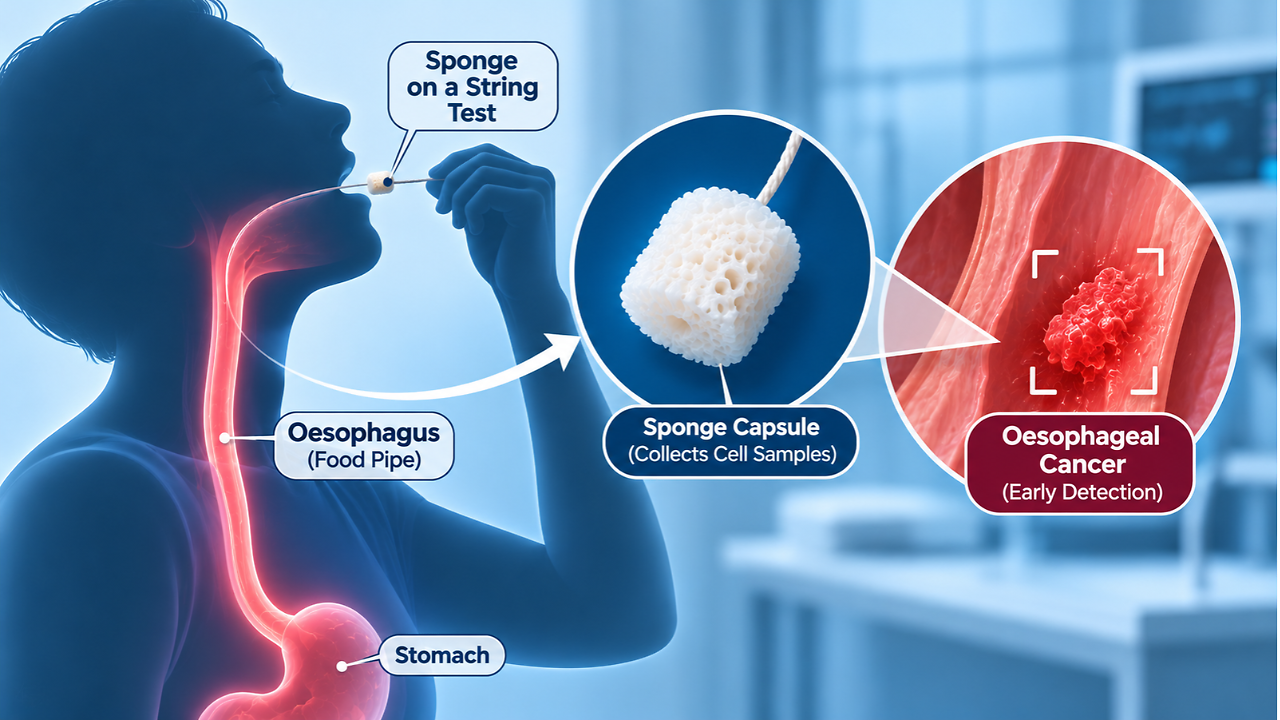
A simple test done with a dissolvable capsule and a tiny sponge is being proposed to be included in standard use to identify people at risk of oesophageal cancer. This could reduce the need for invasive tests. The technology, known as the ‘sponge on a string’ test, is being considered for widespread use across England's National Health Service (NHS) under new recommendations.The UK's National Institute for Health and Care Excellence (NICE) has recommended two capsule sponge tests, Cytosponge and EndoSign, for NHS deployment. The tests can be performed in GP surgeries, pharmacies and community diagnostic centres without needing sedation.The development marks a significant step as oesophageal cancer is often diagnosed at an advanced stage when treatment becomes challenging. More than 9,000 people are diagnosed with that cancer in the UK every year. How Does The 'Sponge On A String' Test Work?Also read: Microplastics May Promote The Growth Of One Of The Deadliest Cancers: StudyThe test is done by having the patient swallow a small capsule attached to a thin string. Once it reaches the stomach, the capsule dissolves and releases a compressed sponge.After approximately five to seven minutes, a healthcare professional gently pulls the sponge back through the mouth with the help of the string. As it travels upwards through the oesophagus, it gathers the cells from the lining of the food pipe. These samples are then sent to a laboratory for analysis.The test takes around seven minutes and does not require sedation. Unlike an endoscopy, it does not involve passing a camera through the throat to examine the oesophagus directly.The cells that are collected are examined for Barrett's oesophagus, a condition in which the cells along the lining of the food pipe undergoes changes related to prolonged exposure to stomach acid. Between one and two adults per 100 is believed to have Barrett's oesophagus. Even though most won't go on to develop cancer, the demand of endoscopy to rule out cancer risk remains high. How Is Barrett's Oesophagus Linked To Cancer?Also read: Ivonescimab: Why Did US FDA Reject China's Promising Lung Cancer Drug?Barrett's oesophagus is commonly linked to long-term gastro-oesophageal reflux in which stomach acid repeatedly flows back into the oesophagus.Over time, this can damage the lining and cause alterations in the cells. In some people, these changes can progress to dysplasia, where cells become increasingly abnormal and eventually turn into oesophageal cancer.The capsule sponge tests are intended to help identify people with Barrett's oesophagus who may need further investigation. Who Is Eligible For The Test? The proposed NHS recommendations are meant for people with chronic acid reflux or indigestion. Reflux is caused due to a weak sphincter at the bottom of the oesophagus, where it meets the stomach. It may keep allowing the stomach acids to flow the wrong way. Common symptoms of acid reflux include:Burning sensation in the chest commonly called heartburn.An unpleasant acidic taste in the mouth.Repeated regurgitation of stomach contents.Chronic indigestion.Professor Jonathan Benger, chief executive of NICE, said, “Capsule sponge tests offer a quick and less invasive way to detect concerning changes associated with oesophageal cancer or Barrett's oesophagus, helping to identify people who should go on to have further tests and treatment.”Professor Peter Johnson, national clinical director for cancer at NHS England, said, “Many people have acid reflux, and having an easier way to check for changes in the lining of the oesophagus can make a big difference for patients – reducing the need for more complicated endoscopy tests and helping the NHS free up resources to find cancers at an earlier stage.”