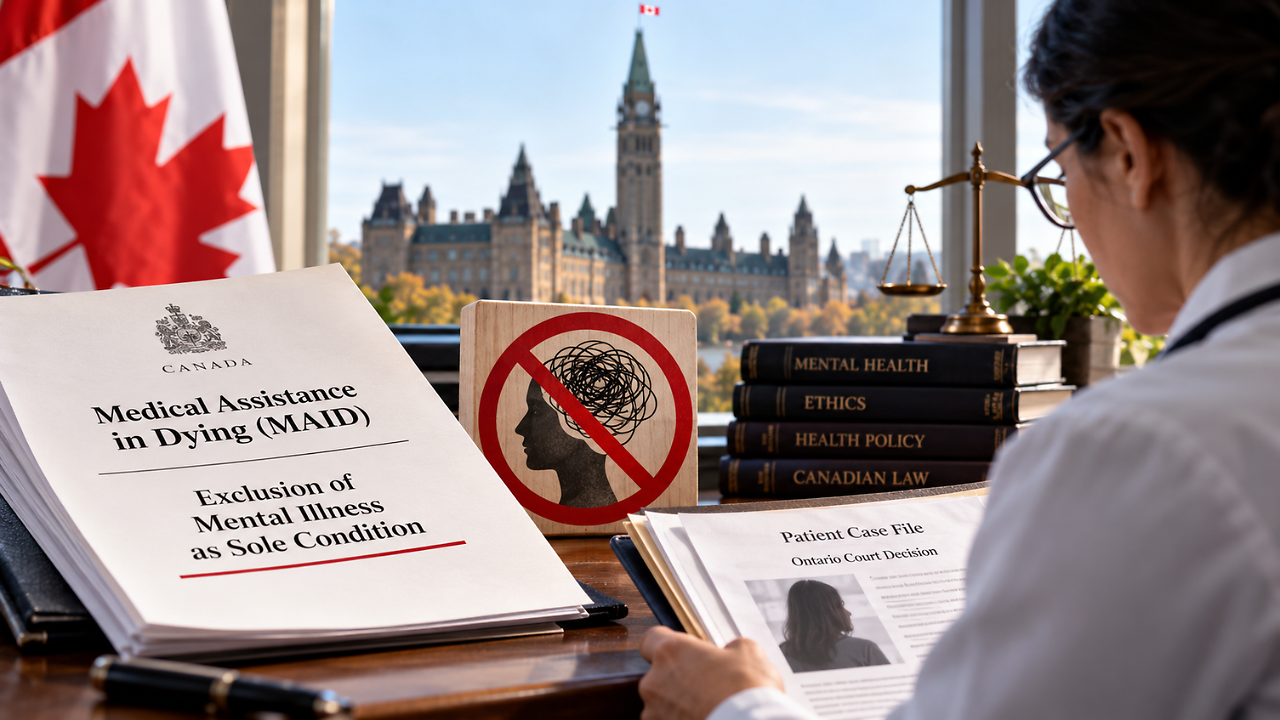
Canada has determined to restrict medical assistance in dying (MAID) for patients whose sole underlying condition is a mental illness, shelving plans to expand the eligibility in 2027. Justice Minister Sean Fraser said the government will introduce legislation to maintain the exclusion beyond the current deadline of March 17, 2027. The decision comes weeks after an Ontario court rejected a woman's request for an exemption that could have allowed her to seek MAID because of severe, longstanding mental illness.Canada Extends Ban On Medical Assistance In Dying The government says there is still no sufficient medical consensus on when a mental illness can be considered irremediable, a key requirement under Canada's MAID policy.Fraser said, “When I hear that there is a lack of consensus within the medical community about the irremediable nature of certain mental illnesses, that gives me real cause for concern.” He also pointed out that access to mental health care in the country is uneven.He acknowledged that the issue does not have unanimous agreement but defended the government's decision. “While there is not a perfect consensus on this issue, we believe this is the correct approach at this particular time,” Fraser said.Canada had originally kept the exception as temporary. When MAID eligibility was expanded in 2021 to people whose natural death was not reasonably foreseeable, mental illness as the sole underlying condition that was deemed ineligible. The exclusion was subsequently delayed several times, with March 2027 becoming the latest planned date for possible expansion.Also read: Canadian Parliamentary Panel Urges Indefinite Ban on Assisted Dying for Mental Illness AloneOntario Court Rejected A Woman’s MAID RequestThe announcement comes just after a controversial case involving Claire Elyse Brosseau, a 49-year-old Toronto woman who sought a constitutional exemption from the existing MAID exclusion.Brosseau said she has lived with severe mental-health problems for decades and had undergone multiple forms of treatment. In May, she asked the Ontario Superior Court for emergency relief that would allow her to apply for MAID.On September 3, Justice Carissima Mathen rejected that request. She also ordered the federal government to respond to Brosseau's constitutional challenge to the exclusion.Mathen described Brosseau's evidence of suffering as credible and compelling, but said the case also involved Parliament's role in making decisions on “sensitive social issues” and interpreting the Charter rights involved.Brosseau, meanwhile, said the decision was nothing but another barrier for people with mental illness. “It is yet another example of governmental systems telling people with mental illnesses that we do not have the same rights nor the same autonomy as others,” she said.Also read: Impact Of Canada’s Delay In Approving MAID For Mental Illness: Patients Say They Feel Abandoned & HopelessParliament Had Already Recommended An Indefinite ExclusionThe government's decision also follows a recommendation that was passed in June from a joint parliamentary committee, which called to exclude people from MAID eligibility whose only underlying condition is mental illness.The committee's review highlighted disagreements among experts over whether clinicians can reliably determine that certain mental illnesses are permanently irremediable.It was based on a report that noted a "divergence of perspectives" on the issue and highlighted concerns raised during testimony about the "pressing need for increased and more equitable access to adequate mental health services".However, the recommendation was not unanimous. Four senators issued a dismissed the report, questioning the committee's process, arguing that the government should consider seeking guidance from the Supreme Court of Canada.Also read: New York Assisted Suicide Law: Nearly 20 People Reportedly Died Since August The government's proposed legislation is expected to circle back to advance requests, which is another another debatable aspect of MAID.Under the proposed changes, people diagnosed with serious illnesses who may eventually lose the ability to consent could be able to make an advance request for MAID.According to the latest available figures from 2024, MAID accounts for around 5 per cent of all deaths in Canada. About 96 per cent of MAID cases involved people whose deaths were reasonably foreseeable, most of them terminal cancer patients.The remaining 4 per cent involved patients whose deaths were not imminent but who had a "grievous and irremediable medical condition".