
- Health Conditions A-Z
- Health & Wellness
- Nutrition
- Fitness
- Health News
- Ayurveda
- Videos
- Medicine A-Z
- Parenting
Cancer Cells Cheat Drugs, Pretends To Be Dead, To Avoid Treatment: Study

Credits: Canva
The World Health Organization (WHO) notes that in 2022, there were nearly 20 million new cancer case in the world. These have included lung, breast, and colorectal cancers. This has led to death of 9.7 million in the year. This means about 1 in 5 people could develop cancer in their lifestyle, and the number is rising significantly by 2050.
While there are new studies, targeted cell therapies that are now opening more doors to cancer treatments, a new study by the University of California, San Diego, could be worrisome. This new study found that some cancer cells turn on their "cell death" mode during drug therapy. So, what happens is that the drug, instead of killing them, persist and regrow in some of the case. This is how drug resistance in cancer cells functions, and by targeting this cell-death programme in cancer cells, scientists could potentially stop the growth of cancer after therapy.
The findings have been found in a peer-reviewed journal Nature Cell Biology.
Why cancer often comes back
Cancer remains one of the biggest global health threats, causing nearly 10 million deaths every year. One of the hardest parts of treating cancer is that it can return, even after treatment seems successful. Doctors call this cancer relapse or recurrence. It happens when some cancer cells survive the first round of treatment and begin growing again after a period of dormancy.
Relapse rates vary by cancer type. Lung cancer, for instance, has a higher chance of returning, while breast cancer generally has lower relapse rates. Still, one problem cuts across many cancers: drug resistance. Over time, cancer cells can learn how to survive medicines designed to kill them.
A surprising discovery during treatment
In this study, researchers set out to look for early signs of drug resistance in cancer cells. They expected to find genetic changes or mutations. Instead, they found something unexpected. Some cancer cells respond to treatment by turning into what scientists call “persister cells.”
These persister cells stop growing during therapy and enter a dormant state. At first glance, this looks like success. But what happens next is more troubling. These cells activate a built-in cell death program, the same process the body uses to break down dying cells. However, the program does not finish the job.
How cancer cells escape death
Rather than dying, these persister cells release enzymes that help them restart growth. One key enzyme involved is DNA Fragmentation Factor B, or DFFB. Normally, DFFB helps fragment DNA in cells that are meant to die. In these cancer cells, it is activated at low levels. That is not enough to kill the cell, but enough to help it escape dormancy and start growing again.
“This flips our understanding of cancer cell death on its head,” said senior author Matthew J. Hangauer. He explained that signals meant to kill cancer cells can sometimes help them survive and regrow instead.
What this means for cancer treatment
The findings offer a new way to think about drug resistance. Instead of relying on genetic mutations, cancer cells may use internal survival mechanisms to outlast treatment. This insight opens the door to new treatment strategies.
The researchers tested this idea by disabling DFFB in melanoma, lung cancer, and breast cancer models. Without the enzyme, the cancer cells stayed dormant and could not restart growth. Importantly, DFFB does not appear to be essential in normal cells, suggesting that targeting it may not cause major side effects.
As first author August F. Williams noted, focusing on these early, non-genetic survival pathways could help patients stay in remission longer and lower the risk of cancer returning.
Union Health Minister JP Nadda Launched Indigenously Manufactured Tetanus And Diphtheria Vaccine
Credits: IANS
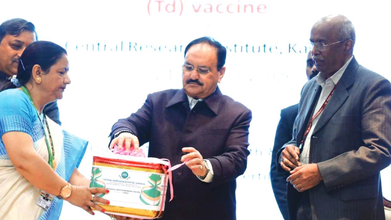
Union Health Minister JP Nadda launched indigenously manufactured tetanus and adult diphtheria (Td) vaccine at the Central Research Institute in Himachal Pradesh's Kasauli on Saturday. The formal launch of the Td vaccine will now include the vaccine under the Universal Immunisation Programme (UIP). The Central Research Institute will supply 55 lakh doses to the UIP by April. The production is also expected to scale up progressively in subsequent years to further strengthen the Central Government's Universal Immunisation Programme, said Nadda.
Nadda also congratulated the scientists, technical experts and staff of the Central Research Institute Kasauli at the gathering, and described the launch Tb vaccine as a momentous and historic occasion. He also stated that the launch marked a significant step towards safeguarding national health security and strengthening India's public health infrastructure.
The minister also noted that the government under the leadership of Prime Minister Narendra Modi, set clear targets for achieving self-reliance in the health and pharmaceutical sectors. Nadda also said that the launch of the indigenously manufactured Td vaccine represents a concrete step towards the vision of Atmanirbhar Bharat in health and medicine.
India Is Pharmacy Of The World
He also highlighted the nation's global standing. He said that the minister also stated that India is widely recognized as the "pharmacy of the world" and is among the leading vaccine manufacturers globally.
He also said that India has achieved Maturity Level 3 in the World Health Organization's (WHO) global benchmarking of regulatory systems, reflecting the robustness of its vaccine regulatory framework. Institution like CRI, said Nadda, have also played a major role in achieving these standards.
Read: After Coldrif, WHO Bans 2 More Drugs, But This Is Not the Only Death from Indian Cough Syrup
From Decades Of Research To Digital Vaccination Tracking
The Union Health Minister said that historically, vaccines and medicines took decades to develop. The tetanus vaccine required years of global research, tuberculosis drugs evolved over nearly 30 years, and the Japanese Encephalitis vaccine took close to a century of scientific effort.
In contrast, during the COVID 19 pandemic, India developed two indigenous vaccines within nine months and administered more than 220 crore doses, including boosters. He added that vaccination certificates were issued digitally, reflecting the country’s expanding use of technology in public health delivery.
Highlighting international cooperation, he noted that under the Vaccine Maitri initiative India supplied vaccines to nearly 100 countries, with 48 receiving them free of cost. Public sector institutions such as the Central Research Institute also strengthened the country’s ability to meet both domestic and global demand.
The minister further said the Central Research Institute became the first government facility to manufacture vaccines under Good Manufacturing Practices standards, marking a major step in modernizing public sector vaccine production.
He described the Universal Immunisation Programme as the world’s largest vaccination drive. It currently provides 11 vaccines protecting against 12 preventable diseases, with significant contributions from the institute.
Every year about 2 to 2.5 crore children are born and a similar number of women become pregnant. From pregnancy registration onward, beneficiaries are tracked through digital platforms such as U WIN. Expectant mothers receive five antenatal check ups including at least one by a specialist, and monitoring continues until the child turns 16 years old, covering 27 doses.
The annual immunization cohort includes nearly 5 crore beneficiaries, around 2.5 crore pregnant women and 2.5 crore children. Due to systematic tracking and sustained immunization efforts, vaccine coverage in the country has reached nearly 99 per cent.
Woman Loses All Her Limbs After Getting Sepsis From Dog Lick
Credits: Go Fund Me
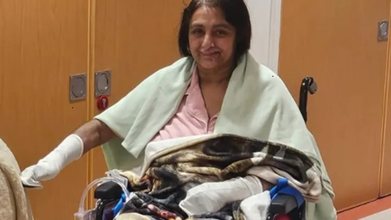
Sepsis from dog lick led to a woman undergoing quadruple amputation. Manjit Sangha, a 56-year-old pharmacy worker from Birmingham, England came back home from work and was not feeling well on a Sunday evening in July 2025. Her husband Kam Sangha found her unconscious on the couch and saw her lips were blue, hands and feet were ice cold. Kam, 60, called ambulance and Manjit was rushed to hospital.
"Your mind is all over the place. You're thinking, 'How can this happen in less than 24 hours?' One minute on a Saturday, she is playing with the dog, Sunday she's gone to work, Monday night she is in a coma," he told BBC.
Manjit was rushed to New Cross Hospital and placed in a medically induced coma as her condition deteriorated rapidly. During her stay in intensive care, she suffered six cardiac arrests, with clinicians repeatedly warning her family she might not survive.
Sepsis From Dog Lick: What Led To All This?
Doctors later diagnosed sepsis, a severe and abnormal response of the body to infection. Medical teams believe bacteria may have entered through a small cut or scratch, possibly after contact with her pet dog.
Sepsis occurs when the immune system’s reaction to infection damages the body’s own tissues and organs. It can progress to septic shock, marked by a dangerous drop in blood pressure and failure of organs such as the lungs, kidneys and liver. Without urgent treatment, it can be fatal.
In Manjit’s case, the illness escalated into disseminated intravascular coagulation (DIC), a rare but critical complication in which widespread clotting occurs inside blood vessels. The process blocks circulation and starves tissues of oxygen, often resulting in irreversible damage.
Her family said doctors warned she had only days to live and, if she survived, amputation was likely.
Sepsis From Dog Lick: Amputation To Save Life
As circulation failed in her limbs, surgeons were forced to amputate both legs below the knee and both hands. She later required removal of her spleen after developing pneumonia and gallstones during prolonged hospitalization.
In total, Manjit spent 32 weeks in hospital before her condition stabilised enough for discharge.
Her relatives have since launched a fundraising campaign to support advanced prosthetics, rehabilitation, mental-health care and home adaptations.
“She is mourning the life she had before, where simple tasks were effortless,” the family said, adding they remain focused on helping her regain independence.
Now back home, Manjit says her goal is simple: to walk again and eventually return to work using prosthetic limbs.
She also hopes her experience raises awareness about sepsis, which can begin with seemingly minor symptoms but worsen quickly.
“It could happen to anybody,” she said, urging people not to ignore infections or sudden illness.
Medical experts echo that message: early recognition, including fever, confusion, extreme pain, breathlessness or mottled skin, and immediate treatment dramatically improve survival.
Her family describes her survival as extraordinary. “Every time we thought we’d lost her, she came back fighting,” a relative said.
1 in 7 Stroke Patients In India Are Under 45; Hypertension Leads Risk Factors: ICMR Study
Credit: Canva
One in seven stroke patients in India are young adults aged below 45 years, with hypertension leading as the major risk factor, according to a study by the Indian Council of Medical Research (ICMR).
The study, published in the International Journal of Stroke, showed that two in five patients arrived in the hospital after 24 hours of onset of symptoms, highlighting the need for improving awareness about the first hour (golden hour) in stroke care.
“The findings highlight the gaps in acute stroke care, including delayed hospital arrival, limited access to advanced treatments, and inadequate follow-up services,” said Prashant Mathur, Director, ICMR—National Centre for Disease Informatics and Research, Bengaluru, in the paper.
“Stroke continues to pose a major public health burden, with poor outcomes. The study shall contribute to the development of evidence-based comprehensive strategies for stroke prevention, effective management, and improved treatment outcomes,” he added.
What Stroke Patterns Did The Study Find?
The team included 34,792 stroke cases from 30 Hospital-Based Stroke Registries (HBSRs) across India, recorded between 2020 and 2022.
About 64 percent of the stroke patients were males, and 36.6 percent were females.
Stroke in the younger age group (aged below 45 years) constituted 13.8 percent of the total cases. More than 70 per cent of the participants were residents from rural areas.
Hypertension (74.5 percent) was the most common risk factor, followed by smokeless tobacco use (28.5 percent) and diabetes mellitus (27.3 percent).
Ischemic stroke accounted for 60 percent of cases. Only 20.1 percent were presented within 4.5 hours of symptom onset, while 37.8 percent of cases presented after 24 hours.
The commonest symptoms at onset included motor impairment (74.8 percent), followed by speech disturbance (51.2 percent), dysphagia (30.4 percent), and impaired consciousness (25.6 percent).
The study also highlighted substantial disparities in stroke care services. Time-sensitive therapies like thrombolysis were given in 4.6 percent of cases, while thrombectomy was administered in 0.7 percent of ischemic strokes.
At three months, 27.8 percent of patients had died, while nearly 30 percent suffered significant disability, and 1.1 percent had a recurrent stroke. This highlighted the need for improving comprehensive stroke care across India.
Burden Of Stroke In India
Stroke remains one of the leading global health burdens, causing significant deaths and disability worldwide, including in India. Compared to Western countries, stroke also tends to occur at a younger age and is associated with a higher case fatality rate in the country.
The Global Burden of Disease Study 2021 identified hypertension, air pollution, tobacco smoking, high cholesterol, increased salt intake, and diabetes as the leading risk factors of stroke.
Incidence of stroke is increasing significantly in low- and middle-income countries (LMICs), especially in India, due to population growth, aging, and greater exposure to risk factors.
The estimated stroke incidence in India ranged from 108 to 172 per 100,000 population, and 1-month case fatality varied from 18 percent to 42 percent.
As per data from the ICMR-NCDIR, India has a crude stroke incidence rate of 138.1 per 100,000 population and an age-standardized case fatality rate of 30 per 100,000 population.
- Follow Us :


© 2024 Bennett, Coleman & Company Limited