
- Health Conditions A-Z
- Health & Wellness
- Nutrition
- Fitness
- Health News
- Ayurveda
- Videos
- Medicine A-Z
- Parenting
Chikungunya Spreads Across Tamil Nadu: All You Need To Know

Credit: Canva
The Directorate of Public Health and Preventive Medicine (DPH) has issued a statewide alert across Tamil Nadu due to a sudden uptick in chikungunya cases in multiple cities.
Cases have been reported across Chennai, Villupuram, Tenkasi, Theni, Cuddalore, Chengalpattu, Kancheepuram and Ariyalur. It remains unknown how many people have been affected and if any deaths have occurred.
Caused by the chikungunya virus, chikungunya virus disease (CHIKVD) is spread by the bite of infected mosquitoes (Aedes aegypti and Aedes albopictus) to humans. The illness usually starts with flu-like symptoms including fever, chills, headache, nausea, vomiting, joint pain and rashes.
Also Read: This Is Why Emmanuel Macron Wore Sunglasses At Davos
Typically, the illness has no clear no symptoms, especially in children and can easily be misdiagnosed as dengue and Zika. While there are no specific antiviral treatments for chikungunya virus infections, medications such as antipyretic and analgesic medications (such as paracetamol) for fever and pain can be used to ease the pain.
Most patients recover completely from the infection, but occasional cases of eye, heart, and neurological complications have been previously been reported with CHIKV infections.
What Are Tamil Nadu Officials Doing To Contain Cases?
To improve virus containment, health officials across the state have been instructed to collect sufficient blood samples in fever-prone areas and ensure laboratory confirmation using IgM ELISA tests, which can detect recent or acute viral infections.Authorities have also emphasized that all government and private hospitals as well as diagnostic laboratories, need to timely report cases to ensure the infection does not spread . Any delay in reporting, officials noted, could allow the virus to spread rapidly within communities.
On the local level, district entomologists and health inspectors have been told to eliminate stagnant water in artificial containers and conduct weekly mass-cleaning drives in high-risk areas.
The DPH has also ordered that all designated dengue and chikungunya wards in hospitals be kept mosquito-free, with adequate bed strength and sufficient mosquito nets for patients.
READ MORE: What Is Chikungunya And How Can It Be Prevented?
Can Chikungunya Spread Easily?
While the illness does not spread directly from person-to-person through touching or coughing; however, in some rare cases, mother-to-baby transmission during childbirth is possible and infected individuals should avoid further bites to prevent spreading the virus.Cases typically emerge mostly in the Americas, Asia and Africa and occasionally in Europe. However, nearly 30,000 CHIKVD cases have been recorded, including 83 associated deaths from 12 countries namely from China, Singapore, Pakistan, France, Argentina, Brazil and Mexico, marking it as one of the biggest outbreaks in the world.
Andhra Pradesh May Ban Social Media for Under-16s To Protect Teenagers
Credit: Canva
Andhra Pradesh may soon follow Australia's steps and ban social media for teenagers under the age of 16 in the state.
Nara Lokesh, Information Technology, Electronics and Communications, Real Time Governance and Human Resources Development Minister for Andhra Pradesh, told Bloomberg at the World Economic Forum 2026 Annual Meeting in Davos, Switzerland: "As a state, we are studying Australia’s under-16 law, and yes, I believe we need to create a strong legal enactment.
"Youngsters below a certain age should not be on such platforms, as they do not fully understand the content they are exposed to. Thus, a strong legal framework may be required."
TDP national spokesperson Deepak Reddy supported Lokesh's claim and stated: "Children below a certain age are not emotionally mature enough to comprehend the negative and harmful content that is freely available online. That is why the Andhra government is studying global best practices and examining Australia's under-16 social media law."
If implemented successfully, Andhra Pradesh would be the first Indian state to issue the ban and could pave the way for other states to consider such policies. State officials are yet to clarify when the rule will be implemented and if any fines will be attached to it.
Is Any Other State Considering a Ban?
While hearing a write petition in December 2025, the Madras High Court has asked the Union Government to look for possibilities in passing a legislation similar to the ban of under 16s using social media.The petition was to emphasize on the awareness of the stakeholders and parental windows in the device that could control the menace of pornographic material which is easily accessible to children. The court asked Centre to order internet provider service companies to provide a 'Parental Window' to prevent children from accessing such content.
The Madurai Bench of Justices G Jayachandran and KK Ramakrishnan told the authorities of child rights to accelerate this matter. The bench also noted that children could only be prevented from consuming such content only if there is a parental control app on the device.
Judges also noted that parents have a higher responsibility in this, as children are highly vulnerable to such content.
READ MORE: Australia Social Media Ban Explained: Why Government Plans to Restrict Accounts of Under-16s
What Did Australia Do?
To protect the mental health of children, Australia has successfully banned several social media apps including Facebook, Instagram, Snapchat, Threads, TikTok, X, YouTube, Reddit, and streaming platforms Kick and Twitch.
YouTube Kids, Google Classroom and WhatsApp are not covered under this rule as they do not fit those criteria.
While anyone under 16 will be still able to watch most of the content without logging in, however, they cannot have an account on it. Critics are urging the government to widen the ban to include online gaming platforms such as Roblox and Discord, which are currently not covered.
The government says that it will also reduce the negative impact of social media's "design features that encourage [young people] to spend more time on screens, while also serving up content that can harm their health and wellbeing".
A government study which was commissioned in 2025 found that 96% of children aged 10 to 15 used social media, and that seven out of 10 of them were exposed to harmful content. These content were misogynistic and violent in its nature, furthermore, content promoted eating disorders and suicide.
Children and parents will not be punished for infringing the ban, instead, social media companies will face fines of up to A$49.5m, which is equivalent of US$32m for serious or repeated breaches.
This Is Why Emmanuel Macron Wore Sunglasses At Davos

Credits: AP
French President Emmanuel Macron on Tuesday addressed the World Economic Forum in Davos, Switzerland. As he spoke on the European solidarity amid US President Donald Trumps' treat to annex Greenland, something else seemed to take the attention away. Macron was seen wearing a pair of blue-tinted mirrored aviator sunglasses. The surprising part was that he wore it indoors. French media had already reported that he was seen wearing sunglasses since last week.
Trump also mocked Emmanuel Macron’s sunglasses during his speech at Davos, joking, “what the hell happened?” regarding the French president’s appearance.
Also Read: Nipah Virus Outbreak In India: After Two West Bengal Cases, Tests On Bats Show No Active Infection
Why Was Emmanuel Macron Wearing Sunglasses Indoors?
On Monday, Macron said that reflective glasses were to disguise a minor eye injury that he had sustained after having been spotted with a heavily bloodshot right eye. "Apologies for the shades, but I have to wear them for a while". He further said that it is for a "mild eye condition".
Last week, when he appeared at a military event in southern France with red eye, while addressing the troop, he said, it was "totally benign" and "completely insignificant", he also added, "Please pardon the unsightly appearance of my eye". He also joked about it, calling it "l'oiel du tigre" or the "eye of the tiger". This was a reference to rock band Survivor's song used in the 1982 boxing moving Rocky III. He said, "For those who get the reference, it is a sign of determination".
What Happened To Macron's Eyes?

As per the French media reports, Macron appeared to have a sub-conjunctival hemorrhage. This means there is a broken blood vessel in his eyes. It is harmless, painless, and does not affect the vision. It also cannot cause permanent injury to the eye, and clears within a fortnight.
Macron Wears Sunglasses Indoor: Is It Absolutely Necessary?
Medical doctor and media commentator Jimmy Mohamed told French broadcaster RTL that Macron "opted for this style for aesthetic reasons, because he is a public figure. However, sunglasses are not necessary to protect vision in this condition. Some people wear it to avoid attracting attention.
"Some people might think he's ill, so to avoid being photographed in that state, he decided to wear sunglasses. The glasses protect his image, but not really his eye," said Jimmy Mohamed.
Read: Why Can't I Hear When I Take My Glasses Off?
How Have Netizen Reacted To Macron Wearing Sunglasses?
He has been called 'kéké', which is a French slang for a show off. Others also joked about him being a "cyborg" or emulating Hollywood actor Top Cruise in Top Gun, the 1986 movie that made wearing aviators a fashion statement.
What Is Sub-conjunctival hemorrhage?
Sub-conjunctival hemorrhage or SCH is a common ocular condition defined by extravasation of blood beneath the conjunctiva, producing a sharply demarcated red patch on the scleral surface. The condition is usually painless and does not impair vision. It usually resolves within 1 to 2 weeks, making it a frequent but benign cause of ocular redness.
It usually happens by a sudden pressure increase from coughing, sneezing, vomiting, or heavy lifting. This could rupture tiny eye blood vessels, or from eye trauma like rubbing or foreign bodies, and can be linked to risk factors like high blood pressure, diabetes, blood thinners, or even childbirth in newborns.
Nipah Virus Outbreak In India: After Two West Bengal Cases, Tests On Bats Show No Active Infection
Credits: iStock/ Canva
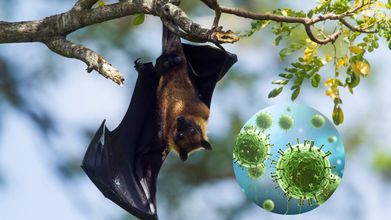
Nipah Virus Outbreak India: Two cases of Nipah virus, a rare, bat-borne pathogen had been confirmed in West Bengal. The virus has been detected in two nurses, both working at the private Narayana Multispecialty Hospital in Barasat. Speaking to The Telegraph, Mr Narayan Swaroop Nigam, Principal Secretary, Health and Family Welfare Department, said, "Two nurses at a private hospital are infected with Nipah virus, and one of them is in critical condition."
Was Nipah Virus Found In West Bengal?
A survey conducted on bats in West Bengal found no active Nipah virus infection. Though there were antibodies detected in one specimen, which indicated prior exposure. This was confirmed by a senior state forest department official on Tuesday. The survey was conducted amid the identification of two confirmed Nipah virus cases.
Also Read: Meghan Trainor Opens Up About Choosing Surrogacy For Her Third Baby
To conduct the survey, nine bats near Kuberpur on the Kolkata-Barasat Road in Madhyamgram were tested using RT-PCR. All samples were negative, however, one bat, tested positive for antibodies. However, it only suggested prior infection, meaning there was no current risk of transmission.
The survey was conducted by the state forest department in collaboration with scientists form Pune-based National Institute of Virology. "The findings are reassuring, but caution is warranted. Surveillance and prevent measures will continue until we are fully assured that there is no risk," confirmed a senior official of the West Bengal Health Department.
What Is Nipah Virus?
As per the World Health Organization (WHO), Nipah virus infection is a zoonotic illness that is transmitted to people from animals, and can also be transmitted through contaminated food or directly from person to person.
In infected people, it causes a range of illnesses from asymptomatic (subclinical) infection to acute respiratory illness and fatal encephalitis. The virus can also cause severe disease in animals such as pigs, resulting in significant economic losses for farmers.
Although Nipah virus has caused only a few known outbreaks in Asia, it infects a wide range of animals and causes severe disease and death in people.
During the first recognized outbreak in Malaysia, which also affected Singapore, most human infections resulted from direct contact with sick pigs or their contaminated tissues. Transmission is thought to have occurred via unprotected exposure to secretions from the pigs, or unprotected contact with the tissue of a sick animal.
In subsequent outbreaks in Bangladesh and India, consumption of fruits or fruit products (such as raw date palm juice) contaminated with urine or saliva from infected fruit bats was the most likely source of infection.
Human-to-human transmission of Nipah virus has also been reported among family and care givers of infected patients.
Read: Doctor Debunks Five Myths Around Nipah Virus
Nipah Virus Symptoms
- Fever
- Headache
- Breathing difficulties
- Cough and sore throat
- Diarrhea
- Vomiting
- Muscle pain and severe weakness
Unique Symptoms Of Nipah Virus
While most of the symptoms of Nipah virus may resemble the symptoms from any common flu, however, what makes it unique is that the symptoms come in stages.
Dr Shaikh Abdul Kalam, MD Physician, an Andhra Pradesh-based GP writes for Apollo 24 that the symptoms come in three different phases.
Nipah Virus Phase 1: Flu Like Symptoms
Like mentioned above, most symptoms seem like common flu symptoms. Even Nipah virus begins like a common flu or viral infections. This is what makes the diagnosis difficult.
Most common sign is a fever and a headache. It is often a severe headache and does not break with simple pain medication. What follows is myalgia or muscle pain and sore throat.
The initial symptoms could last for 3 to 14 days before more severe symptoms appear. What helps best is to know the patient's travel history to make the right diagnosis.
Also Read: Unique Symptoms Of Nipah Virus Found In West Bengal And How Long Infection Now Last
Nipah Virus Phase 2: Respiratory Symptoms
As the infection progresses, it begins to attack the respiratory system. This causes dry cough, and dyspnea, or acute difficulty with breathing. This means that the virus has started causing inflammation in the respiratory tract.
Atypical pneumonia is also a symptom, which means air sacs in the lungs get filled with fluid and leads to acute respiratory distress.
Nipah Virus Phase 3: Neurological Signs or Encephalitis
This is usually the most dangerous phase of Nipah virus, because it crosses the blood-brain barrier. A person may experience drowsiness, disorientation, and even mental confusion. Complications could lead to seizures and even coma.
All these symptoms could last from 3 to 14 days.
- Follow Us :


© 2024 Bennett, Coleman & Company Limited