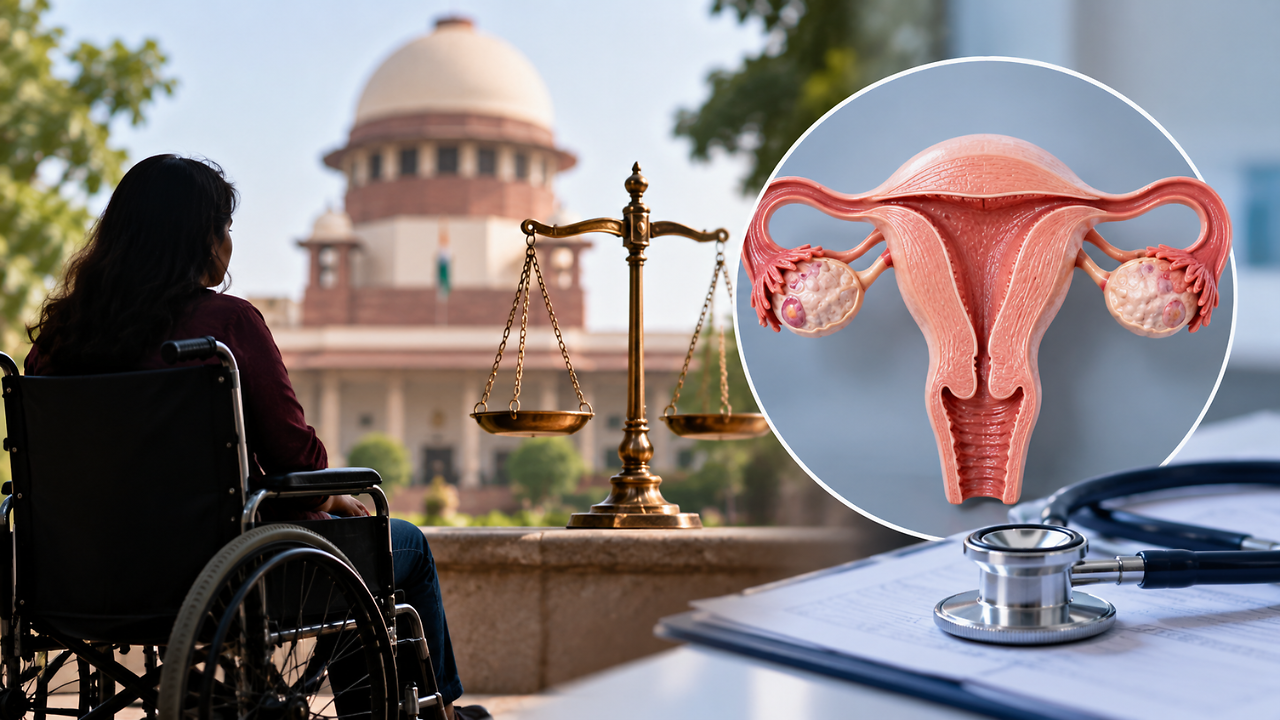
A recent Delhi High Court ruling has highlighted reproductive autonomy of women with disabilities. The court dismissed a plea seeking to let a woman with cerebral palsy undergo hysterectomy (uterus removal) solely because she was unable to manage her menstrual cycles independently. The court stated that “disability can never be the only ground to deny reproductive autonomy”. At the same time, it also said that such surgeries can only be considered if medical experts determine that it is in the person's best interests and would protect their welfare and dignity. Delhi HC On Disability And Reproductive AutonomyThe Delhi High Court was hearing a plea from the parents of a differently-abled woman suffering from cerebral palsy with spastic moderate hemiparesis with moderate mental retardation. They had approached the court seeking to let the woman undergo a surgery for removal of the uterus. According to the petition, the woman was born in March 2005 and had cerebral palsy with spastic moderate hemiparesis and moderate mental retardation. Her parents argued that her disability was permanent and that she was unable to give consent for the procedure. They also cited difficulties in managing her during menstruation. The court, however, dismissed the plea for the surgery. Justice Amit Mahajan, instead, directed authorities to constitute an independent multidisciplinary medical board to evaluate whether hysterectomy was medically appropriate. The board was asked to make a decision within four weeks. The court's stance was that disability by itself cannot justify removing a person's reproductive organs. The judge said, “It is apposite to mention that disability in itself can never be the only ground to deny reproductive autonomy or approve removal of reproductive organ and thus, such a route of surgical intervention can be adopted if medical evaluations suggest that the same would be in the best interest of the petitioner for protection of her welfare and dignity.”The court also clarified that allowing the medical board to examine the situation was not the same as approving the hysterectomy. “The same may not be construed as carte blanche or approval of the surgery, since the opinion on the surgery has to be formed by domain experts, that is, medical experts,” the judge said.Also read: Trying to Conceive After an Abortion? Key Physical and Emotional Factors to Consider What Is A Hysterectomy? Hysterectomy is a surgical procedure to remove the uterus. Depending on medical reasons, other reproductive organs like the cervix, fallopian tubes or ovaries may also be removed. After the uterus removal, a woman can no longer become pregnant and will no longer have menstrual periods. It is therefore a major, irreversible procedure that warrants careful consideration. When Is Hysterectomy Medically Necessary?Difficulty in managing menstruation due to a disability is not automatically the same thing as a medical indication for hysterectomy. Hysterectomy may be recommended for certain serious medical conditions when other treatments are ineffective or inappropriate. Dr. Renu Raina Sehgal, Chairperson - Department of Obstetrics & Gynaecology, Artemis Hospital, Gurugram, told HealthandMe, “Hysterectomy is not indicated for disability alone. It may be considered if a woman has heavy bleeding, pain, fibroids, cancer and another problem with her uterus.” Doctors also believe that women with disabilities may have difficilty in managing heavy periods and other symptoms difficult. Dr. Anagha Chhatrapati, Senior Consultant Gynaecologist, Gleneagles Hospital, told HealthandMe, “For a woman with severe physical or cognitive disability, managing recurrent heavy periods may be particularly difficult, but less invasive options should generally be considered first. The decision should be individualised, medically justified, and made with the woman’s informed consent, wherever she has decision-making capacity.”Also read: Rare Pregnancy Infections Linked To 3-Fold Higher Autism Risk: What Is TORCH? Experts On The Court's Ruling Delhi High Court’s ruling focuses on medical necessity and reproductive autonomy for disabled women. People with disabilities may require additional support to manage menstruation and reproductive needs. But the need for assistance does not, by itself, mean that an irreversible reproductive surgery is appropriate. Dr. Raina Sehgal said, “Removal of the uterus cannot be done solely on the wishes of the patient or caregivers. There must be a valid medical indication and in cases involving mental illness and severe debilitating conditions, approval of an appropriate medical board may also be required. Disability may affect care needs but should never automatically determine hysterectomy.” Alternatives For Disabled Women Besides Hysterectomy The doctors also explain that women with disability have several alternatives to an irreversible surgery. Dr. Raina Sehgal said, “Alternatives may include menstrual management with hormonal medications, a hormonal intrauterine device, pain management, management of underlying conditions and endometrial ablation in selected women. Practical support, accessible menstrual products as well as caregiver support could help.” Dr. Chhatrapati said that the choice should be individualised based on the woman’s medical needs, preferences, and overall wellbeing. Risks Of Hysterectomy It is important to consider alternatives to hysterectomy as it is not only irreversible but also has some risks. Dr. Chhatrapati said, “Hysterectomy can lead to bleeding, infection, blood clots and injury to nearby organs such as the bladder or bowel. Recovery can take several weeks, depending on the type of surgery and the woman’s overall health. It also permanently ends the ability to carry a pregnancy and, if the ovaries are removed, can cause surgical menopause.”