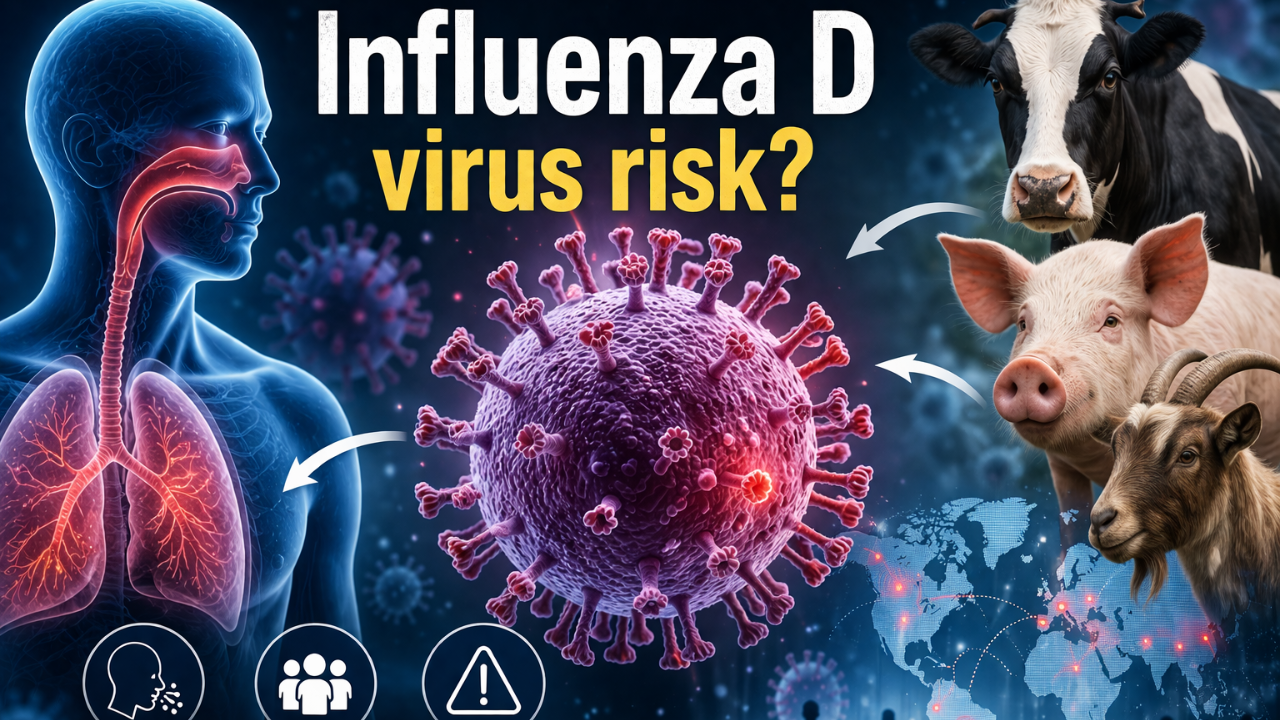
A new research paper published in the PNAS Journal triggered concerns over the potential risk of influenza D spilling over into humans. Although primarily found in livestock such as cattle and swine, this virus has been increasingly studied due to evidence of exposure among agricultural workers. A key concern raised was that the influenza D virus triggers a relatively weak early immune response in human respiratory cells. However, to understand whether it is just a hype or a real concern, HealthandMe spoke to Dr. Rajeev Jayadevan, Ex-President of IMA Cochin and Convener of the Research Cell, Kerala. “So far, this virus has not been a major cause of respiratory disease in man, unlike other types of Influenza viruses like H1N1 and H3N2 of the Influenza A family. It is true that studies have demonstrated antibodies against this virus among cattle farmers, which is consistent with its ability to infect species other than cattle,” Dr. Jayadevan said. He noted that the virus may not be an “imminent threat” to humankind as feared. “So far, the signals are that this virus remains primarily a cattle pathogen, which doesn’t pose an imminent threat to man, unlike other types of influenza viruses”. What is the Influenza D Virus? Influenza D is one of four types of influenza viruses and belongs to the Orthomyxoviridae family. Unlike the more familiar influenza A and B viruses that cause seasonal flu in humans, influenza D has primarily been detected in animals, particularly cattle and pigs. According to the US CDC, the virus was first identified in 2011. It has since been found across multiple species, including livestock and wildlife, including camels, deer, giraffes, kangaroos, llamas, wallabies, and wildebeests. It is not currently known to cause illness in humans, but has had a spill over in different animal species — more recently in poultry. CDC’s January 2026 report stated that “influenza D has shown to have considerable potential for causing future human epidemics, but diagnostics and surveillance for the viruses are lacking”.Also read: Can A Common Cold Virus Save You From Cancer? New Study Claims So What Did The PNAS Study find? Researchers investigated multiple influenza D virus isolates collected from livestock between 2011 and 2020 to assess their ability to infect human airway systems. The paper demonstrated that the virus is capable of infecting human respiratory cells and was also adept at switching off the interferon-based ‘alarm systems’ of the cell. This means that the virus may spread silently and efficiently, but without causing significant symptoms, Dr. Jayadevan said. Importantly, the findings suggest that only small genetic changes might be needed for influenza D virus to achieve more sustained transmission in humans, although this has not yet been observed. Read More: Hantavirus Outbreak: WHO Flags 6 Suspected Cases; How The Rare Rodent-Borne Virus SpreadsH5N1 Bird Flu: A More Deadly Threat Dr. Jayadevan told HealthandMe that a bigger concern for humans besides the commonly circulating human Influenza A and B viruses is the avian influenza (bird flu) virus H5N1. H5N1 spreads among birds and carries a very high death rate whenever it infects humans. “Fortunately, this bird flu virus isn’t able to easily spread from person to person, but ongoing mutations could potentially change that,” the expert said.