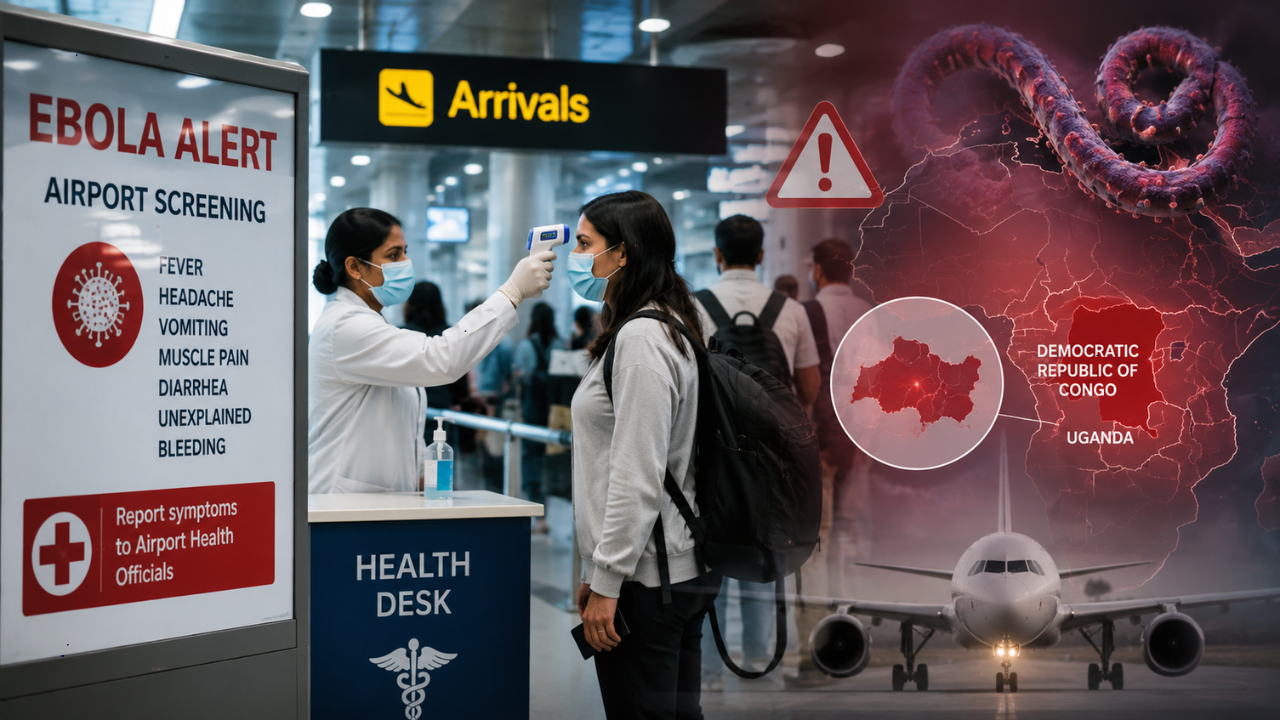
Amid rising cases of the Ebola virus in the Democratic Republic of Congo and Uganda, India and the US have stepped up airport screening.The latest outbreak, caused by the Bundibugyo Ebola virus, has so far affected nearly 600 people and has caused 139 suspected deaths, as per the latest update by the World Health Organization (WHO). The global health agency has also determined that the deadly outbreak is a “Public Health Emergency of International Concern (PHEIC)”.India Issues Health AdvisoryIndia today issued a health advisory for passengers arriving from or transiting through Ebola-affected nations. Passengers with symptoms or exposure history should immediately report to the airport health authorities before immigration clearance.The advisory, issued by the Directorate General of Health Services (DGHS), specifically mentions travelers coming from the Democratic Republic of Congo, Uganda, and South Sudan, all of which have been categorized as "high-risk countries" by the WHO.The advisory is displayed at the Delhi airport by the Airport Health Organization (APHO). It advises passengers to watch out for symptoms such as:fever,weakness,headache,muscle pain,vomiting,diarrhea,sore throat,unexplained bleeding.It also asks travelers who had direct contact with blood or body fluids of a suspected or confirmed Ebola patient to immediately report to the airport health officer or the health desk.According to the APHO, any traveler developing symptoms within 21 days of arrival should seek immediate medical care and inform authorities about their travel history.India Reviews Preparedness MeasuresOn Wednesday, India’s Health Secretary Punya Salila Srivastava chaired a high-level review meeting with health secretaries of all states and Union territories to assess preparedness and response measures for Ebola.Officials clarified that “no case of Ebola has been detected in India so far”.However, after the WHO declared Ebola a Public Health Emergency, the Indian government has proactively strengthened surveillance and preparedness measures across the country as an abundant precaution, official sources had said. During the meeting, states and Union territories were advised to ensure readiness at all levels.The 2026 India-Africa Forum Summit, scheduled for May 28 to 31, was also postponed due to the "evolving health situation in parts of Africa", India's Ministry of External Affairs announced today.The decision was made in recognition of “the importance of ensuring the full participation and engagement of African leaders and stakeholders, and mindful of the emerging public health situation on the continent", said a joint statement issued by the Indian Ministry of External Affairs and the African Union.US Tightens MonitoringMeanwhile, the Centers for Disease Control and Prevention (CDC) has also been enhancing public health screening and traveler monitoring amid a growing Ebola outbreak, and non-US passport holders face entry restrictions if they have been to Uganda, the Democratic Republic of Congo, or South Sudan in the previous 21 days.“To the American public, the risk to the United States remains low,” said Satish Pillai. “Travelers to the region should avoid contact with sick people, report symptoms immediately, and follow our travel guidance.”A US missionary doctor infected with the Ebola virus while treating patients in DR Congo has been admitted to Charité hospital in Berlin. The patient was flown to Berlin on a special medical aircraft and then transported to the hospital in a specially designed vehicle escorted by police. The aircraft also carried six other people who had contact with the infected man.WHO Says Vaccine Could Take MonthsTedros Adhanom Ghebreyesus said he was “deeply concerned about the scale and speed of the epidemic”. He noted that the numbers are expected to rise given the time taken to detect the virus.The WHO says it could take up to nine months before a vaccine against this particular species of Ebola is ready.Two possible "candidate vaccines" against the Bundibugyo species are being developed, but neither has gone through clinical trials yet, WHO advisor Dr. Vasee Moorthy said, according to the BBC.Speaking to journalists in Geneva, Tedros said 51 cases have been confirmed in the Democratic Republic of Congo — where the first case was reported — and two in neighboring Uganda.