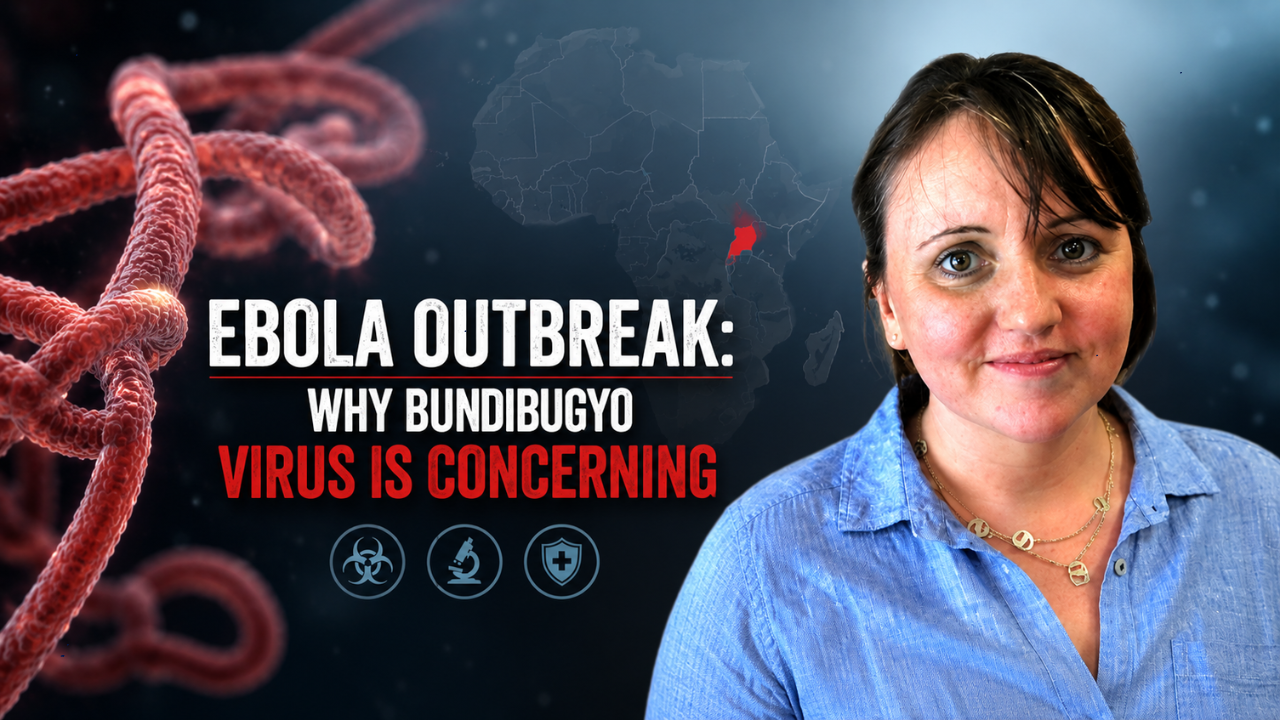
The ongoing Ebola virus outbreak in the Democratic Republic of Congo, which has also spread to Uganda, has been identified as caused by the rare Bundibugyo strain.As per the US CDC, as of May 17, there are reports of 10 confirmed cases and 336 suspected cases, including 88 deaths, in DRC.Uganda has reported 2 confirmed cases, including 1 death, among people who travelled from DRC. No further spread has been reported. These numbers are subject to change as the outbreak evolves.Speaking exclusively to HealthandMe, Professor Emma Thomson, Director of the Centre for Virus Research (Virology) in the School of Infection and Immunity at the University of Glasgow, shared why the virus outbreak, which has been declared a Public Health Emergency of International Concern (PHEIC) by the World Health Organization (WHO), is of concern.While the Bundibugyo virus, a member of the species Orthoebolavirus bundibugyoense, is closely related to the Ebola virus (species Orthoebolavirus zairense), it is still different and currently has no treatment or vaccine. Professor Emma told HealthandMe that “there are several reasons for concern". Ebola Outbreak: Likely Went Undetected For Some TimeThe expert noted that "the reports that initial GeneXpert Ebola testing was negative suggest that the outbreak may have gone undetected for some time, with early diagnostic blind spots delaying recognition".There have also been reports of infections in healthcare workers, which is "a serious warning sign in any filovirus outbreak, because they indicate unrecognized transmission in healthcare settings and gaps in infection prevention and control", the Professor said.Notably, Ebola cases have been identified in Kinshasa and Kampala. These are "hundreds of kilometres from Ituri province, and it shows that the virus has already moved through human mobility networks before full containment was in place," Professor Emma said.The Bundibugyo virus: Previous Outbreaks The Bundibugyo virus has previously caused two recognized outbreaks. The first was in Bundibugyo District, Uganda, in 2007–2008, with 131 reported cases and 42 deaths, and a case fatality proportion of 34–40 per cent.The second was in Isiro, Democratic Republic of the Congo, in 2012, with 38 laboratory-confirmed cases and 13 deaths, although wider outbreak reports, including probable and suspected cases, gave higher totals.These figures are lower than the case fatality rates seen in many outbreaks caused by the Ebola virus, but they are still extremely serious. "Bundibugyo virus disease is not a mild infection," the expert said.Ebola virus: Vaccine And Therapeutics Currently, there is a licensed vaccine that targets the Ebola virus from the species Orthoebolavirus zairense (rVSV-ZEBOV)."Experimental non-human primate work suggests that rVSV-ZEBOV may provide partial heterologous protection against Bundibugyo virus, but this cannot be assumed to translate into reliable protection in people during an outbreak," Professor Emma noted."Adenovirus- and MVA-vectored vaccine platforms may offer broader possibilities, particularly where multivalent constructs are used, but recent immunological data suggest that some licensed or advanced platforms still induce responses that are predominantly directed against the Ebola virus rather than broadly cross-reactive across all ebolaviruses," she added.In other words, "we do not currently have a proven, licensed, Bundibugyo-virus-specific vaccine available for outbreak control," the Professor said, stressing the need for "urgent research" on vaccines.Similarly, she stressed the need to boost "therapeutics" against the Ebola virus."Approved monoclonal antibody treatments such as Inmazeb and Ebanga were developed for the disease caused by the Ebola virus, not Bundibugyo virus, and their efficacy against other ebolaviruses has not been established," Professor Emma told HealthandMe."There are promising experimental broad-spectrum antibodies, but these are not yet a substitute for rapid detection, high-quality supportive care, infection prevention and control, and contact tracing," she added.Bundibugyo-virus OutbreaK: What Should Be Prioritized?Professor Emma further called for ramping up practical and scientifical priorities. These include:the Bundibugyo-virus-capable diagnostics,rapid genomic sequencing,strong infection prevention in healthcare settings,safe clinical pathways,contact tracing,community engagement,treatment centres able to deliver high-quality supportive care.The expert also stressed the importance of genomic sequencing as it can:confirm the virus species,Identify whether cases are linked,reconstruct transmission chains,Detect whether the outbreak reflects sustained human-to-human transmission or multiple introductions.“This outbreak also highlights a persistent weakness in epidemic preparedness. We tend to build tools around the best-known outbreak pathogens, but rarer viruses such as Bundibugyo virus can still cause severe disease and international spread," Professor Emma said.The expert also highlighted the essential need forsustained investment in high-containment laboratories,diagnostic development,genomic surveillance,vaccine platforms,therapeutics and international research partnerships."These capacities cannot be assembled at speed once an outbreak is already moving," she said.