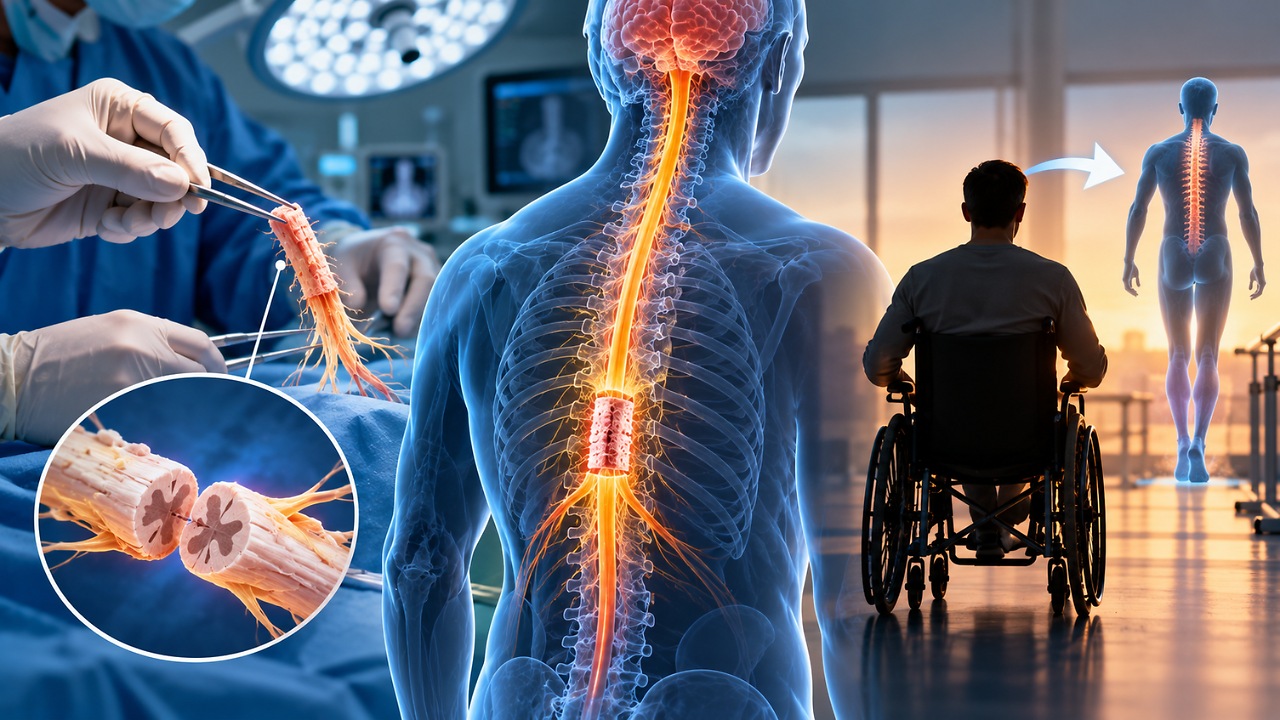
A Chinese-Russian surgical team has reportedly replaced a damaged section of a paralysed patient's spinal cord with tissue from a brain-dead donor, executing the world's first human spinal cord transplant successfully. However, with no evidence of neurological recovery, scientists have been questioning whether the procedure can restore movement so far. The 12-hour operation was performed at the Sklifosovsky Research Institute for Emergency Medicine in Moscow on October 14–15, according to Chinese surgeon Ren Xiaoping, one of the doctors who participated in the procedure. The patient had sustained a severe spinal cord injury three years ago.Ren told the South China Morning Post, “It was our Guangxi University of Chinese Medicine Second Affiliated Hospital and the Russian team working together.”Moscow Mayor Sergei Sobyanin announced the procedure on October 16, describing it as a significant development in spinal surgery. “A patient who was threatened with complete immobility had a chance to recover. Now he feels good,” he wrote.However, feeling well after surgery does not mean that a patient has regained movement. The surgical team has not publicly released neurological evidence showing whether signals can travel across the transplanted section.How Was The Spinal Cord Tissue Transplanted?Also read: World Arthritis Day - Arthritis At 42, 62 & Even 15: How Treatment & Rehabilitation Help Patients Regain MobilityAccording to Ren, surgeons removed the damaged section of the patient's spinal cord and replaced it with tissue obtained from a brain-dead donor. They used microsurgery and polyethylene glycol (PEG), a substance that can fuse cell membranes to join the tissues.This technique addresses one of the central challenges of treating severe spinal cord injuries. The spinal cord carries signals between the brain and the rest of the body. When it is severely damaged, these signals cannot pass normally through the injury, causing paralysis and loss of sensation below the affected area.But joining two sections of tissue is not enough. Nerve fibres must establish functional connections across the damaged area and the tissue that is transplanted must receive blood supply. The recipient's immune system may also attack the donor tissue.These challenges become important when the injury is several years old. Repairing a recently damaged spinal cord is different from replacing tissue in a patient with a longstanding injury.Scientists Have Raised Questions Also read: Digital Lifestyle and Neck Pain: How to Keep Your Spine Healthy in the Age of SmartphonesScientists have raised concerns about the evidence about whether it can restore meaningful neurological function in humans.Melissa Andrews, a neuroscientist at the University of Southampton, questioned the quality of the animal studies supporting the technique and warned about the risks involved, according to New Atlas.Experiments involving PEG has shown some promise in animals but they do not prove that the technique can reconnect a human spinal cord successfully enough to restore movement. The lack of publicly available evidence is another limitation. Details about the patient's injury, the precise location of the transplanted segment, neurological examinations after the procedure and changes in movement or sensation have not been disclosed. No peer-reviewed clinical report documenting the operation and its outcomes has been published.Ren told New Atlas, “We have informed the patient of every potential risk and surgical outcome, and the patient's current condition is good.”The operation is an experimental treatment, not proof that transplanting spinal cord tissue can reverse paralysis. Even if the patient survives the operation without major complications, recovery would depend on whether functional nerve connections develop and whether the brain can communicate with the body across the damaged region. Rehabilitation and long-term follow-up would be needed to assess any improvement.