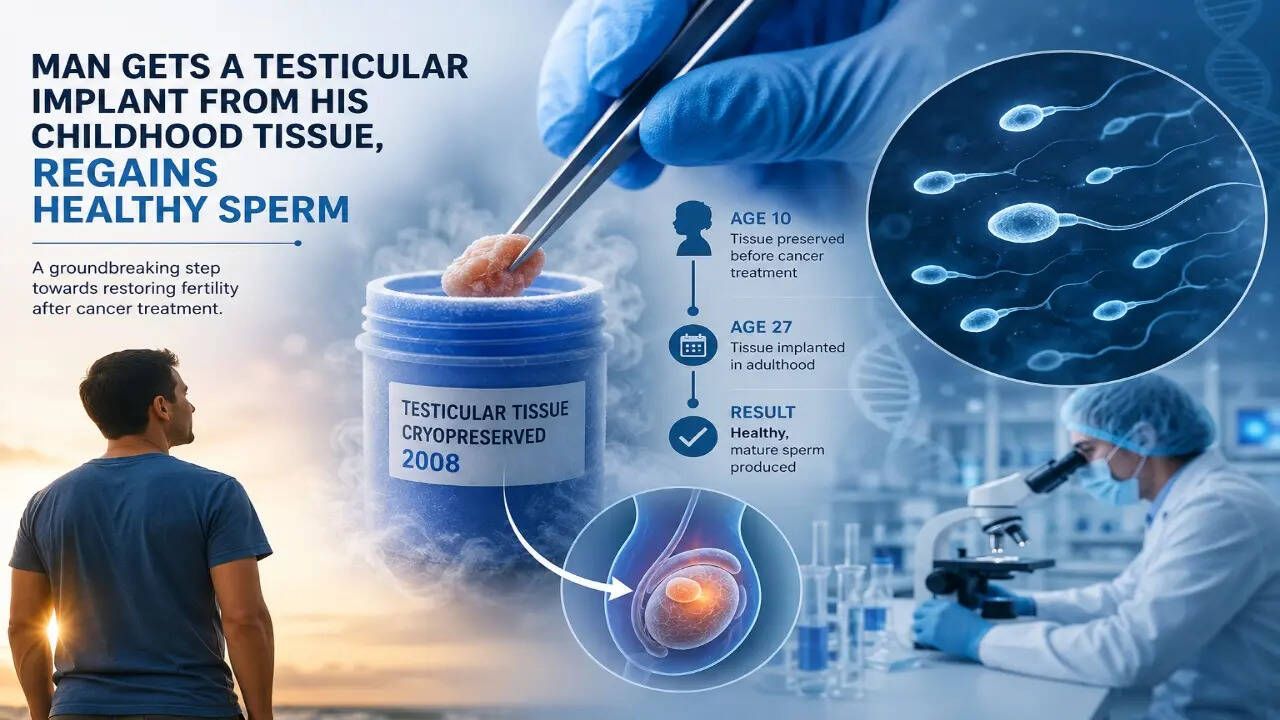
Radiation and chemotherapy might be lifesaving for millions of children globally, but the cost of these intense therapies is much greater. Therapies like these spike the risk of infertility in adulthood — one third of men on these treatments are considered 'azoospermic' after pube—onehis means that when they ejaculate, it lacks any viable sperm. But on the bright side, a medical team at the University Hospital Brussels and the Free University of Brussels (VUB) found that they successfully restored sperm production in one such patient.How to preserve fertility in men after chemotherapy?In a new case study, which is now in peer review, researchers explained how they treated a male patient with no viable sperm by retransplanting his own childhood testicular tissue into his adult testicle. The anonymous patient was born with sickle cell anaemia, an inherited disease that can be managed with small chemotherapy doses or through a donated bone marrow transplant. In 2008, before the treatment, the patient's family consented to the removal of one of his testicles and had it frozen for future use. The patient was 10 years old at the time.Later, in 2022, the patient returned to Brussels IVF at VUB hoping to become a father. However, it was found that there was no viable sperm in his testicle. He requested a transplantation of the frozen tissue. In 2025, during the trial, he underwent surgery to receive four tissue grafts within his testicle and four in his scrotum. A year later, some of these produced motile, mature sperm. However, only the parts of the testicle with the transplants held viable sperm — and these were not connected to the patient's sperm duct. The sperm, therefore, was not likely to reach his semen. Consequently, IVF was the only option for the patient to have a baby — but the silver lining was that, if he wanted a baby, it was possible.What is sperm banking?According to doctors, adults who undergo radiation and chemotherapy must undergo sperm banking in the conventional way. However, before puberty, patients are not fit for freezing sperm, as the body is not producing mature sperm yet. In childhood, the testicles contain spermatogonial stem cells (SSCs) — these have the potential to become sperm later. Freezing this tissue could be a way to preserve fertility in younger patients who are prone to infertility.The University Hospital Brussels became the first-ever hospital to introduce this practice in 2022. Years later, other hospitals followed suit and offered cryopreservation for over 3,000 boys globally. The samples collected were banked for future studies and research to determine whether the approach is, in fact, viable or not. For many patients, it is the only way to restore existing fertility. Although a single patient is not enough to prove that the procedure works, the Brussels story offers hope for men dealing with infertility.Is there a downside?Animal studies have found that the grafts have a shorter lifespan. However, how long they can last in humans is still unknown; furthermore, researchers are yet to ascertain whether these sperm can lead to healthy babies. This step is important for further research on preserving fertility.