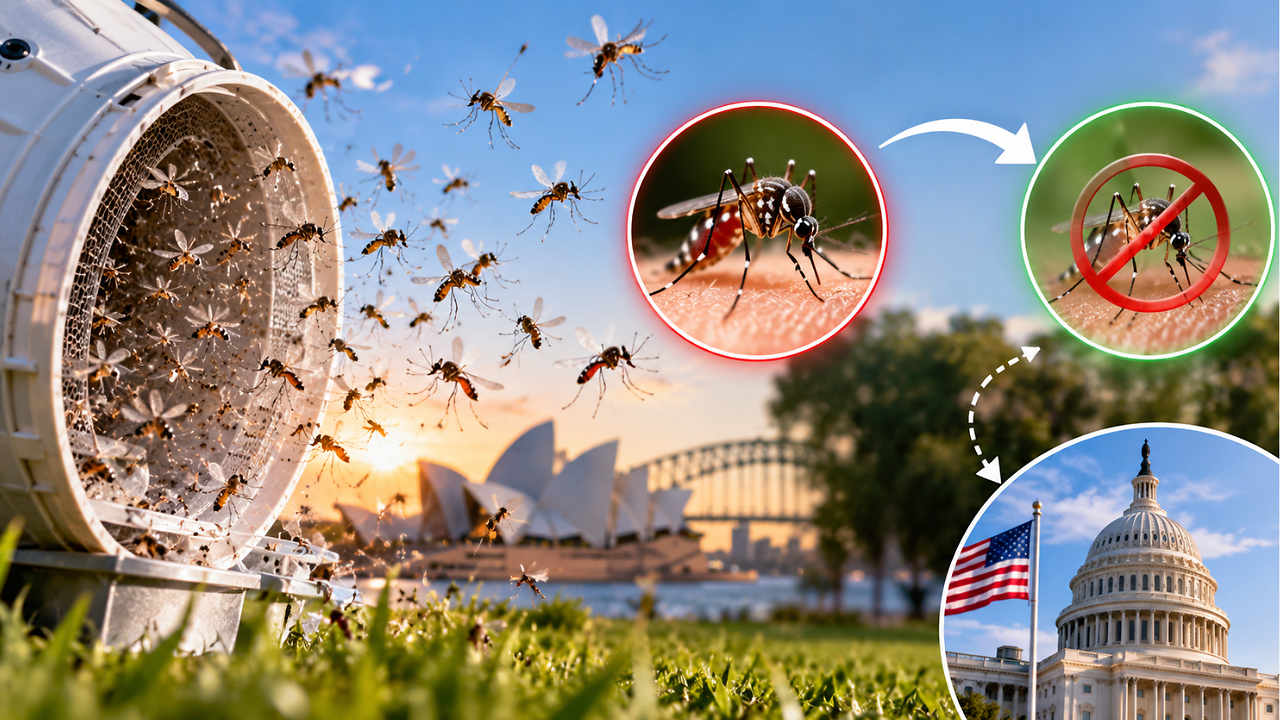
In 2018, Google released around three million specially bred male mosquitoes in one trial town to see if disease-causing pests could be controlled. As a result, the local mosquito population fell by approximately 95%. Google’s parent company, Alphabet, is now also seeking approval for running similar trials in the United States, where mosquito-borne diseases like dengue, Zika and West Nile virus pose continuing public health challenges. Their aim is to reduce mosquito population without relying solely on chemical insecticides. How Does Releasing Mosquitoes Help Control Them? Also read: Bangladesh Dengue Outbreak: 90,000 Hospitalized, 281 DeadThe project, known as Debug, focuses on Aedes aegypti, a mosquito species that can transmit dengue, Zika, chikungunya and yellow fever. The method uses male mosquitoes carrying a naturally occurring bacterium called Wolbachia. When these males mate with wild females that do not carry a compatible strain, the resulting embryos fail to develop. Over time, this reproductive incompatibility can suppress the local mosquito population. Male mosquitoes do not bite humans or transmit mosquito-borne diseases. Researchers therefore release large numbers of these males to increase the likelihood that wild females will mate with them rather than produce viable offspring. The Australian field surveys began in 2015, with the mosquito release taking place in 2018. Around three million male mosquitoes were released over 20 weeks across three treatment towns in Queensland. Researchers compared mosquito populations in these locations with those in towns where no mosquitoes were released. The results, published in 2021, showed that mosquito numbers began declining within four weeks. In one town, monitoring found only a handful of Aedes aegypti mosquitoes 12 months later, representing approximately 95% population suppression. US Is Considering The Same Approach Also read: Florida Reports First Dengue Death In Nearly A Century As Cases Surge To 152Alphabet’s Debug programme has applied to release up to 32 million male mosquitoes in California and Florida, according to a July 2026 report in The Guardian. A separate US Environmental Protection Agency filing describes proposed experimental releases of up to 16 million mosquitoes annually in New Jersey, California and Florida. The EPA’s April 2026 notice invited public reactions on the application. The proposed trials are intended to assess whether the released males can mate with wild mosquitoes and suppress their populations. Additionally, an executive order signed on September 29, 2026, directed federal agencies to develop non-chemical and technology-enabled methods to control invasive mosquitoes and ticks. Could This Help Reduce Disease Transmission? Reducing the population of a disease-carrying mosquito species could help lower the risk of transmission. However, fewer mosquitoes do not automatically translate into an equivalent reduction in human infections. The outcome also depends on local mosquito ecology, movement between areas, the diseases circulating, and how consistently the activity is implemented. The trial results in Australia are promising, but success is not guaranteed. Mosquito behaviour, environmental conditions, population movement and the ability to release enough numbers of males can affect outcomes. Researchers must also ensure that only males are released, since female mosquitoes bite and can transmit disease. The Australian project used specialised technology to separate male and female mosquitoes.